| Apr 12, 2013 |
Scientists develop world's smallest drug deliverer |
| (Nanowerk News) Cornell researchers have created a pore in “Cornell Dots” – brightly glowing nanoparticles nicknamed C-Dots – that can carry medicine. This new and improved nanoscale courier may help light up cancer cells and provide a new patient-friendly, viable option to battle cancer. |
| “No one has ever made a one-pore, super-small silica particle – at 10 nanometers and below – to deliver medicine,” says Ulrich Wiesner, Cornell’s Spencer T. Olin Professor of Materials Science and Engineering. “Clearing this object out of the body quickly also minimizes its impact on the body.” |
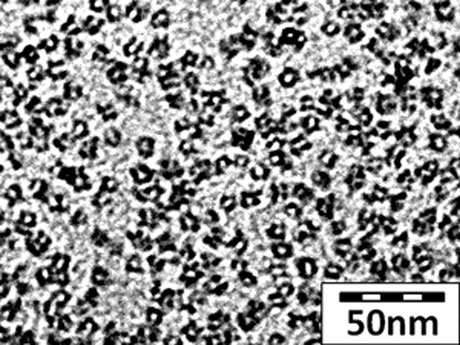 |
| Mesoporous C-Dots populate a field a few hundred nanometers wide. These new, single pore particles can carry medicine and then flush quickly from the body. |
| Wiesner presented the talk, “Cornell Dots: Fluorescent Core-shell Silica Nanoparticles to Interrogate Biological Environments,” at the American Chemical Society meeting in New Orleans on April 7. |
| Previously, Wiesner and his colleagues had demonstrated the useful, diagnostic aspects of C-Dots. Now, they have illustrated the porous C-Dots (mC-Dots, for mesoporous) concept: The mC-Dots could act like tiny Navy Seals on a seek-and-destroy mission: Find the tumor, deliver medicine to kill it, then escape in urine within a couple of hours. |
| A single C-Dot consists of dye molecules encased in a chemically inert silica shell that can be as small as 5 nanometers in diameter. (A nanometer is one-billionth of a meter, about three times the diameter of a silicon atom). |
| Previous research showed that the outside of the shell can be coated with organic molecules that will attach to such desired targets as tumor surfaces or even locations within tumors. |
| The cluster of dye molecules in a single dot in solution fluoresces near-infrared light much more brightly than single dye molecules, and the fluorescence will identify malignant cells, showing a surgeon exactly what needs to be cut out and helping ensure that all malignant cells are found. But, surgeons may one day forego the scalpel, because with a built-in pore, the mC-Dots have the ability to bring medicine to the tumor. |
| Source: By Blaine Friedlander, Cornell University |