| Apr 24, 2014 |
Cracker-sized satellites launch into orbit |
| (Nanowerk News) After years of planning and several last-minute delays, about 100 Cornell-developed mini satellites demonstrating space flight at its simplest have launched into orbit and are now circling Earth. |
| With just a laptop, antenna and a few other basics, space flight enthusiasts can listen for signals sent by the cracker-sized “sprites” that launched April 18 aboard a SpaceX Falcon 9 rocket as part of NASA’s CRS-3 mission. Still inside their mothership craft, the sprites are scheduled to deploy on May 4 to become the smallest free-flying spacecraft. |
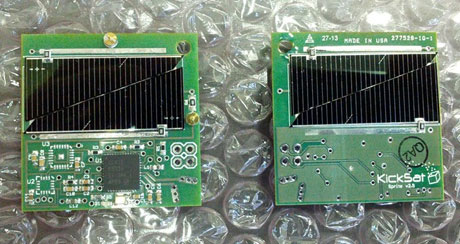 |
| 'Sprite' mini satellites that are now in orbit. |
| The project is called KickSat and has been led by Zac Manchester ’09, now a graduate student in aerospace engineering, since he was an undergraduate doing research with Mason Peck, associate professor of mechanical and aerospace engineering. |
| Sprites are satellites stripped down to their most basic components: a microcontroller, transceiver and solar cells for power. Manchester took to Kickstarter in 2011 to see if amateur space enthusiasts would help fund the project. |
| More than 300 people sponsored KickSat and were allowed to transmit whatever signal they wanted from it – for example, their initials or a message to a loved one. The KickSat housing is engraved with the sponsors’ names. |
| The sprites are housed inside a CubeSat, which is a small satellite frequently used in space research. The CubeSat is aboard a capsule that separates from the shuttle, which continues to the International Space Station. The KickSat CubeSat is second in line to deploy. (Other research missions are aboard.) |
| The big event – when the sprites leave the spacecraft and begin transmitting signals – will be the afternoon of May 4 (subject to change). |
| Manchester has been updating his Kickstarter blog with mission information. |
| “After a beautiful launch at 3:25 this afternoon [April 18], KickSat was deployed in low Earth orbit. We at Cornell and several amateur radio operators around the world have made contact with the spacecraft, and it is alive and well. I can't thank all of you enough for your tremendous support over the past two years. Thank you for believing in KickSat!” |
| Source: By Anne Ju, Cornell University |