

Mutation: Types, Causes, Effects on Genes and Proteins, and Role in Disease
What Is a Mutation?
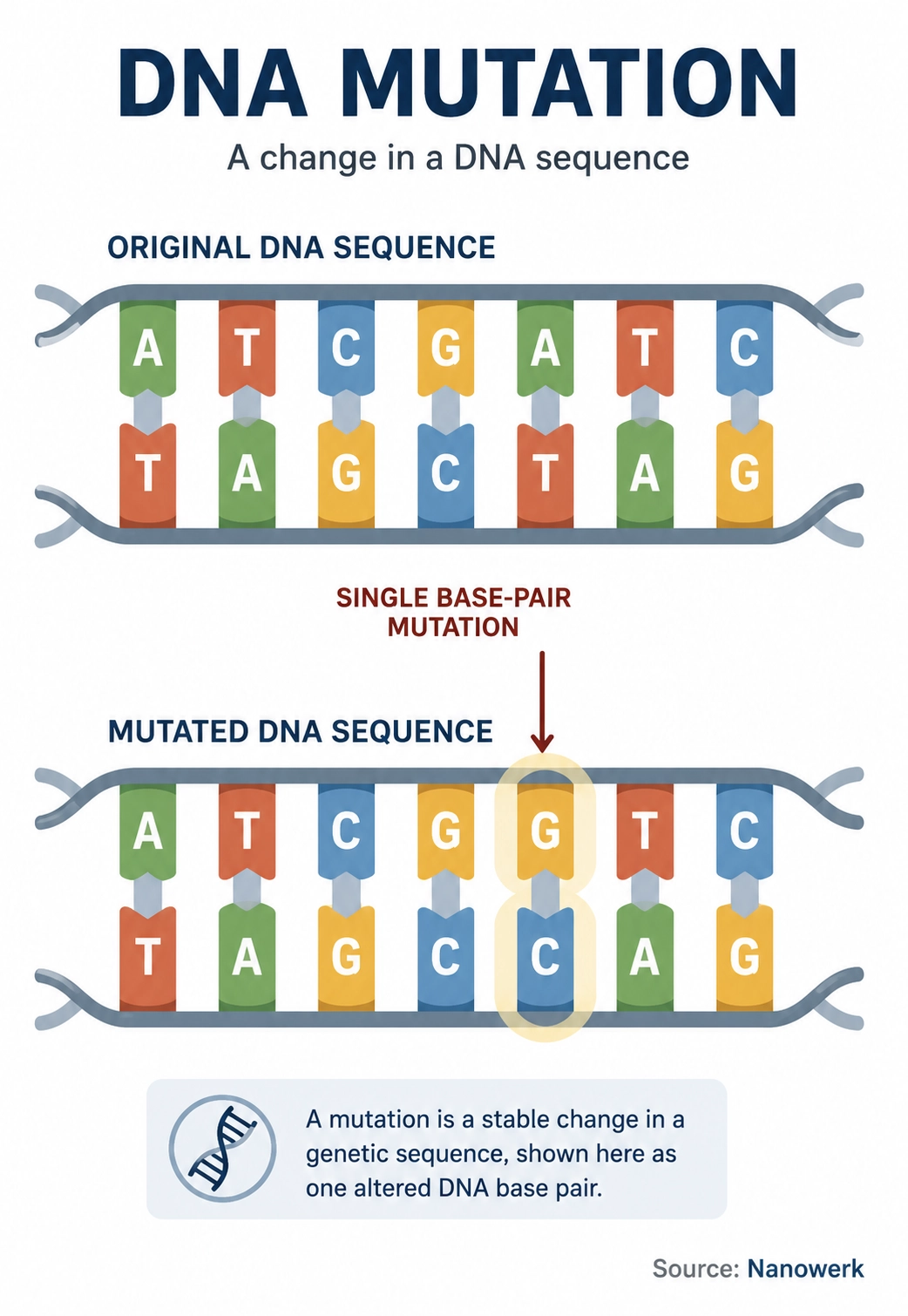
Definition: A mutation is a stable change in the nucleotide sequence of a genome. In organisms with a DNA genome, the change is in DNA; in RNA viruses, it is in viral RNA. Mutations range from a single base substitution to large deletions, duplications, inversions, translocations, or whole-chromosome changes.
In simple terms: a mutation is a stable change in genetic sequence that can be copied when cells or viruses replicate. Most mutations have no detectable effect, some contribute to disease, and a small fraction provide the raw material for evolution.
A mutation is a change in the sequence of genetic material. It can affect a single nucleotide, a short stretch of DNA, an entire gene, or a much larger chromosome region. Mutations occur in every organism and at every stage of life. Many are corrected by DNA repair systems or disappear when the affected cell dies; others persist in a cell lineage, a tumor, a microbial population, or the germline.
In medical genetics, the word variant is often preferred because it is neutral about clinical effect. A variant may be benign, pathogenic, likely pathogenic, or of uncertain significance. The word mutation is still widely used in biology for any sequence change, but in clinical contexts it can imply harmfulness, so many diagnostic reports use the more precise term pathogenic variant.
At a glance:
- Mutation: a stable change in the DNA or RNA sequence of a genome
- Scale: from one base pair to whole chromosomes
- Main types: substitutions, insertions and deletions, structural variants, and repeat expansions
- Origin: replication errors, spontaneous chemical damage, mobile genetic elements, or exposure to mutagens such as UV light and tobacco smoke
- Human germline: roughly 100–200 new mutations may be transmitted from parents to a child, depending on which classes of variation are counted
- Clinical role: mutations underlie inherited disease, cancer evolution, antimicrobial resistance, and many gene-therapy strategies
Key Takeaways
A mutation is not automatically a disease. The same sequence change can be harmless in one genomic location, mildly disruptive in another, and severely pathogenic in a third. Whether a mutation matters depends on what it changes: a protein sequence, a regulatory element, chromosome structure, gene dosage, RNA processing, or nothing functionally important at all.
Two distinctions organize much of mutation biology. Germline mutations occur in egg or sperm cells, or their precursors, and can be inherited by offspring. Somatic mutations arise in non-reproductive cells and affect only the individual in whom they occur. Spontaneous mutations arise from normal replication errors or chemical instability. Induced mutations are caused by external mutagens such as ultraviolet radiation, ionizing radiation, tobacco smoke, or certain chemicals.
Mutation, Variant, and Polymorphism
Several related terms are used for genetic differences. They overlap, but they are not identical.
| Term | Meaning | Typical use |
|---|---|---|
| Mutation | A new or stable sequence change in DNA or RNA | General biology, evolution, cancer biology, microbial genetics |
| Variant | A sequence difference compared with a reference genome or another individual | Clinical genetics and genome sequencing, because the term is neutral about effect |
| Polymorphism | A variant common enough in a population to be considered normal genetic variation | Population genetics and association studies |
| Pathogenic variant | A variant shown to cause or contribute to disease | Diagnostic reports, genetic counseling, and precision medicine |
Types of Mutations
Mutations are classified by what they change and how much of the genome is affected. The smallest are point mutations, or single-base substitutions, in which one nucleotide is exchanged for another. In coding sequences, substitutions may be silent if they do not change the encoded amino acid, missense if they replace one amino acid with another, or nonsense if they convert an amino-acid codon into a premature stop signal.
Insertions and deletions, collectively called indels, add or remove one or more bases. When an indel in a coding region is not a multiple of three, it shifts the reading frame. Such frameshift mutations often severely disrupt protein function, especially when they occur early in a coding sequence. Larger changes are called structural variants and include copy number variants, inversions, translocations, and whole-chromosome gains or losses. Repeat expansions occur when short tandem repeats grow in copy number across generations and can cause disorders such as Huntington disease and fragile X syndrome.
| Type | What changes | Typical effect on the gene or protein |
|---|---|---|
| Point mutation / substitution | A single base is replaced by another | Can be silent, missense, nonsense, regulatory, benign, or pathogenic |
| Insertion or deletion (indel) | One or more bases are added or removed | Often mild outside coding regions; can be severe in coding regions |
| Frameshift | An indel shifts the codon reading frame | Often produces a truncated or nonfunctional protein, especially if early in the gene |
| Copy number variant | A larger DNA region is duplicated or deleted | Changes gene dosage; important in developmental disorders and cancer |
| Repeat expansion | A short tandem repeat grows in copy number | Can cause disease after a repeat-length threshold is crossed |
| Inversion or translocation | A chromosome segment is flipped or moved | May disrupt genes, alter regulation, or create gene fusions |
Examples of Mutations
A familiar example of a point mutation is the HBB variant that causes sickle cell disease, in which a single amino acid change in beta-globin alters the behavior of hemoglobin in red blood cells. A different class of mutation, a repeat expansion in the HTT gene, causes Huntington disease when the CAG repeat exceeds a disease threshold. In cancer, mutations in genes such as TP53, KRAS, EGFR, BRAF, NOTCH1, or BRCA1/BRCA2 can help cells grow, evade repair, or survive in inappropriate contexts. In microbes, mutations can alter drug targets or activate resistance mechanisms, enabling antibiotic or antiviral resistance.
Causes of Mutations
Mutations arise because genomes are chemically active molecules that must be copied, repaired, packaged, and transmitted. DNA polymerases occasionally insert the wrong base during replication. Bases can be chemically altered by deamination, oxidation, alkylation, or spontaneous loss from the sugar-phosphate backbone. Repair enzymes usually correct such damage, but repair is not perfect, and some changes become fixed the next time the molecule is copied.
External agents increase mutation rates by damaging DNA or RNA in characteristic ways. Ultraviolet light produces pyrimidine dimers in skin cells. Ionizing radiation can break DNA strands. Tobacco smoke contains carcinogens that leave distinctive mutational patterns in lung and other tissues. Some viruses, transposable elements, and replication slippage at short tandem repeats also create mutations. The resulting patterns, called mutational signatures, can reveal the history of exposures and repair defects in a cancer genome.
How Mutations Affect Genes and Proteins
A mutation in a protein-coding region can leave the protein unchanged, alter one amino acid, truncate the protein, disrupt folding, change an active site, or eliminate expression altogether. Mutations outside coding regions can still matter if they affect promoters, enhancers, splice sites, untranslated regions, chromatin organization, or noncoding RNA genes. Many sequence changes have no measurable consequence because they occur in redundant, nonfunctional, or well-buffered parts of the genome.
The effect also depends on biological context. A sequence change that is harmless in one tissue may be harmful in another if the gene is expressed only there. A heterozygous mutation may be tolerated if one normal copy of the gene is enough, but damaging if the gene is dosage-sensitive. Some mutations are recessive, some dominant, some mosaic, and some matter only when combined with other variants or environmental pressures.
Mutations in Evolution and Genetic Variation
Mutation creates new genetic variation. Natural selection, genetic drift, recombination, migration, and population history then determine whether a mutation disappears, remains rare, becomes common, or spreads through a population. Most new mutations are neutral or nearly neutral; many harmful mutations are removed by selection; rare beneficial mutations can increase in frequency when they improve survival or reproduction in a particular environment.
Mutation is also central to microbial evolution. Because viruses and bacteria replicate rapidly and exist in large populations, useful mutations can arise and spread quickly. This is why antimicrobial resistance, immune escape, and viral adaptation can be observed over weeks, months, or years rather than over thousands of generations.
Mutations and Disease
Mutation-related disease usually follows one of two routes. In inherited disorders, a pathogenic germline variant is present from conception and can be passed through families. In cancer, somatic mutations accumulate in a tissue over time; a tumor develops when combinations of driver mutations give cells growth, survival, or invasion advantages. These routes explain most mutation-related disease mechanisms relevant to biotechnology, genetic diagnostics, cancer genomics, and gene therapy.
Many neurodevelopmental and psychiatric conditions have complex genetic architectures, involving common variants, rare inherited variants, and, in some cases, de novo mutations. Cardiovascular disease, autoimmune disease, diabetes, and many other common conditions usually involve many variants of small effect interacting with environment. A mutation can therefore be a single sufficient cause, one risk factor among many, or clinically irrelevant.
Somatic mutation is now understood as a normal feature of aging tissues, not only a property of tumors. Studies of healthy tissues have found expanding cell clones carrying cancer-associated mutations, including NOTCH1-mutant clones in normal esophageal epithelium. Most such clones never become cancer, but they show that mutation, clonal competition, aging, and disease risk form a continuum.
Detecting and Interpreting Mutations
Modern sequencing can detect mutations at many scales. Short-read sequencing is efficient for substitutions and small indels. Long-read sequencing is especially valuable for repeat expansions, structural variants, duplicated regions, and other genomic regions that are difficult to resolve with short reads. A 2025 four-generation pedigree reference combined multiple sequencing technologies to estimate human de novo mutation rates across variant classes, including variation in repetitive and centromeric regions (Nature, 2025).
Finding a sequence change is only the first step. Interpreting it requires evidence from population frequency, inheritance, functional experiments, clinical observations, protein structure, conservation, and computational prediction. AlphaMissense, released by Google DeepMind in 2023, classified most of the roughly 71 million possible human missense variants as likely benign or likely pathogenic, while only a tiny fraction had been clinically confirmed at the time (Science, 2023). Such tools are useful for prioritization, but they complement rather than replace clinical evidence.
Mutations as Tools in Biotechnology
Mutation is not only something to detect; it is also a tool. Random mutagenesis followed by selection underpins directed evolution, in which proteins are improved by generating variation and selecting molecules with desired catalytic, binding, or stability properties. Targeted mutation introduced by gene editing is now routine: CRISPR-Cas9 can create site-specific DNA breaks that repair as small indels, while base editing and prime editing can install precise sequence changes without making a double-strand break.
Gene therapy often uses the same logic in reverse: introduce a working gene copy, silence a harmful gene product, or edit patient cells so they compensate for an inherited defect. Casgevy, the first FDA-approved CRISPR-based cell therapy, is indicated for sickle cell disease and transfusion-dependent beta-thalassemia in eligible patients 12 years and older (FDA). These therapies depend on knowing which genetic changes cause disease, which cells must be treated, and how genome editing will alter cellular function.
Frequently Asked Questions
What is the difference between a mutation and a variant?
A mutation is a new or stable change in a genetic sequence. A variant is any sequence difference compared with a reference genome or another sequence. In medical genetics, variant is often preferred because it does not assume the change is harmful.Are all mutations harmful?
No. Many mutations have no detectable effect. Some are harmful, some are beneficial in a particular environment, and many are neutral or nearly neutral. Mutation is best understood as the raw material of genetic variation, not as harmful by default.Are mutations random?
Mutations are random in the sense that they do not arise because an organism needs them. However, they are not distributed uniformly across the genome. Some sites, such as methylated CpG dinucleotides, short tandem repeats, and late-replicating regions, mutate more often than others.Why do many de novo mutations come from fathers?
Sperm are produced continuously from dividing precursor cells, and each cell division creates another opportunity for replication error. Egg cells complete most of their divisions before birth. This difference explains the paternal-age effect seen for many new germline mutations.How fast do viruses and bacteria mutate compared with humans?
Many viruses and bacteria evolve much faster than humans because they replicate quickly and have large populations. RNA viruses often accumulate mutations rapidly enough for measurable evolutionary change to occur over weeks or months. The human germline mutation rate is far lower per generation.Can mutations be reversed?
A mutation can sometimes be reversed by a second mutation that restores the original sequence, but spontaneous reversion is rare. In research and medicine, genome-editing tools such as base editors, prime editors, and CRISPR-based systems can be designed to correct or compensate for specific genetic changes.Further Reading
Genome Biology, New Insights into the Generation and Role of De Novo Mutations in Health and Disease
Nature Reviews Cancer, Mutational Signatures: Emerging Concepts, Caveats and Clinical Applications
U.S. Food and Drug Administration, Casgevy
