Synthetic Biology: Definition, Methods, Applications, and Safety
What Is Synthetic Biology?
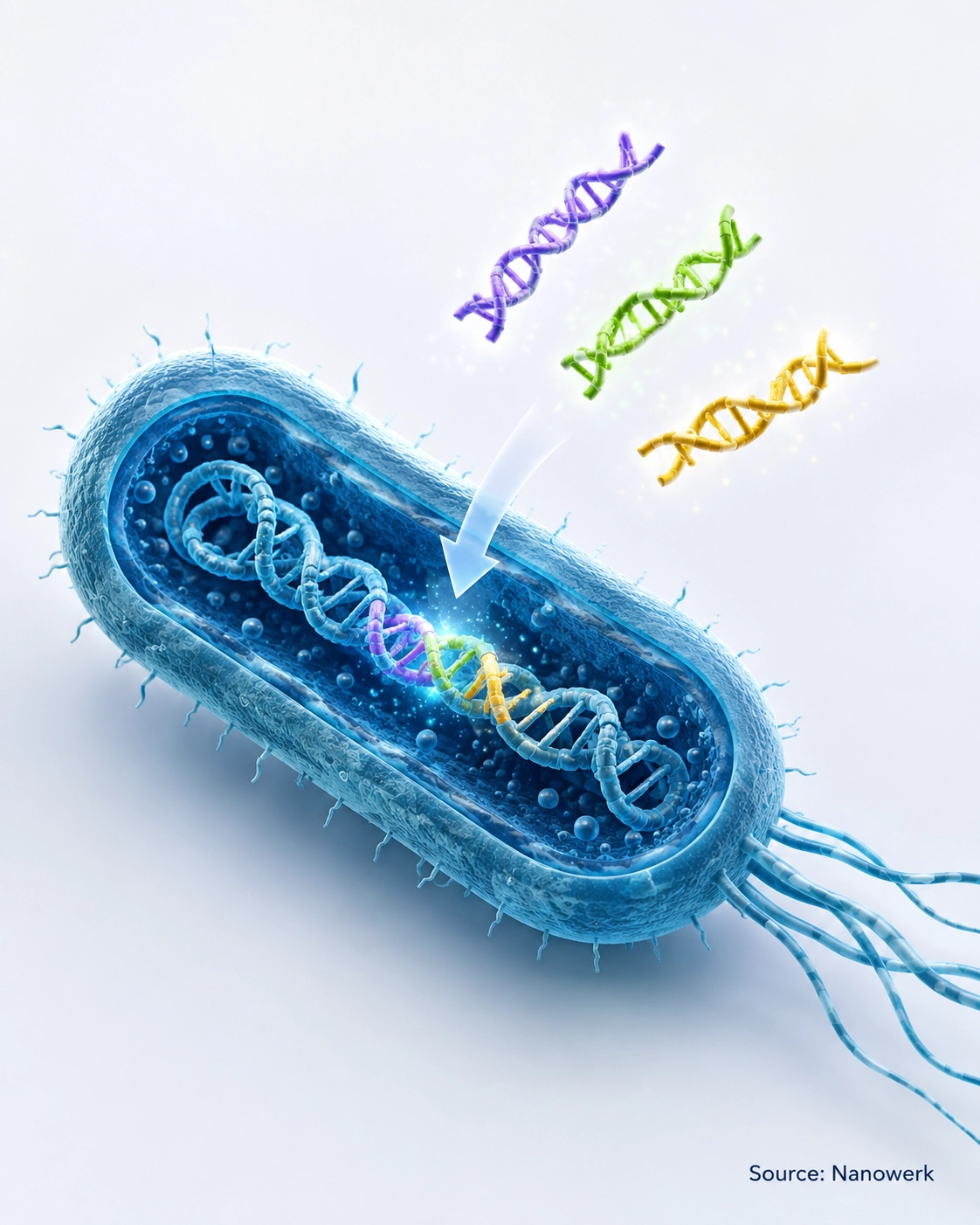
Definition: Synthetic biology is an engineering approach to biology that designs and constructs new biological parts, circuits, metabolic pathways and even whole genomes, or substantially redesigns existing ones, so that living systems carry out defined, useful functions.
In simple terms: synthetic biology treats DNA as programmable biological instructions. Rather than focusing only on individual gene changes, it often assembles multiple genetic parts into systems that make a cell do something new, such as produce a drug, sense a chemical, or run a logic operation.
Synthetic biology is the deliberate design and construction of biological systems that do not exist in nature, or the substantial redesign of natural ones. It combines molecular biotechnology with concepts borrowed from electrical and software engineering: abstraction, standardization, modular parts and iterative design. While classical genetic engineering often modifies one or a few genes, synthetic biology usually starts with a desired behavior and then builds or rewrites the DNA needed to produce it, often from many characterized components at once.
The scale of what can now be built is substantial. Commercial DNA synthesis can produce gene-length sequences, assembly methods can combine shorter fragments into larger pathways, and entire bacterial genomes exceeding a million base pairs have been chemically synthesized and activated after transplantation into recipient cells. The field is generally dated to around 2000, when engineered genetic switches and oscillators showed that defined circuit behavior could be programmed into bacteria. It has since grown into a recognized engineering discipline spanning medicine, manufacturing, agriculture, nanobiotechnology and environmental monitoring.
At a glance:
- What it is: an engineering discipline for designing and building biological systems
- Core idea: standardized, characterized DNA parts assembled into more controllable biological systems
- Central workflow: the design-build-test-learn cycle, repeated iteratively
- Key building blocks: promoters, genes, genetic circuits, pathways and synthetic genomes
- Main applications: medicines, biomanufactured chemicals and materials, food, environmental sensing and remediation
- Key constraints: biological unpredictability, biosafety, biosecurity and governance
Why Synthetic Biology Matters
Synthetic biology matters because it shifts biotechnology from modifying organisms case by case toward designing biological systems with specified functions. It uses many of the same molecular tools as genetic engineering but organizes them around standardized parts, models and repeated design cycles. Its clearest successes so far are in biomanufacturing and engineered cells; many proposed applications remain at the research or early commercial stage.
Synthetic Biology Versus Genetic Engineering and Related Terms
Synthetic biology overlaps heavily with genetic engineering, genome editing and metabolic engineering, and the terms are often used loosely. The distinctions are real but are differences of scale, intent and method rather than sharp technical boundaries. The table below summarizes how the most commonly confused approaches relate to one another.
| Approach | Typical scope | Defining characteristic |
|---|---|---|
| Genetic engineering | One or a few genes added, removed or altered | Directed modification of an organism's genetic material, often via recombinant DNA |
| Genome editing | Precise changes at chosen genomic sites | Targeted nucleases such as CRISPR-Cas9 that rewrite existing sequences |
| Metabolic engineering | Whole biochemical pathways in a host cell | Rerouting cellular metabolism to overproduce a target molecule |
| Synthetic biology | Parts, circuits, pathways or entire genomes | Engineering design principles: standardized parts, modeling and iteration |
| Directed evolution | Single proteins or pathways | Iterated mutation and selection rather than rational design |
A non-obvious point in this comparison is that the categories are not mutually exclusive but layered. A synthetic biology project routinely uses genome editing to install DNA, metabolic engineering logic to balance a pathway, and directed evolution to tune a stubborn enzyme that no model could optimize. What distinguishes synthetic biology is less any single tool than the insistence on reusable, characterized components and a structured, repeatable design process.
How Synthetic Biology Works: The Design-Build-Test-Learn Cycle
The operational core of synthetic biology is an iterative workflow called the design-build-test-learn cycle. It mirrors the engineering loop used to develop machines and software, adapted to the fact that the system being engineered is alive and can grow, mutate and adapt. Because cellular behavior is difficult to predict from sequence alone, a useful system is rarely obtained on the first attempt; the cycle is repeated, often many times, until performance meets the specification.
In the design phase, researchers define the target function and select genetic parts to achieve it: regulatory sequences such as promoters and ribosome binding sites, protein-coding genes, and control elements that connect them. Computational models and design software predict how the assembled system should behave, increasingly aided by structure prediction tools such as AlphaFold and by sequence-design algorithms. The aim is a genetic circuit: an arrangement of parts that produces a defined input-output behavior, such as switching a gene on only when two signals are present.
In the build phase, the designed DNA is physically constructed. Short chemically synthesized fragments are joined by standardized assembly methods into larger constructs, then introduced into a host such as Escherichia coli or baker's yeast, frequently carried on a plasmid or integrated into the genome. In the test phase, the engineered cells are measured: how strongly the circuit responds, how much product accumulates, whether the behavior is stable across generations. In the learn phase, these data are used to update the models and inform the next design. Specialized automated laboratories, often called biofoundries, run many such cycles in parallel, and machine learning is now used to propose designs and reduce the number of iterations needed.
Core Tools and Foundational Technologies
Synthetic biology rests on a small set of enabling technologies. The first is reliable, inexpensive DNA synthesis and assembly, which lets researchers obtain almost any desired sequence rather than only sequences that can be cut from existing organisms. Falling synthesis costs are the main reason the field expanded from single circuits in 2000 to synthetic chromosomes within two decades.
The second is standardized biological parts. These include characterized promoters, coding sequences and regulatory elements whose behavior has been measured. In principle, such parts let researchers design biological systems from catalogued components, much as engineers design circuits from known electronic parts. The third is precise gene editing, which makes it possible to install or modify constructs at chosen genomic locations. The fourth is computational design and modeling, including circuit-design software, metabolic models and, more recently, machine-learning tools for protein and sequence design that draw on advances in bioinformatics and protein engineering. Cell-free synthetic biology is another important toolkit: engineered genetic programs can be run in molecular extracts rather than living cells, enabling rapid prototyping, biosensing and portable diagnostic formats.
A distinct strand of the field engineers genomes rather than individual circuits. In 2010 a research team at the J. Craig Venter Institute chemically synthesized the roughly one-million-base-pair genome of the bacterium Mycoplasma mycoides and transplanted it into a recipient cell, which then replicated under the control of the synthetic DNA. Subsequent work produced a stripped-down minimal genome retaining only genes needed for life under laboratory conditions, and international consortia have been rewriting the chromosomes of baker's yeast from synthetic DNA. These projects connect synthetic biology to systems biology by testing how completely a genome can be understood and rebuilt.
Applications of Synthetic Biology
Medicine and Health
Medical applications are among the most developed. Engineered microbes and cultured cells are used to manufacture protein drugs and vaccine components, and synthetic genetic circuits underpin engineered cell therapies in which immune cells are reprogrammed to recognize and attack cancer. Synthetic biology overlaps with vaccine platform design, including engineered nucleic acid constructs, lipid-formulated mRNA vaccine platforms and rapid sequence-to-product workflows. It also contributes to engineered viral and bacterial vectors used in some gene therapy strategies. Researchers are also engineering members of the human microbiome to sense disease states in the gut and release therapeutic molecules locally.
Industrial Biomanufacturing
A large fraction of commercial activity is in biomanufacturing, where engineered microorganisms convert sugars or other feedstocks into target chemicals during fermentation. The best-known example is the antimalarial compound artemisinin: a yeast strain was engineered with a multi-step plant pathway to produce a precursor that is chemically converted into the drug, providing a supply route independent of plant harvests. Other engineered strains produce flavors, fragrances, industrial enzymes, biofuels and bioplastics, typically grown at scale in a bioreactor.
Agriculture, Food and the Environment
In agriculture and food, synthetic biology is used to engineer microbes that supply nitrogen to crops, reducing fertilizer dependence, and to produce food ingredients by fermentation, such as a heme protein used to give plant-based meat substitutes a meat-like character. Environmental and nanobiotechnology applications include engineered biosensors that detect pollutants or pathogens, microbes designed to degrade plastics or contaminants, and the broader field of engineered living materials, in which living cells are programmed to grow, sense, self-heal or repair functional materials. DNA itself is also being explored as an ultradense medium for long-term data storage.
Biosafety, Biosecurity, and Ethics
Because synthetic biology creates organisms with new capabilities, it is governed by the biosafety frameworks that apply to recombinant DNA work, with engineered organisms generally confined to laboratories or closed industrial systems. A specific technical safeguard is biocontainment: engineering organisms to depend on synthetic nutrients or unnatural building blocks not available outside the laboratory, so that an escaped cell cannot survive or spread. Such safeguards reduce but do not eliminate risk, and their reliability is itself a research question.
The field also raises biosecurity and ethical concerns. The same techniques that build beneficial systems could in principle be misused, a dual-use problem that has prompted screening of synthetic DNA orders and ongoing policy attention. Engineering organisms intended for release, such as agricultural microbes or gene drives in insect populations, raises ecological and governance questions, and the prospect of extensively redesigned or synthetic genomes raises broader questions about access, ownership and the appropriate limits of engineering life. These debates are treated as an integral part of the discipline rather than an afterthought.
Future Directions
Several trends are shaping the next phase of the field. Automation and machine learning are tightening the design-build-test-learn cycle, with biofoundries and predictive models reducing the trial and error that has limited progress. Genome-scale engineering is advancing from editing toward writing, including organisms with expanded or recoded genetic systems that use additional DNA letters or reassigned codons. This connects synthetic biology to xenobiology and genetic code expansion, where cells are redesigned to use non-natural molecular building blocks or altered coding rules. The persistent challenge across all of these directions is biological complexity: engineered systems still interact unpredictably with their host and environment, and making biology genuinely as designable as other engineered media remains the field's central open problem.
Frequently Asked Questions
What is the difference between synthetic biology and genetic engineering? Genetic engineering typically transfers or alters one or a few genes in an organism. Synthetic biology takes an engineering approach to the whole system: it uses standardized, characterized parts, computational design and iterative testing to build genetic circuits, pathways or even entire genomes that perform a defined function. The boundary is one of scale and philosophy rather than a sharp technical line, and synthetic biology generally relies on the same molecular tools as genetic engineering.
What is the design-build-test-learn cycle? The design-build-test-learn cycle is the iterative workflow at the heart of synthetic biology. Researchers design a genetic system using models and known parts, build it as physical DNA, test how the engineered cells behave, and use the results to learn and refine the next design. Because biological systems are hard to predict, the cycle is usually repeated many times, and automation and machine learning are increasingly used to speed it up.
Has a synthetic genome been made? Yes. In 2010 a research team chemically synthesized the genome of the bacterium Mycoplasma mycoides and transplanted it into a recipient cell, which then replicated under the control of the synthetic DNA. Later work produced a minimal bacterial genome, and large-scale projects are rewriting yeast chromosomes. These efforts demonstrate that genomes can be designed and built, not only edited.
What are real-world products of synthetic biology? Commercial products include the semisynthetic antimalarial drug artemisinin produced in engineered yeast, plant-based foods that use a heme protein made by fermentation, microbes engineered to fix nitrogen for crops, and engineered cell therapies. Synthetic biology also underpins biomanufactured chemicals, materials and some diagnostic tests.
Is synthetic biology safe? Synthetic biology is governed by the same biosafety regulations as other recombinant DNA work, and engineered organisms are usually contained within laboratories or industrial bioreactors. Researchers also build in safeguards such as engineered dependence on synthetic nutrients so that escaped organisms cannot survive. Concerns remain about accidental release, dual-use research and equitable access, which is why governance and ethics are active parts of the field.
Is synthetic biology the same as genome editing? No. Genome editing, including CRISPR-based methods, is a precise tool for changing existing DNA sequences. Synthetic biology is a broader engineering discipline that uses genome editing as one technique among many, alongside DNA synthesis, standardized parts and computational design, to construct systems with new functions.
Further Reading
Nature Reviews Microbiology, A Brief History of Synthetic Biology
Nature Communications, The Second Decade of Synthetic Biology: 2010–2020
Nature Communications, Engineering Is Evolution: A Perspective on Design Processes to Engineer Biology