

Nanotechnology News – Latest Headlines
Large solar cell module based on organic solar cells
Scientists of the Fraunhofer IPMS succeeded in fabricating a large solar cell module (80 x 20 square centimeters) based on organic solar cells, which will be presented for the first time at the EU PVSEC 2010.
August 24, 2010 Read more
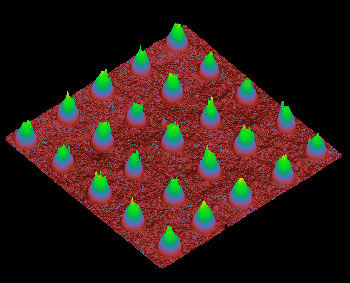
New architectures of nano-brushes developed
Just as cilia lining the lungs help keep passages clear by moving particles along the tips of the tiny hair-structures, man-made miniscule bristles known as nano-brushes can help reduce friction along surfaces at the molecular level, among other things. In their latest series of experiments, Duke University engineers have developed a novel approach to synthesize these nano-brushes, which could improve their versatility in the future.
August 24, 2010 Read more
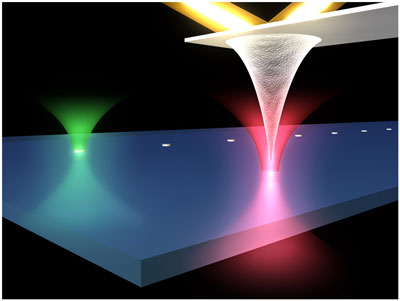
An optical 'tripod' enhances the use of atomic-force microscopy
A novel optical stabilization method extends the instrument's inherent precision and applicability to a wide range of perturbative operating conditions.
August 24, 2010 Read more
Princeton builds research ties with historically black universities
As an early career scientist, Max Fontus wondered how successful researchers repeatedly make discoveries worth publishing. Collaborating with a Princeton engineering professor this summer, he realized that working with scientists from other fields of research results in a cross-pollination of ideas that lays the foundation for great progress in science.
August 24, 2010 Read more
Visiting professor and students conduct nanotechnology research at Argonne National Laboratory
The students gained experience with nanoparticle synthesis methods, photoelectrochemistry and related topics.
August 24, 2010 Read more

Michael Roukes, Pamela Bjorkman recognized for their 'highly innovative approaches' to biomedical research
Two scientists from the California Institute of Technology (Caltech) have been recognized by the National Institutes of Health (NIH) for their innovative and high-impact biomedical research programs.
August 24, 2010 Read more
Additional speakers add new dimensions to Particle Summit program
Organisers of the two-day Particle Summit, which takes place near Boston in October (October 20-21, 2010; The Charles Hotel, Cambridge MA), have announced two further speakers for the event.
August 24, 2010 Read more
Mapping the structure of protonated water clusters
Water molecules are continuously forming short-lived networks called clusters. These can in turn bind positively charged protons, and such clusters can provide active functional groups in proteins. Using infrared spectroscopy, it is possible to determine the bond strengths, geometrical structures and chemical properties of protonated water clusters. In order to measure the spectrum of molecular vibrations in clusters it is, however, necessary to use other molecules as messengers.
August 24, 2010 Read more

Chad A. Mirkin to deliver Pittcon 2011 plenary lecture
The Pittcon Program Committee is pleased to announce that Dr.Chad A. Mirkin, Professor of Chemistry, Northwestern University, Evanston, Illinois, will deliver the Pittcon 2011 Plenary Lecture, 'Polyvalent DNA Architectures: New Modalities For Intracellular Gene Regulation and Detection' on Sunday, March 13, 2011, at 4:30 p.m., in the Sidney Marcus Auditorium, Georgia World Congress Center, Atlanta, Georgia.
August 24, 2010 Read more
Surface acoustic waves convert cell membrane into nano-conveyor belt
Membranes protect every single cell of our body. Researchers have now discovered that exposure to standing surface acoustic waves influences the distribution of the membrane's lipids.
August 24, 2010 Read more
Rheological technique predicts stability of solid lipid nanoparticles
A rheological technique, used by researchers at National Nanotechnology Center (NANOTEC) in Thailand has revealed the instability of y-oryzanol-loaded solid lipid nanoparticles er 60 days storage at three different temperatures of 4, 25, and 40C.
August 24, 2010 Read more
Colossal magnetoelectricity points the way to ultra-dense data storage
A team of scientists at Rutgers University has found a material in which an electric field can control the overall magnetic properties of the material. If the magnetoelectric effect discovered by the Rutgers group can be extended to higher temperatures, it could be useful for manipulating small-scale magnetic bits in ultra high-density data storage.
August 23, 2010 Read more
15 new US patents awarded this past year to NJIT researchers
New Jersey Institute of Technology (NJIT) researchers were awarded 15 new U.S. patents this past year, increasing the total number of issued patents for NJIT to 97. More than 150 applications are in process.
August 23, 2010 Read more
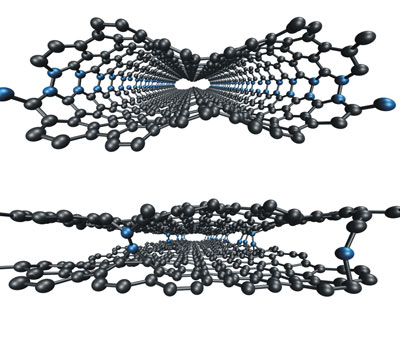
Researchers discover how loops develop in graphene
Nanoscale simulations and theoretical research performed at the Department of Energy's Oak Ridge National Laboratory are bringing scientists closer to realizing graphene's potential in electronic applications.
August 23, 2010 Read more
Breakthrough discovery enables nanoscale manipulation of the piezoelectric effect
The generation of an electric field by the compression and expansion of solid materials is known as the piezoelectric effect, and it has a wide range of applications ranging from everyday items such as watches, motion sensors and precise positioning systems. Researchers have now discovered how to control this effect in nanoscale semiconductors called quantum dots, enabling the development of incredibly tiny new products.
August 23, 2010 Read more
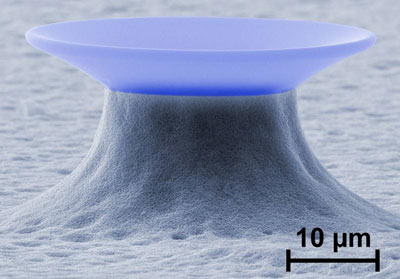
Laserlicht aus polymeren Mikrokelchen
In einem interdisziplinaeren Projekt ist es Wissenschaftlern des KIT gelungen, eine neue Erscheinungsform von optischen Resonatoren zu schaffen: Mikrokelche. Diese Polymerstrukturen sind durch ihre Form und ihre glatte Oberflaeche besonders effiziente Quellen fuer Laserlicht. Zudem haben sie das Potenzial kleinste Bio-Molekuele, Viren oder Gefahrstoffe nachzuweisen.
August 23, 2010 Read more
 Subscribe to our Nanotechnology News feed