

Space Exploration News – Latest Headlines
 Subscribe to our Space Exploration News feed
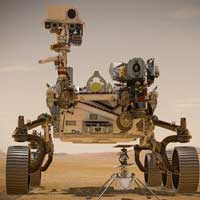
New Mars rover tool will zap rocks to investigate planet's past habitability
SuperCam will examine the chemistry and mineralogy of rocks on Mars.
July 27, 2020 Read more
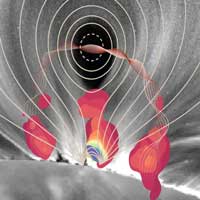
Researchers offer unprecedented look into 'central engine' powering a solar flare
An international research team has presented a new look inside the 'central engine' of a solar flare accompanied by an eruption, revealing an enormous electric current 'sheet', offering the first measurements characterizing the magnetic field.
July 27, 2020 Read more
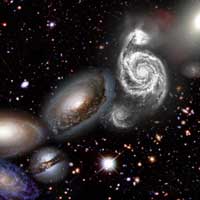
New approach refines the Hubble's constant and age of universe
Physicists reconfigure a distance-calculation technique built around empirical observations.
July 27, 2020 Read more
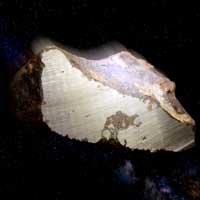
An origin story for a family of oddball meteorites
Study suggests the rare objects likely came from an early planetesimal with a magnetic core.
July 27, 2020 Read more
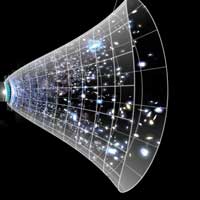
Dark energy: map gives clue about what it is - but deepens dispute about the cosmic expansion rate
Dark energy is one of the greatest mysteries in science today. We know very little about it, other than it is invisible, it fills the whole universe, and it pushes galaxies away from each other. This is making our cosmos expand at an accelerated rate. But what is it?
July 23, 2020 Read more
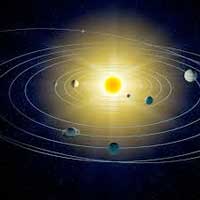
Artificial intelligence predicts which planetary systems will survive
Why don't planets collide more often? How do planetary systems organize themselves? Of all of the possible ways planets could orbit, how many configurations will remain stable over the billions of years of a star's life cycle?
July 23, 2020 Read more
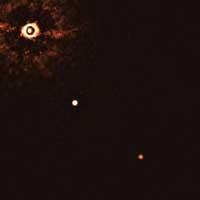
Astronomers capture first ever image of a multi-planet system around a sun-like star
The European Southern Observatory's Very Large Telescope has taken the first ever image of a young, Sun-like star accompanied by two giant exoplanets.
July 22, 2020 Read more
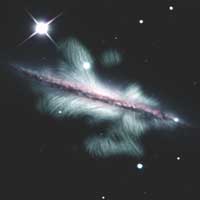
New cosmic magnetic field structures discovered in galaxy NGC 4217
Spiral galaxies such as our Milky Way can have sprawling magnetic fields. New data suggest that star formation and star explosions, so-called supernovae, are responsible for the visible structures.
July 21, 2020 Read more
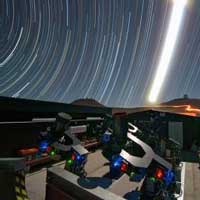
'Lost' world's rediscovery is step towards finding habitable planets
The rediscovery of a lost planet could pave the way for the detection of a world within the habitable 'Goldilocks zone' in a distant solar system.
July 21, 2020 Read more
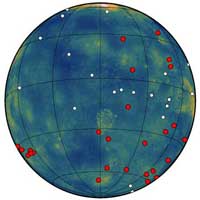
Scientists discover volcanoes on Venus are still active
New 3D model provides evidence that Venus is churning inside.
July 20, 2020 Read more
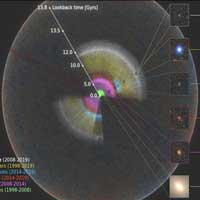
Astrophysicists measure the expansion of the Universe across 11,000 million years
The Sloan Digital Sky Survey publishes a comprehensive analysis of the largest three-dimensional map of the Universe ever created.
July 20, 2020 Read more
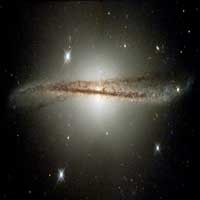
New evidence sheds light on origin of warp in the Milky Way
Most spiral galaxies, like Milky Way, have a warped disk, which is like a potato chip in the outer disk. But the origin of warp is still a mystery for astrophysicists.
July 20, 2020 Read more
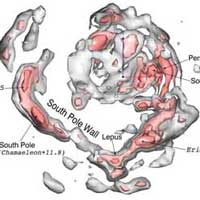
Astronomers map massive structure beyond Laniakea Supercluster
For the past decade, an international team of astronomers has been mapping the distribution of galaxies around the Milky Way. They have discovered an immense structure beyond Laniakea, an immense supercluster of galaxies, including our own. Astronomers have dubbed the newly identified structure the South Pole Wall.
July 20, 2020 Read more
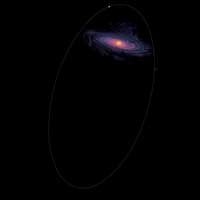
A population of asteroids of interstellar origin inhabits the Solar System
The discovery provides clues for understanding the star nursery from which the Sun emerged.
July 17, 2020 Read more
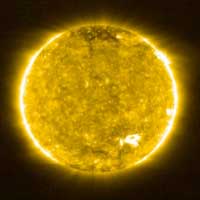
Solar Orbiter returns first data, snaps closest pictures of the sun
The first images from ESA/NASA's Solar Orbiter are now available to the public, including the closest pictures ever taken of the Sun.
July 17, 2020 Read more
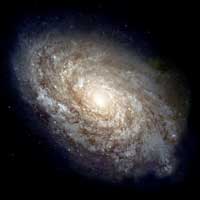
How galaxies die: New insights into the quenching of star formation
A simple model explains a wide range of observations by describing the contest between galaxy halos and their central black holes that eventually turns off star formation.
July 16, 2020 Read more
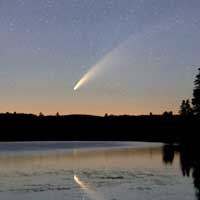
Neowise: an increasingly rare opportunity to spot a comet with the naked eye
Neowise is the first bright comet to be visible with the naked eye from the northern hemisphere since the mid-1990s. Another thing that makes this comet interesting is that it has a relatively long orbital period, meaning it was only discovered a few months ago.
July 16, 2020 Read more
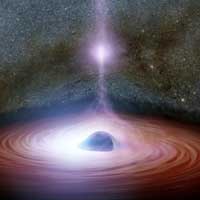
A black hole blinks
In a first, astronomers watch a black hole's corona disappear, then reappear.
July 16, 2020 Read more