

Space Exploration News – Latest Headlines
 Subscribe to our Space Exploration News feed
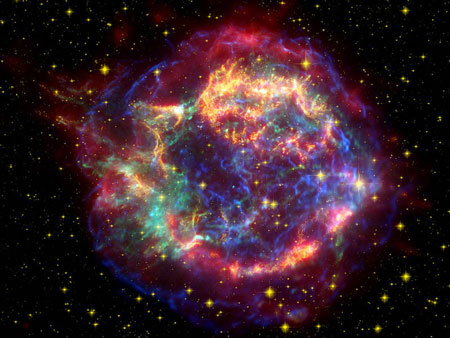
First biological evidence of a supernova
In fossil remnants of iron-loving bacteria, researchers of the Cluster of Excellence Origin and Structure of the Universe at the Technische Universitaet Muenchen (TUM), found a radioactive iron isotope that they trace back to a supernova in our cosmic neighborhood. This is the first proven biological signature of a starburst on our earth. The age determination of the deep-drill core from the Pacific Ocean showed that the supernova must have occurred about 2.2 million years ago, roughly around the time when the modern human developed.
May 8, 2013 Read more
NASA will fly a space mission using a revolutionary 'green' spacecraft propellant
In 2015, NASA, for the first time, will fly a space mission utilizing a radically different propellant - one which has reduced toxicity and is environmentally benign.
May 7, 2013 Read more
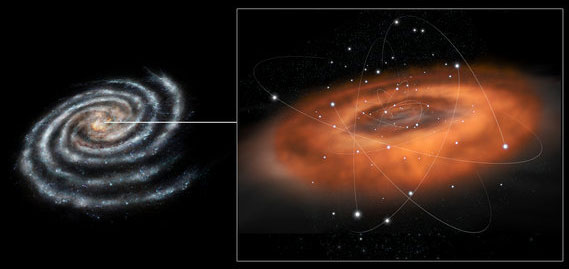
Herschel finds hot gas on the menu for Milky Way's black hole
ESA's Herschel space observatory has made detailed observations of surprisingly hot molecular gas that may be orbiting or falling towards the supermassive black hole lurking at the centre of our Milky Way galaxy.
May 7, 2013 Read more
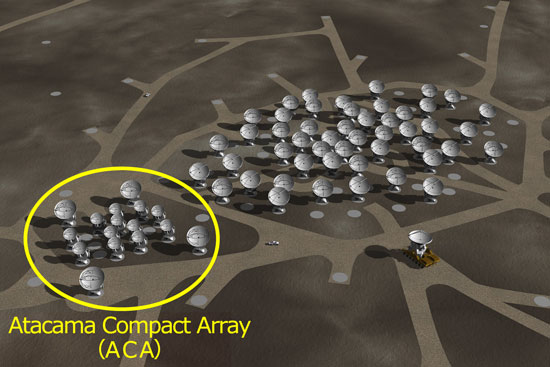
ALMA Compact Array completed and named after Japanese astronomer
The Atacama Large Millimeter/submillimeter Array (ALMA) has reached another milestone with the delivery of the last antenna forming the Atacama Compact Array (ACA) to the ALMA high site. The ACA is a subset of 16 closely separated antennas that will greatly improve ALMA's ability to study celestial objects with a large angular size, such as molecular clouds and nearby galaxies.
May 7, 2013 Read more
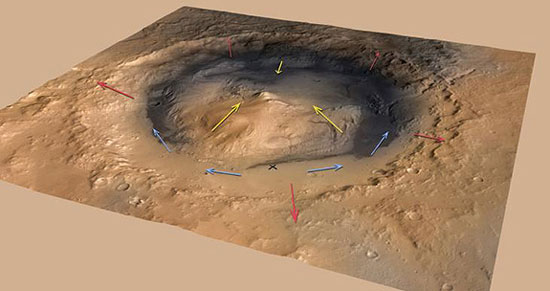
New analysis suggests wind, not water, formed mound on Mars
Researchers suggest that Mars' roughly 3.5-mile high Mount Sharp most likely emerged as strong winds carried dust and sand into Gale Crater where the mound sits. If correct, the research could dilute expectations that the mound is the remnant of a massive lake, which would have important implications for understanding Mars' past habitability.
May 6, 2013 Read more
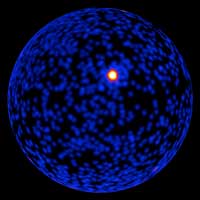
NASA's Fermi, Swift see 'shockingly bright' burst
A record-setting blast of gamma rays from a dying star in a distant galaxy has wowed astronomers around the world. The eruption, which is classified as a gamma-ray burst, or GRB, and designated GRB 130427A, produced the highest-energy light ever detected from such an event.
May 5, 2013 Read more
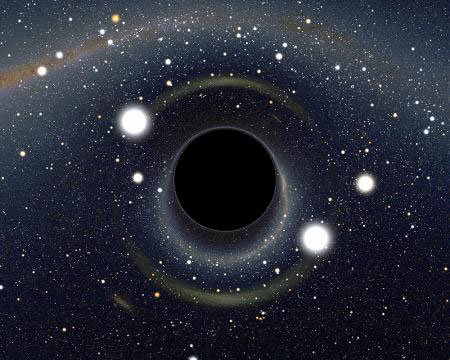
Birth of a black hole
A new kind of cosmic flash may reveal something never seen before: the birth of a black hole.
May 5, 2013 Read more
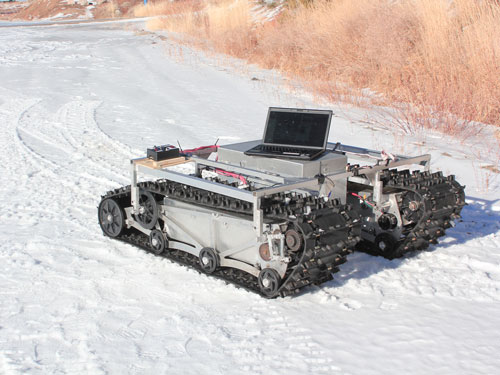
NASA rover prototype set to explore Greenland ice sheet
NASA's newest scientific rover is set for testing May 3 through June 8 in the highest part of Greenland.
May 3, 2013 Read more
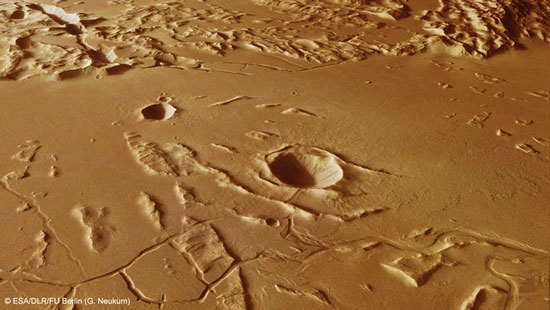
Landslides and lava flows at Olympus Mons on Mars
Giant landslides, lava flows and tectonic forces are behind this dynamic scene captured recently by ESA's Mars Express of a region scarred by the Solar System's largest volcano, Olympus Mons.
May 3, 2013 Read more
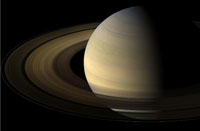
Telling time on Saturn
A University of Iowa undergraduate student has discovered that a process occurring in Saturn's magnetosphere is linked to the planet's seasons and changes with them, a finding that helps clarify the length of a Saturn day and could alter our understanding of the Earth's magnetosphere.
May 3, 2013 Read more
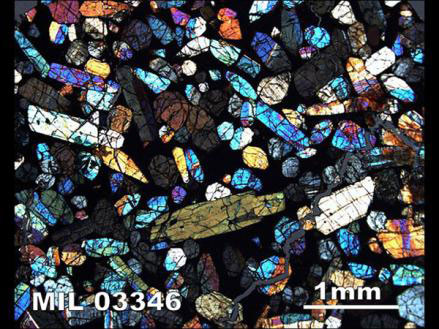
Studying meteorites may reveal Mars' secrets of life
In an effort to determine if conditions were ever right on Mars to sustain life, a team of scientists, including a Michigan State University professor, has examined a meteorite that formed on the red planet more than a billion years ago.
May 2, 2013 Read more
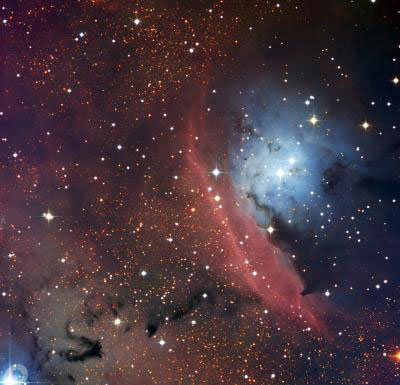
An anarchic region of star formation
The Danish 1.54-meter telescope located at ESO's La Silla Observatory in Chile has captured a striking image of NGC 6559, an object that showcases the anarchy that reigns when stars form inside an interstellar cloud.
May 2, 2013 Read more
Molecule hunter in the universe
HIFI has opened up new window to explore the cosmos.
May 2, 2013 Read more
The day NASA's Fermi dodged a 1.5-ton bullet (w/ video)
While Fermi is in fine shape today, continuing its mission to map the highest-energy light in the universe, the story of how it sidestepped a potential disaster offers a glimpse at an underappreciated aspect of managing a space mission: orbital traffic control.
May 1, 2013 Read more
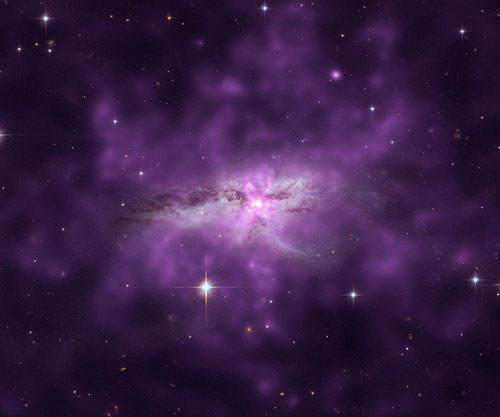
Colossal hot cloud envelopes colliding galaxies
Scientists have used Chandra to make a detailed study of an enormous cloud of hot gas enveloping two large, colliding galaxies. This unusually large reservoir of gas contains as much mass as 10 billion Suns, spans about 300,000 light years, and radiates at a temperature of more than 7 million degrees.
April 30, 2013 Read more
Saturn's youthful appearance explained
As planets age they become darker and cooler. Saturn however is much brighter than expected for a planet of its age - a question that has puzzled scientists since the late 1960s. New research has revealed how Saturn keeps itself looking young and hot.
April 30, 2013 Read more
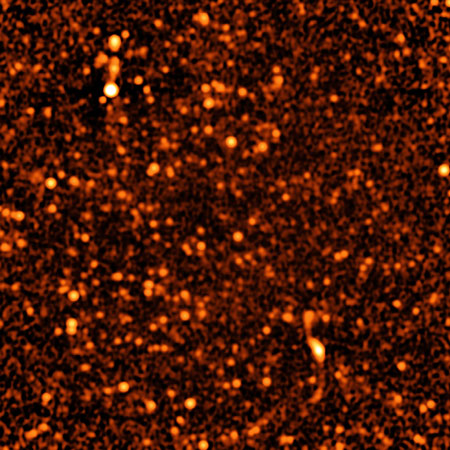
VLA gives deep, detailed image of distant universe
Staring at a small patch of sky for more than 50 hours with the ultra-sensitive Karl G. Jansky Very Large Array (VLA), astronomers have for the first time identified discrete sources that account for nearly all the radio waves coming from distant galaxies.
April 30, 2013 Read more
NASA and its partners solicit creative materials manufacturing solutions
NASA, the U.S. Agency for International Development (USAID), the U.S. State Department and Nike have issued a challenge to identify 10 game-changing innovations that could enable fabric systems to enhance global economic growth, drive human prosperity and replenish the planet's resources.
April 29, 2013 Read more