| Jun 16, 2026 |
Advanced 3D printing creates origami-inspired structures
A mold-free additive process prints rigid and flexible materials onto fabric, cutting time and cost for lightweight, origami-like parts.
|
|
(Nanowerk News) Researchers at the Manufacturing Demonstration Facility at Oak Ridge National Laboratory have introduced an innovation in additive manufacturing by integrating origami-inspired 3D printing techniques with hybrid composites — materials made from mixed reinforcing components. By eliminating the need for molds to fabricate a part, this process produces lightweight, cost-efficient structures with faster build times and greater adaptability.
|
|
Traditional composite manufacturing, while highly effective for producing strong, durable components, can sometimes involve long lead times and high mold costs that limit design flexibility. The ORNL method uses hybrid materials in an additive process without molds to produce flat-to-foldable structures that merge flexible and rigid components into a single design.
|
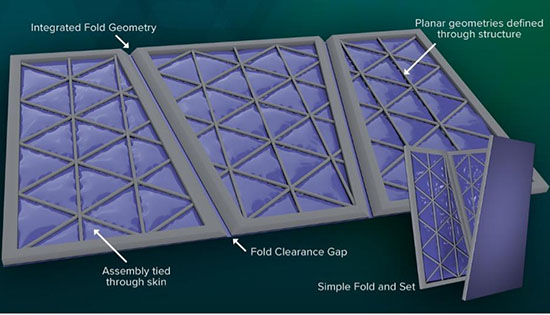 |
| Integrated fold geometries and structural reinforcement patterns enable this origami-inspired composite to transition from a flat panel into a three-dimensional form. (Image: Andrew Sproles, ORNL)
|
|
“This pioneering method redefines advanced manufacturing by fusing material science with transformative design principles,” said ORNL’s Steven Guzorek, lead researcher on the project. “By applying origami-inspired principles to hybrid composites, we are improving the efficiency and scalability of large-structure manufacturing and achieving forms unattainable with traditional additive approaches — advancing robust, cost-effective solutions for a broad range of applications.”
|
|
The innovative process works by depositing materials onto a flexible, fabric-based surface, allowing precise control over the material’s form and strength. This flexibility enables foldable 3D forms without molds or extensive finishing.
|
|
The structures are composed of a high-strength fabric base such as nylon, glass fiber or resin-infused composite fibers, followed by an integration or bonding layer such as thermoplastic polyurethane for compatibility and adhesion. The reinforcing layer is then applied using deposited composite materials, including thermoplastic carbon-fiber acrylonitrile butadiene styrene for lightweight structural performance or thermoset formulations such as styrene-based or epoxy-based resins for enhanced stiffness, geometry control and durability. The materials bond at the molecular level, forming a strong connection between the grid and the outer layer.
|
|
Guzorek said the key to this bond lies in material selection. “By understanding the materials science, we chose materials that we knew would bond effectively, producing a truly integrated component.”
|
|
This advancement opens the door for next-generation composite manufacturing strategies that bypass molds and expand the boundaries of lightweight structural design.
|
Benefits of mold-free hybrid composite 3D printing
|
|
The method enables the production of complex geometries that traditional mold-based methods cannot economically achieve. It also allows the fabrication of objects larger than the printing machine itself, reducing capital costs and boosting production efficiency. In a test print, researchers found that eliminating molds reduced fabrication time by 95 percent and costs by 90 percent for printing a unique design compared to conventional mold-based composite manufacturing.
|
|
The new method eliminates mold storage challenges, enables rapid deployment and facilitates rapid printing of flat components directly onto sheet materials, which keeps costs down and supports both thermoplastic and thermoset materials.
|
|
“Our goal is to make this innovation scalable so manufacturers across industries can harness its potential,” said Guzorek. “By broadening access to mold-free hybrid composites, we’re empowering manufacturers to explore new design possibilities and unlock entirely new applications for this transformative technology.”
|