| Jul 07, 2026 |
Holographic printer produces ultra-high aspect-ratio 3D microstructures in one shot
Engineers use nanoscale 'mask' to avoid leaky seams that come with standard layering process.
|
|
(Nanowerk News) University of Utah researchers have demonstrated a new method of 3D printing that avoids the leaky seams that come with the layer-by-layer process. Using a nanoscale “mask” that diffracts laser light into a holographic pattern of the desired shape, it fuses its print material solid in one shot. The process takes about 20 seconds, a stark contrast with the hours other laser-based printing methods can take.
|
|
In a study published in the journal Nature Communications ("Single-exposure holographic lithography of ultra-high aspect-ratio microstructures"), the researchers demonstrated they could print multiple shapes in a conveyor-belt fashion. The research was led by Rajesh Menon, professor in the Department of Electrical & Computer Engineering at the Price College of Engineering, along with lab member Dajun Lin.
|
|
Menon’s team used this technique to print microtubule assemblies with individual diameters as small as 6 micrometers. They tested their assemblies for physical toughness and also showed they could transport liquid via the capillary effect.
|
|
The project takes inspiration from photolithography, but applies the concept to three dimensions.
|
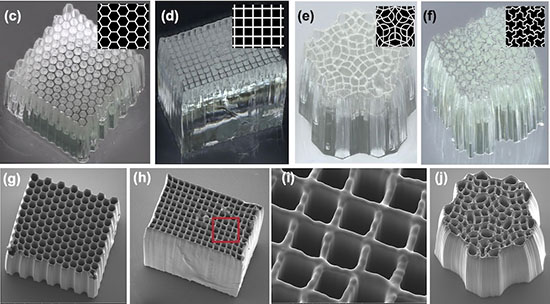 |
| The researchers demonstrated multiple different lattice patterns for their microtubule arrays. (Image: Menon Lab, University of Utah)
|
|
The researchers’ prints are made of a substrate called SU-8, commonly used in photolithography. Made of stringy polymers, those molecular threads crosslink and harden when exposed to laser light. The unexposed sections of the substrate can then be easily washed away, leaving the desired shape behind.
|
|
In 2D photolithography, that shape is controlled by an opaque mask that blocks the laser from reaching the unwanted parts of the substrate. This approach is fine for two dimensions, since light only needs to reach the substrate’s surface.
|
|
To apply the concept to three dimensions, the laser must pass through the substrate itself, crosslinking a volume of space inside. The challenge there is accuracy; because the substrate isn’t perfectly transparent, it will deflect the path of the laser as it passes through, causing blurring.
|
|
Menon’s group devised a way around the blurring problem: a mask consisting of a nanopatterned lens that compensates for the substrate’s diffraction. Placed in front of the light source, the mask channels the laser’s energy only to the volume of substrate that will become the final print.
|
|
To demonstrate the printer, the researchers made a variety of complex microstructures, with dimensional ratios as high as 120:1. Menon describes these prints as “extended 2D” rather than true 3D — while they have length, width and height, the researchers can only control the shape of the former two dimensions.
|
|
“The mask is working like a cookie cutter, stamping a complex shape out of thick dough,” Menon said. “The laser is ‘baking’ the dough on the inside at the same time, so the resulting shape is physically tough.”
|
|
The researchers produced multiple lattice patterns for their microtubule arrays. The technique’s limitations lend themselves to lattice-like microtubule patterns, as they have extreme fine details in two dimensions that are extended as far as possible into the third. In subsequent experiments, the researchers demonstrated that these microtubules could successfully transport liquid via capillary action, as well as withstand various compression tests.
|
|
The researchers are now working to achieve true 3D prints using their new technique.
|