

Space Exploration News – Latest Headlines
 Subscribe to our Space Exploration News feed
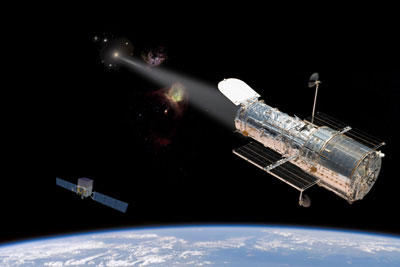
Distant blazar is a high-energy astrophysics puzzle
Blazar PKS 1424+240 is the most distant known source of very high-energy gamma rays, but emission spectrum deviates from expectations.
April 18, 2013 Read more
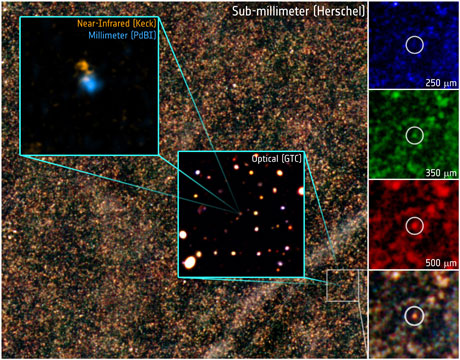
Despite young age, galaxy births billions of stars
A Cornell researcher and his team have uncovered an oddity in the early cosmos: A newly discovered distant galaxy, born just after the big bang, is starting to furiously churn out stars at peak capacity - despite its young age. The unique galaxy is forming 2,000 times the number of stars as our own Milky Way.
April 18, 2013 Read more
Astronomers discover five-planet system with most Earthlike exoplanet yet
A University of Washington astronomer has discovered perhaps the most Earthlike planet yet found outside the solar system by the Kepler Space Telescope.
April 18, 2013 Read more
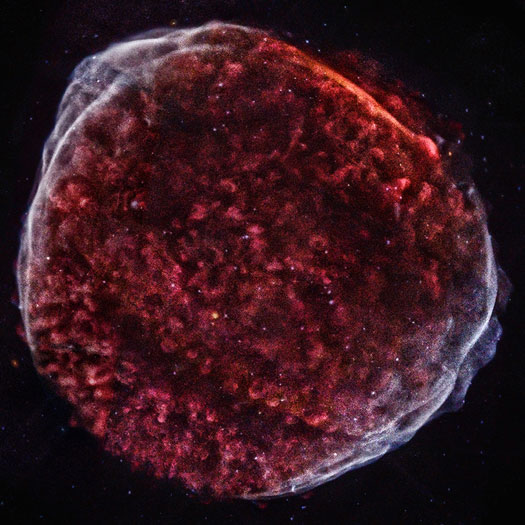
X-ray view of a thousand-year-old cosmic tapestry
A long Chandra observation reveals the SN 1006 supernova remnant in exquisite detail. By overlapping 10 different pointings of Chandra's field-of-view, astronomers have stitched together a cosmic tapestry of the debris field that was created when a white dwarf star exploded, sending its material hurtling into space as seen from Earth over a millennium ago.
April 17, 2013 Read more
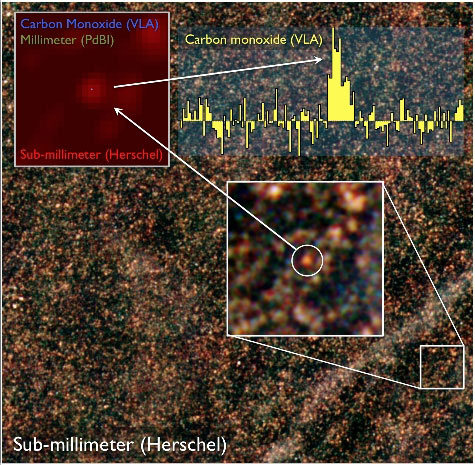
Massive star factory churned in universe's youth
Astronomers find the most prolific star factory yet seen, in a far-distant galaxy that reveals important information about the cosmic environment in the early history of the Universe.
April 17, 2013 Read more
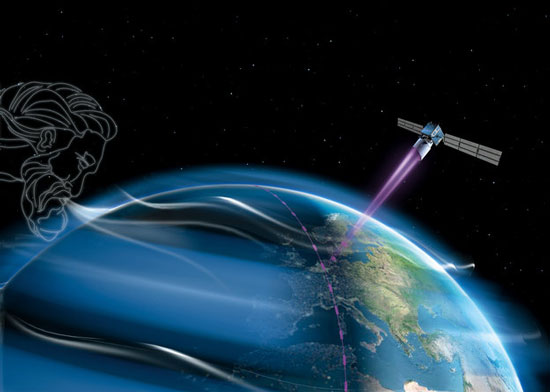
90 million laser shots bring Wind satellite back on track
Developing new ways of monitoring Earth is always demanding, but ESA's Aeolus mission has faced some particularly difficult technical challenges. However, with the success of intense high-energy tests on its novel laser there is now light at the end of the tunnel for this unique mission.
April 17, 2013 Read more
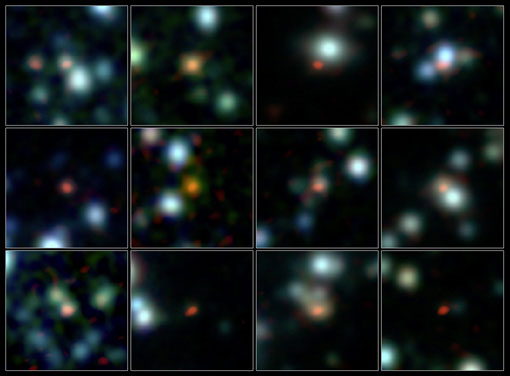
Pinpointing the most fertile galaxies in the universe
Using the compound telescope ALMA, a team of researchers has pinpointed the positions of more than 100 of the most fertile star-forming galaxies. The precise position measurements clear up a mystery about the observed productivity of these objects. They also show that previous studies of these objects have often suffered from mis-identifications, and how precise measurements like these new results avoid this kind of error.
April 17, 2013 Read more
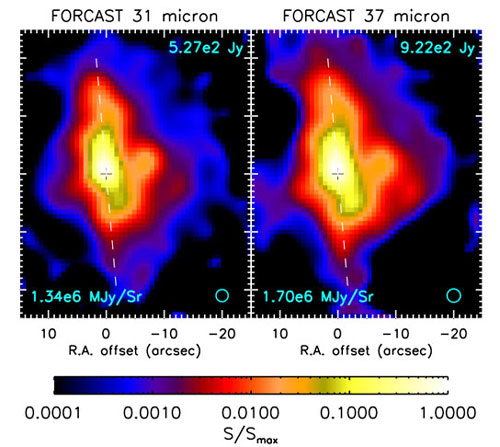
Sofia observations reveal a surprise in massive star formation
Researchers using the airborne Stratospheric Observatory for Infrared Astronomy (SOFIA) have captured the most detailed mid-infrared images yet of a massive star condensing within a dense cocoon of dust and gas.
April 16, 2013 Read more
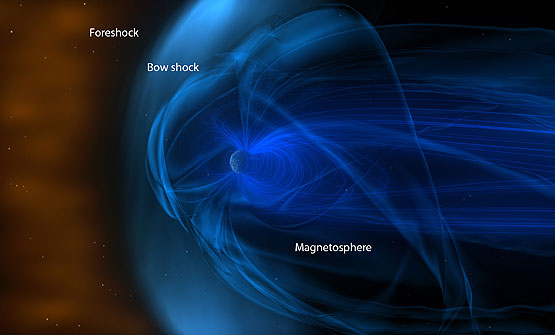
NASA's Wind mission encounters 'SLAMS' waves
To tease out what happens at the boundary of the magnetosphere and to better understand how radiation and energy from the sun can cross it and move closer to Earth, NASA launches spacecraft into this region to observe the changing conditions.
April 16, 2013 Read more
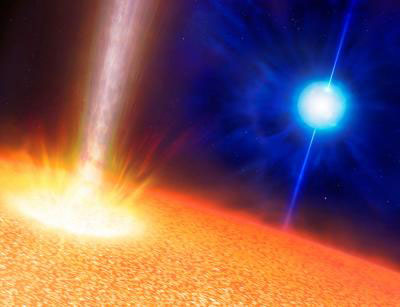
Strange new bursts of gamma rays point to a new way to destroy a star
A team led by the University of Warwick has pinpointed a new type of exceptionally powerful and long-lived cosmic explosion, prompting a theory that they arise in the violent death throes of a supergiant star.
April 16, 2013 Read more
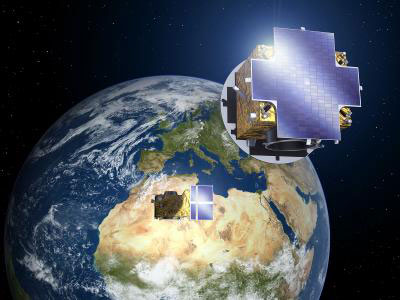
For the very first time, 2 spacecraft will fly in formation with millimeter precision
Spanish industry is leading the Proba-3 mission, a world first in precise formation flying. This European Space Agency (ESA) project aims to demonstrate that two satellites can move as one single object with sub-millimetre precision. This configuration will enable the creation of enormous space telescopes with the lens and detector hundreds of metres apart.
April 16, 2013 Read more
Speeding up research into the evolution of the solar system
In an attempt to obtain a comprehensive picture of the solar system's evolution in a much shorter time, mathematicians at the Computing Faculty of the University of the Basque Country (UPV/EHU) have developed new numerical methods which enable simulation calculations to be done faster and more accurately.
April 16, 2013 Read more
Understanding how space turbulence works
Researcher conducts supercomputer simulations to learn impacts on Earth's magnetic field
April 16, 2013 Read more
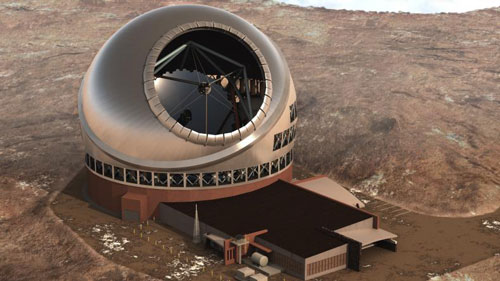
Hawaii approves construction of the most powerful optical telescope on Earth
Friday marked another important step forward for the future of astronomical discovery and economic opportunity on Hawaii Island. The Hawaiian Board of Land and Natural Resources (BLNR) announced that it has granted a permit to the Thirty Meter Telescope (TMT) project to build and operate the next-generation observatory near the summit of Mauna Kea.
April 15, 2013 Read more
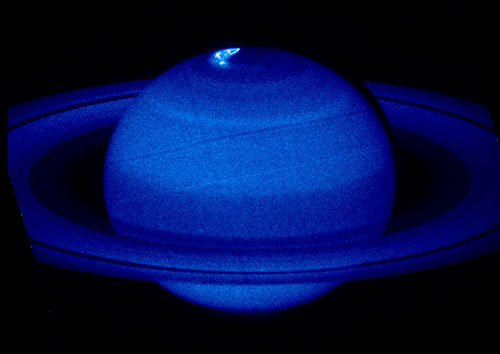
Groundbreaking observational campaign of Saturn's auroras
University of Leicester planetary scientists have collaborated with an international team of researchers to organise the largest ever observational campaign of Saturn's auroras.
April 15, 2013 Read more

Can one buy the right to name a planet? - The IAU responds to recent name-selling campaign
In the light of recent events, where the possibility of buying the rights to name exoplanets has been advertised, the International Astronomical Union (IAU) wishes to inform the public that such schemes have no bearing on the official naming process.
April 12, 2013 Read more
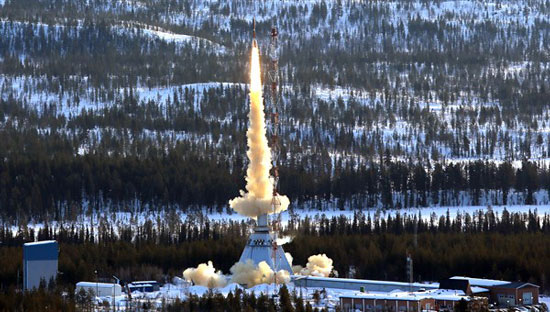
TEXUS 50 - Anniversary for Germany's sounding rocket programme
It is the world's longest running rocket programme for conducting research in microgravity, and today it is celebrating an anniversary. Around 35 years after the launch of the first TEXUS mission in December 1977, the 50th TEXUS rocket was successfully launched into space from the Esrange Space Center near Kiruna in northern Sweden on 12 April 2013.
April 12, 2013 Read more
NASA announces challenges for the 2013 International Space Apps Challenge
NASA and over 150 partner organizations worldwide will be hosting the International Space Apps Challenge on April 20-21, 2013. The International Space Apps Challenge is a technology development event during which citizens from around the world work together to solve challenges relevant to improving life on Earth and in space.
April 12, 2013 Read more