| Jun 17, 2026 |
MOFs advance cleaner carbon capture, methane storage and hydrogen use
A comprehensive review assesses metal-organic frameworks for simultaneous carbon capture, methane utilization, and hydrogen storage.
(Nanowerk News) The world faces an urgent challenge to achieve carbon neutrality, demanding innovative solutions for managing strategic gases like carbon dioxide (CO₂), methane (CH₄), and hydrogen (H2). CO₂ capture is vital for emissions reduction, CH₄ requires careful valorization and control due to its potent global warming impact, and H2 is rapidly emerging as a cornerstone of future energy systems.
|
|
Metal–organic frameworks (MOFs), a class of porous materials recognized by the 2025 Nobel Prize in Chemistry, are rapidly changing possibilities for strategic gas management due to their exceptional tunability.
|
|
A new review in Carbon Research ("Next-generation metal–organic frameworks for CO2 capture, CH4 utilization, and H2 integration: toward a circular and clean energy future") provides a critical and integrated assessment of MOFs' potential across these three domains.
|
|
Led by Reda Elkacmi from Sultan Moulay Slimane University, the authors detail how MOFs’ unique attributes—including surface areas exceeding 6000 m² g⁻¹, tunable pore environments, and modular coordination chemistry—enable significant CO₂ uptakes, high methane storage capacities, and impressive hydrogen volumetric densities. These properties empower MOFs to address multiple environmental and energy challenges simultaneously.
|
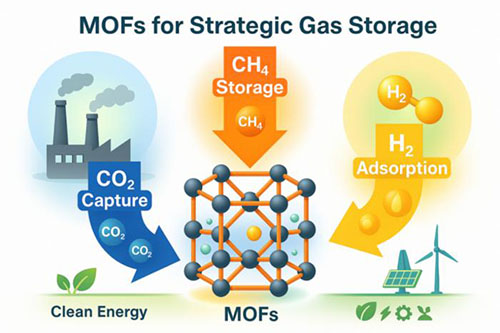 |
| Next-generation metal–organic frameworks for CO₂ capture, CH₄ utilization, and H₂ integration. (Image: Reproduced from DOI:10.1007/s44246-026-00268-2, CC BY)
|
A Unified Strategy for Strategic Gases
|
|
The review’s core contribution is its unified analysis of MOFs for all three strategic gases. Rather than treating CO₂ capture, CH₄ storage, and H2 adsorption in isolation, the authors identify common performance drivers, shared bottlenecks, and potential synergies.
|
|
This integrated approach clarifies actionable insights for carbon mitigation, methane utilization, and hydrogen storage, revealing how optimal material design principles can be applied and adapted across different applications for a cohesive clean energy strategy.
|
From Lab Bench to Industrial Scale
|
|
Despite impressive laboratory performance, the path to industrial deployment for MOFs contains significant hurdles. The review details challenges concerning stability and durability in real-world conditions, particularly when exposed to moisture and other impurities in gas streams. Production costs remain high compared to conventional adsorbents, and scaling up synthesis while maintaining quality, consistency, and mechanical robustness continues to be a major obstacle.
|
|
The review emphasizes that overcoming these limitations requires more than just high adsorption capacity; it demands reliability and economic viability.
|
Charting the Path to a Circular Future
|
|
The authors emphasize that translating MOFs from promising academic materials to operational technologies requires an integrated strategy. Innovations in green chemistry, such as aqueous or mechanochemical synthesis, aim to reduce the environmental footprint and production costs associated with MOFs.
|
|
The development of robust, shaped MOF architectures and hybrid composites is also essential for improving durability and facilitating integration into existing industrial processes, guiding the scientific community toward practical, scalable solutions.
|
|
Looking ahead, the review posits that MOFs possess the potential to become key enablers of the clean energy transition. Their continued development, when aligned with industrial and policy frameworks, can advance them from promising research prototypes to operational components in a circular and low-carbon energy economy.
|
|
This includes combining their adsorption capabilities with catalytic functions for converting CO₂ into valuable chemicals or supporting hydrogen conversion in fuel cells, paving the way for truly multifunctional systems.
|
|
"To truly contribute to a carbon-neutral, hydrogen-centered future, MOFs must bridge the gap between their remarkable laboratory performance and the robust demands of industrial scale," states Reda Elkacmi, a corresponding author from Sultan Moulay Slimane University. "Our review aims to provide a clear roadmap for this transition, emphasizing the need for integrated design, scalable synthesis, and sustained durability across all strategic gas applications."
|