| Jul 06, 2026 |
How water cages in free electrons
How does water's behavior change when there�s a free electron around? Researchers figured this out, with implications on the understanding of biological radiation damage.
(Nanowerk News) Radiation is the silent bogeyman of the chemical world. We know that ionizing radiation can do terrible damage to proteins and DNA. But how exactly does that damage start and develop, on the chemical level? A team of researchers led by DESY lead scientist Robin Santra at the Center for Free Electron laser Science at DESY developed a better picture of this process.
|
|
The team has produced a simulation of how a free electron injected at various energies begins to disrupt and distort the structure between water molecules. This distortion is much more dependent on how the electron was initially injected as previously expected.
|
|
The research is published in the The Journal of Physical Chemistry Letters ("Impact of Initial Electron Localization on Electron Solvation Dynamics in Liquid Water").
|
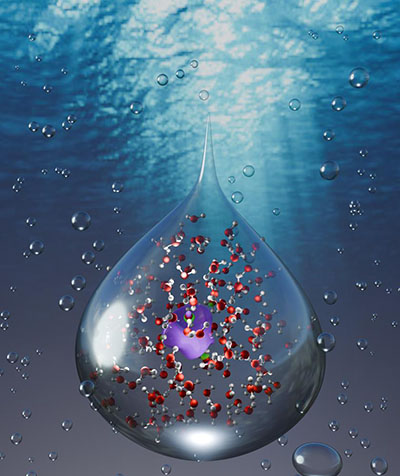 |
| Illustrative representation of free electron's wave function in a droplet of water, with the arrangement of water molecules in its vicinity. (Image: Mathilde Goullieux / DESY)
|
|
The mechanism has implications on how complex molecules important to life get disrupted by ionizing radiation. Biological cells are essentially bags of water with assorted biomolecules distributed in solution in the water and across all of the cell’s containment structures. Nucleic acids such as DNA and mRNA and all sorts of structural and functional proteins are contained in various structures within the cell, but the presence of water is always the constant anywhere you look.
|
|
When ionizing radiation – gamma rays and X-rays, or charged particles like alpha or beta particles – passes through biological cells, it strips multiple electrons off of the molecules it encounters. These electrons likely end up surrounded by water, given the large proportion of water in the cell.
|
|
“Compared to the primary damage caused by the ionizing radiation, the secondary effects due to the injection of these newly freed electrons into the cell contribute a substantial part of the total radiation damage,” says DESY lead scientist Robin Santra, who is also a professor at the University of Hamburg.
|
|
The research team at DESY performed simulations showing what happens when a single electron suddenly appears in an otherwise normal mass of water. What follows is a “bubble” of influence on the water molecules across the entire mass – they all start reacting differently than usual. The strange rules of quantum mechanics hold that an electron cannot be pinpointed to a single location at any point in time – so its influence is over a large amount of water at first.
|
|
“The electron is particularly delocalized – it flies around the bulk water, and over time, through its interactions with the water molecules, the water more or less confines the electron to a much more limited area,” says DESY and CFEL scientist Ludger Inhester, a co-author on the paper. In making this bubble of influence smaller, five or six individual water molecules surround the electron isolating it from the rest of the water molecules. “The amazing thing is that this smaller bubble stays there for quite a long time. The electron wants to keep away from the water molecules as much as possible, so the electron ends up in a spatial void among these few water molecules.”
|
|
The interaction between the excess electron and the water depends heavily on how the electron was originally injected. “We observe that the speed in which the electron bubble forms, becomes considerably faster when the initial spread of the excess electron is smaller,” says Nathaniel Okpara, a doctoral student at DESY and CFEL and first author of the study.
|
|
The created “water cage” might hold in the excess electron but now the damage can start. Since the number of molecules influenced by the presence of the electron is smaller, they carry a larger proportion of it, affecting its interactions with other local molecules – including ones like DNA.
|
|
The team wants to continue looking at this effect in more detail in more diverse environments. This may include situations when ions or other chemicals are present in the water.
|