| Jul 02, 2026 |
Room-temperature photon source brings quantum security closer to deployment
A compact plug-and-play device produces single photons without cryogenic cooling, easing integration with quantum-secure communication networks.
(Nanowerk News) The Korea Research Institute of Standards and Science (KRISS) has developed a room-temperature single-photon source built into a compact 19-inch rack-mounted device that operates without cryogenic cooling. Designed as a plug-and-play system that works as soon as it is powered on, the device moves quantum light source technology beyond the laboratory and closer to practical, on-site use.
|
|
A single-photon source is a device that generates particles of light, or photons, one at a time. It serves as the starting point for photon-based quantum technologies such as quantum communication, quantum sensing, and quantum measurement. In quantum communication, for example, information is encoded onto individual photons, and any attempt at eavesdropping alters the photon's state, leaving a detectable trace.
|
|
Until now, however, conventional single-photon sources have required cryogenic temperatures of around minus 270 degrees Celsius (about 3 kelvin), room-sized optical tables, and skilled researchers to operate them, which limited their deployment in real-world settings such as communication sites, hospitals, and security facilities.
|
|
KRISS researchers implemented this gallium nitride (GaN) semiconductor-based single-photon source as a room-temperature, plug-and-play device. The system runs on a standard 220 V power supply and generates single photons without the need for complex optical alignment. Its 19-inch rack-mounted form factor makes it easy to connect with existing quantum key distribution (QKD) equipment, while also lending itself well to on-site installation and operation.
|
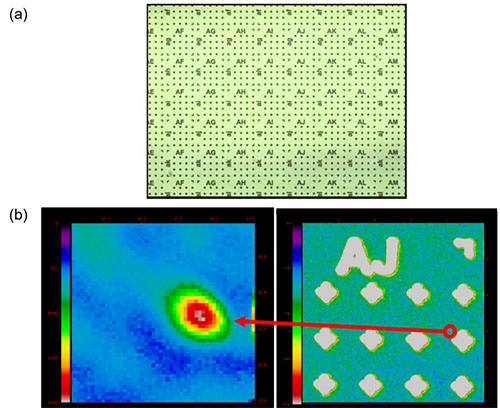 |
| "A GPS for particles of light": the deterministic spatial mapping technique. (Image: KRISS)
|
|
The core of this technology lies in harnessing the tiny defects that form naturally within the gallium nitride semiconductor. When energy is applied to one of these defects, it emits photons one at a time. However, because the defects are atomic in scale and scattered at random, it has been difficult to repeatedly use a position once it is found. KRISS developed a deterministic spatial mapping technique that records each emission site like a set of coordinates, allowing the device to automatically return to the same point even after being switched off and on.
|
|
The team of Professor Lee Wook-Jae at Kongju National University, a collaborating partner in the research, designed and fabricated nanometer-scale circular Bragg gratings (CBGs) on the semiconductor surface that guide photons upward, maximizing the extraction efficiency of the photons emitted from the defects.
|
|
As global competition to secure an early lead in quantum technology intensifies, securing core equipment and components has emerged as a matter of national competitiveness. This achievement represents a case of domestic localization of quantum materials, parts, and equipment, turning a single-photon source into a fully realized device using homegrown technology. It can serve as a key light source for strengthening the security of quantum cryptography communication along critical channels such as financial, medical, and government networks. KRISS is currently pursuing commercialization in collaboration with its spin-off company QRAD Inc.
|
|
Beyond producing single-photon sources, KRISS operates the only one-stop quantum light platform in Korea, connecting the verification of source quality with development and further improvement. Drawing on its quantum characterization testing services and single-photon measurement capabilities, the research team reflects these insights in its designs to refine the sources into purer and more stable light.
|
|
KRISS is also enhancing international credibility through comparison and validation with overseas metrology institutes, including PTB (Physikalisch-Technische Bundesanstalt, Germany) and INRIM (National Metrology Institute of Italy), as well as collaboration on an EU Horizon project.
|
|
"Single-photon sources are an essential component of photon-based quantum technologies, yet they have long been confined to cryogenic laboratories," said Dr. Hong keesuk, Principal Research Scientist at KRISS. "The significance of this achievement lies in turning the source into a device that works at room temperature, greatly lowering the barrier to real-world use."
|
|
"Competitiveness in the quantum industry depends on whether you can build core components yourself and supply them reliably," said Dr. Lee Dong-hoon, Chief Executive Officer of QRAD Inc. "We aim to develop the KRISS technology into a smaller and more robust product, building a quantum light source supply chain grounded in domestic technology."
|
|
The research on improving photon extraction efficiency, which laid the foundation for this achievement, was carried out jointly by the Photometry and Radiometry Metrology Group at KRISS and the team of Professor Lee Wook-Jae in the Department of Data Information and Physics at Kongju National University.
|
|
The findings were published in Laser & Photonics Reviews ("Boosting Single‐Photon Extraction Efficiency in GaN Through Radiative Mode Conversion").
|