| Jun 26, 2026 |
Nanodiamonds emerge from a giant press and powerful X-rays
Researchers use extreme pressure and bright X-rays to track how nanodiamonds form, opening ways to tune ultra-hard materials for future technologies.
(Nanowerk News) Diamonds: precious stones and some of the hardest material on Earth, they are not only pretty to look at, but they are useful in industry and science. To make them, one has to apply high temperatures and pressures to carbon molecules such as graphite.
|
|
A recent result published in the journal Nature ("Bottom-up synthesis of molecular nanodiamond from nanographene") described how researchers could generate custom-made diamonds three to four nanometres in size, whereas a human hair is 80,000 to 100,000 nanometres thick. These nanodiamonds could be deployed for various uses, from extremely durable cutting tools to quantum technologies. But how do they form? The research team was able to analyse the production process using PETRA III’s X-rays and a very large crusher.
|
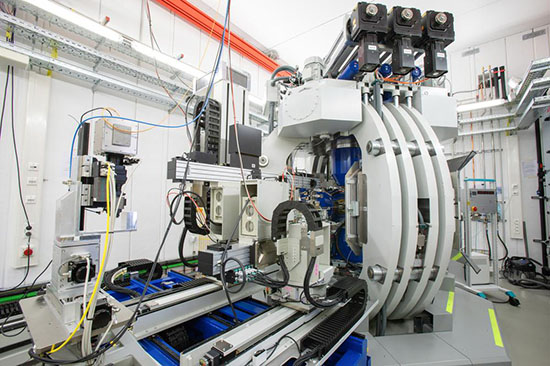 |
| The large volume press Aster-15 at P61B at PETRA III. (Image: Marta Mayer, DESY)
|
|
The research team, led by the Max Planck Institute for Polymer Research in Mainz, Germany, created nanodiamonds from small fragments of a hydrogen-bonded carbon molecule, graphene. Diamond synthesis has been routine practice in a standard laboratory for over 50 years. However, producing high-purity gem-quality nanocrystalline diamonds is considerably more challenging, as it requires exceptionally pure starting materials, precise control of the microstructure of the growing nanocrystals, and suppression of runaway crystal growth at high temperatures.
|
|
“Nanocrystalline diamond with a uniform grain size is very precious,” says Robert Farla, leader of the P61B beamline at DESY’s light source PETRA III and a co-author of the study. “It’s ultra hard, actually with a higher geological hardness than normal diamonds. And this team made a great achievement: They managed to make this structure at lower pressure and temperature than otherwise required using ordinary graphite.”
|
|
Farla and his colleague at P61B and fellow co-author Shrikant Bhat operate a large volume press (LVP) called Aster-15 as a key part of the beamline station. The press can crush sample volumes up to the size of a small sugar cube to pressures of tens of gigapascal, on the order of 100,000 times normal air pressure, while also heating the sample to high temperatures on the order of 2000°C. The research team could vary the temperature of the experiment easily between compressions, enabling them to try numerous parameters to explore the minimum temperature and pressure needed to generate the nanodiamonds. By using the PETRA III X-rays, the team could directly observe and analyse the exact formation conditions of the nanodiamonds each time.
|
|
“Otherwise, without the ability to see the structure and compression temperature, the research team would have to run many, many, many, experiments, each at a different temperature and pressure, and quench them and recover the results,” says Bhat. “It would take much more time, effort, and resources than if they came to our beamline and had a quick look.”
|
|
Using P61B, the team was able to work out the best starting materials, temperatures, and pressures for generating nanodiamonds. The result can enable a faster production of the nanocrystalline diamonds, which are increasingly of interest for a variety of uses. Beyond their exceptional hardness, nanodiamonds are of interest for quantum technologies: atomic-scale defects in the diamond crystals can detect extremely weak magnetic fields. The nanocrystalline diamonds can also be used for precision machining and extreme high-quality polishing.
|
|
“There’s a lot of attention now on this topic,” says Bhat. “Twenty years ago, people would have said that diamonds are a dead topic. Now because of interest in quantum technologies, many people are again interested in them, and these nanodiamonds would be of high interest because of their qualities.”
|
|
“I’d expect that we see many more experiments of this type coming to our beamline,” Farla adds. “And with PETRA IV, we will have even better beams on offer.”
|



