| Jun 26, 2026 |
pH-triggered nanocomposite delivers dual blow to wound infections
Researchers design a ZIF-8-based platform that synchronizes the release of antibacterial and antioxidant agents, offering a new strategy for smart wound dressings.
(Nanowerk News) Infected wounds pose a significant medical challenge, often leading to delayed healing and complications due to bacterial biofilms and excessive inflammation. A key characteristic of these infection sites is an acidic microenvironment. Scientists have now engineered a smart nanoplatform that uses this acidity as a trigger to release a potent combination of therapeutic agents directly at the wound site.
|
|
In an article appearing in the journal Biomedical Analysis ("pH-responsive antibacterial biomedical platform based on SH@ZIF-8/AgNPs promotes healing of infected wounds"), researchers from Sun Yat-sen University describe the development of a novel nanocomposite, SH@ZIF-8/AgNPs.
|
|
This platform consists of a porous carrier called a zeolitic imidazolate framework-8 (ZIF-8), which is loaded with shikonin (SH), a natural compound with anti-inflammatory and antioxidant properties. The surface of this carrier is then decorated with silver nanoparticles (AgNPs), which are well-known for their broad-spectrum antibacterial activity. The design enables the encapsulation of a high concentration of shikonin within a stable structure.
|
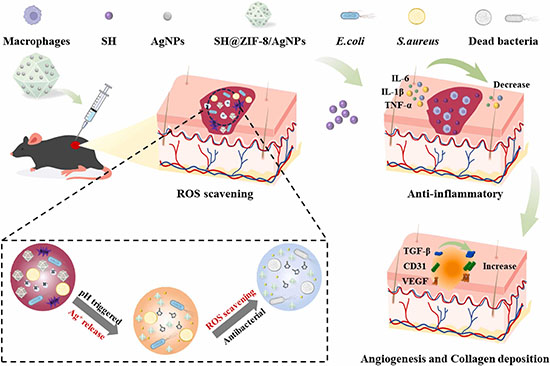 |
| Schematic illustration of the therapeutic mechanism of SH@ZIF-8/AgNPs in infected wounds. In the acidic microenvironment of infected tissue, the nanoplatform gradually degrades and releases silver ions and shikonin. The released agents inhibit bacterial growth, scavenge excessive reactive oxygen species (ROS), reduce inflammation, and promote angiogenesis, collagen deposition, and tissue regeneration. (Image: Reproduced from DOI:10.1016/j.bioana.2026.03.004, CC BY)
|
A Smart Response to Infection's Acidic Signal
|
|
The core of the innovation lies in the platform's pH-responsive behavior. Under normal physiological conditions (pH 7.4), the ZIF-8 metal-organic framework remains intact, safely containing its therapeutic cargo. However, in the acidic environment typical of an infected wound (pH 5.5–6.4), the structure automatically degrades. This disintegration triggers the synchronized, on-demand release of both shikonin and silver ions.
|
|
This targeted release mechanism ensures that the active agents are deployed precisely where they are most needed, minimizing potential damage to healthy surrounding tissue.
Synergistic Attack on Bacteria and Oxidative Stress
|
|
Once released, the agents work in concert to combat the infection on multiple fronts. The silver ions disrupt bacterial cell membranes and interfere with their essential functions, effectively killing a wide range of pathogens. At the same time, the released shikonin (SH) provides a complementary antibacterial effect while also scavenging harmful reactive oxygen species (ROS).
|
|
Excessive ROS at a wound site causes oxidative stress, which damages cells and hinders the natural healing process. By neutralizing these molecules, the platform not only fights the infection but also helps restore a healthy microenvironment conducive to tissue repair.
|
Promising Results in Pre-clinical Models
|
|
Laboratory experiments confirmed the platform's design and function. The material exhibited a high drug loading capacity of 44.2% and demonstrated potent, sustained antibacterial activity against both E. coli and S. aureus, two common wound pathogens. Importantly, the composite showed excellent biocompatibility, with minimal toxicity to healthy fibroblast cells at its effective therapeutic concentration.
|
|
When tested in a mouse model of an infected skin wound, the SH@ZIF-8/AgNPs treatment significantly accelerated healing. Wounds treated with the nanocomposite showed complete re-epithelialization, well-organized collagen deposition, and robust formation of new blood vessels.
|
|
"Our goal was to create a 'smart' nanoplatform that senses the acidic signal of an infection and responds by releasing its therapeutic payload exactly where it's needed," explains corresponding author Zetao Chen. "By combining the antibacterial power of silver with the antioxidant properties of shikonin in a single, pH-responsive system, we can address two major barriers to healing in infected wounds simultaneously. This offers a targeted, on-demand approach for developing more effective wound dressings."
|



