| Jun 22, 2026 |
Interlocking 3D nano-architecture powers solar desalination for freshwater and irrigation
The material's interlocked, porous structure improves salt resistance, water transport, and vapor generation, enabling stable solar desalination outdoors.
(Nanowerk News) The global shortage of freshwater has become a critical challenge. Conventional water treatment relies heavily on fossil fuels and associated infrastructure, which can make it unsuitable for remote and harsh regions. In contrast, solar thermal evaporation is a promising alternative, but its application is limited by material performance and production constraints.
|
|
Now, researchers from the Institute of Process Engineering, Chinese Academy of Sciences, and Shenzhen University have developed a new three-dimensional (3D) photothermal structure that greatly improves solar evaporation efficiency.
|
|
The new structure tightly integrates polymer chains with hollow multishelled structures (HoMS), yielding a record evaporation rate of 38.14 kg m-2 h-1—a figure 8.5 times higher than rates previously reported for two-dimensional membrane systems.
|
|
The study was published in Advanced Materials ("Interlocking Stabilized 3D Photothermal Nano‐Architectures Enables Distributed Solar Desalination").
|
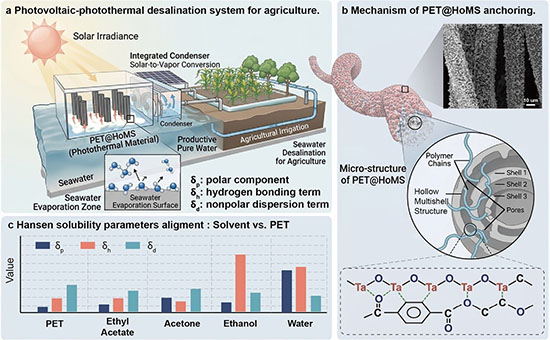 |
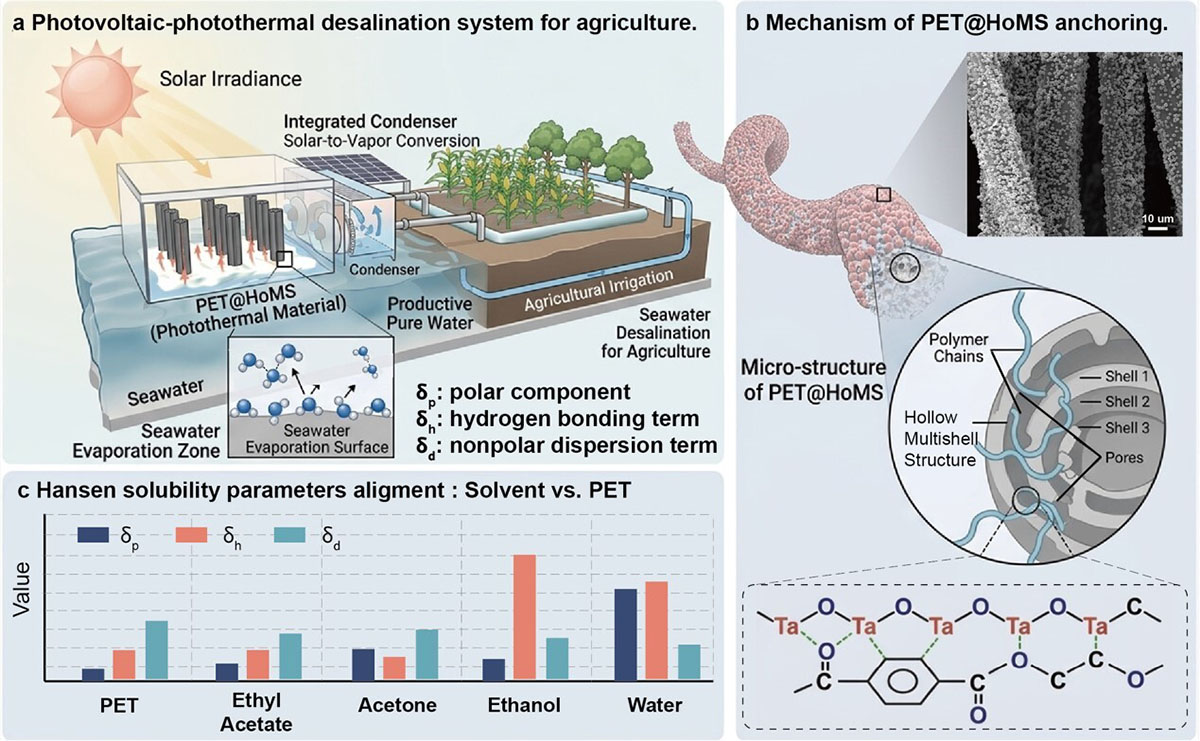
| Schematic illustration of the integrated photovoltaic-photothermal hybrid desalination system for sustainable agriculture. (Image: YU Dan) (click on image to enlarge)
|
|
"The excellent photothermal conversion and water transport capacity deliver such outstanding evaporation performance," said Prof. WANG Dan, corresponding author of the study. He noted that the material's unique "nanoforest" microstructure maximizes sunlight capture, and the nanoconfinement effect decreases evaporation energy consumption by 45.7%.
|
|
The researchers used Hansen solubility parameter theory to tightly combine polyethylene terephthalate (PET) chains with HoMS. Accelerated seawater aging tests found no detectable particle detachment from the material after 30 days of continuous exposure. In addition, no active free radicals were detected when the material was exposed to light, suggesting potentially good durability and reliability during long-term use.
|
|
The researchers further evaluated the technology under real-world conditions using a 0.75 m2 outdoor demonstration device. Operating under natural sunlight, the system produced 20.16 liters of freshwater per day, with water quality meeting World Health Organization drinking water standards. This output is sufficient to satisfy the basic daily drinking needs of about ten people.
|
|
In addition to producing freshwater, the desalinated water was successfully used to irrigate a 5 m2 experimental field. The system supported the full growth cycle of spinach, corn, and Chinese cabbage. These results demonstrate the technology's potential for agricultural irrigation in water-scarce regions.
|
|
The new technology also shows promising economic potential. The researchers estimate that after two years of operation, the cost of water produced by this technology would be lower than that of commercial bottled water. If it proves capable of stable long-term performance, the new material may offer a practical solution for sustainable freshwater production in regions facing water shortages.
|