| Jul 10, 2026 |
New ligand engineering strategy creates more active nanocluster catalysts
Bridging ligands let gold–platinum nanoclusters shed surface coatings at lower temperatures, boosting low-temperature carbon monoxide oxidation.
(Nanowerk News) A joint research group from Tohoku University, Tokyo University of Science, Tokyo Metropolitan University, and the Japan Fine Ceramics Center has successfully developed a thermal catalyst that exhibits high carbon monoxide (CO) oxidation activity under low-temperature conditions.
|
|
The team achieved this by introducing dithiolate (SR'S) bridging ligands into an atomically precise gold-platinum (Au₂₄Pt) alloy nanocluster protected by thiolate (SR) ligands. This new design allows the protective ligands to be removed at relatively low temperatures while preserving the nanocluster's precise structure.
|
|
In conventional alloy nanoclusters (Au₂₄Pt(SR)₁₈), the surface is covered by protective ligands that maintain structural stability but also block the active metal sites needed for catalytic reactions. Although weakening the bond between the ligands and the metal can make these active sites easier to expose, it also makes the nanocluster itself less stable, creating a long-standing trade-off between stability and catalytic activity.
|
|
To overcome this challenge, the researchers designed a new ligand structure that strengthens the nanocluster's outer "staple" framework. They used a relatively weakly bound thiolate ligand (TBBT) together with dithiolate (TDT) bridging ligands, which reinforce the staple structure while allowing the weaker ligands to be removed more easily.
|
|
As a result, the newly developed alloy nanocluster, [Au₂₄Pt(TBBT)₁₂(TDT)₃]⁰, combines excellent structural stability with ligand removal at relatively low temperatures. When supported on cerium oxide (CeO₂) and activated through pretreatment, the catalyst showed significantly higher low-temperature CO oxidation activity than the conventional monothiolate-protected alloy nanocluster [Au₂₄Pt(PET)₁₈]⁰, reducing the temperature required to achieve 50% CO conversion by 39 °C.
|
|
The findings demonstrate that advanced ligand engineering can directly control nanocluster structure while greatly improving the activity of thermal catalysts.
|
|
The research was published in Nano Letters ("Ligand Engineering of Dithiolate-Protected Au24Pt Nanoclusters for Improved Thermocatalytic Activity").
|
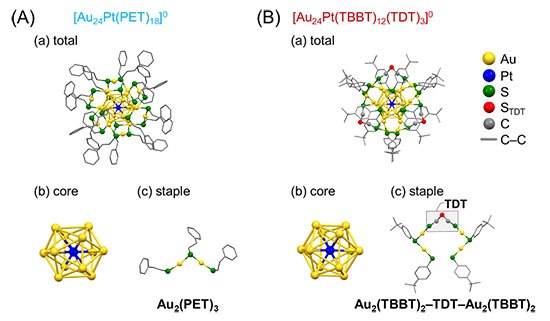 |
| Comparison of (a) total, (b) core and (c) staple geometric structures of (A) [Au₂₄Pt(PET)₁₈]⁰ and (B) [Au₂₄Pt(TBBT)₁₂(TDT)₃]⁰. (Image: Tohoku University)
|
|
Atomically precise metal nanoclusters have attracted considerable attention as catalysts because their geometric and electronic structures can be precisely tailored. However, the protective ligands covering their surfaces, while essential for maintaining structural integrity, also prevent reactant molecules from reaching the active metal sites.
|
|
To expose these active sites, researchers typically use thermal, chemical, or electrochemical pretreatments to remove the ligands. Previous studies have shown that removing the ligands can greatly improve catalytic activity. However, the high temperatures often required can cause the nanoclusters to aggregate and leave sulfur-containing residues on the catalyst support, reducing performance. This has created an urgent need for methods that remove ligands under milder conditions.
|
|
To address this challenge, the research group developed a ligand engineering strategy using a gold-platinum alloy nanocluster (Au₂₄Pt). While conventional Au₂₄Pt(SR)₁₈ nanoclusters rely on strongly bound ligands that limit catalytic activity, simply replacing them with weaker ligands compromises structural stability. Instead, the team reinforced the nanocluster by bridging the weaker thiolate ligands with dithiolate groups. This strengthened the outer staple motifs while lowering the temperature required to remove the weaker ligands and activate the catalyst.
|
|
The researchers synthesized the alloy nanocluster [Au₂₄Pt(TBBT)₁₂(TDT)₃]⁰ through ligand exchange, replacing some of the original PET (2-phenylethanethiolate) ligands with TBBT (4-tert-butylbenzenethiolate) and TDT (thiodithiolate). Structural analysis showed that the new nanocluster retained almost exactly the same metal core as the original [Au₂₄Pt(PET)₁₈]⁰, while the addition of the dithiolate ligands strengthened the surrounding staple structure.
|
|
To understand how the ligands detached during heating, the researchers used direct insertion probe mass spectrometry (DIP-MS). The analysis showed that the conventional nanocluster lost PET ligands through the breaking of either sulfur-carbon or gold-sulfur bonds. In contrast, the new nanocluster selectively released only the monothiolate TBBT ligands by breaking the gold-sulfur bonds, leaving the reinforcing dithiolate framework intact.
|
|
The nanoclusters were then supported on CeO₂ at a loading of just 0.5 wt% and tested as catalysts for CO oxidation. Without pretreatment, CO oxidation began at approximately 236 °C for [Au₂₄Pt(PET)₁₈]⁰/CeO₂ but at a lower temperature of 215 °C for [Au₂₄Pt(TBBT)₁₂(TDT)₃]⁰/CeO₂.
|
|
After oxidative pretreatment at 250 °C for 30 minutes, CO oxidation started at 128 °C for the conventional catalyst and at only 110 °C for the newly designed catalyst. The temperature required to achieve 50% CO conversion also fell from 301 °C to 262 °C - a reduction of 39 °C. These results suggest that subtle differences in how ligands detach from nanoclusters can influence the structure of the supported catalyst and ultimately improve its catalytic performance.
|
|
This study demonstrates that reinforcing the staple motifs with dithiolate groups makes it possible to incorporate weaker gold-sulfur bonds without sacrificing structural stability. As a result, the nanoclusters can be activated more easily while maintaining their precise atomic structure, leading to higher catalytic activity.
|
|
The researchers expect that this ligand engineering strategy will contribute to the development of supported metal nanocluster catalysts with improved activity, selectivity, and durability. Future studies will investigate how different ligand desorption pathways influence the structural evolution of supported nanocluster catalysts during catalytic reactions.
|