| Jul 07, 2026 |
How proximity steals energy from nanoresonatorsResearchers show that placing insolating materials near ultracoherent nanomechanical resonators causes energy loss. The work reveals a previously overlooked design constraint for devices that rely on bringing tiny mechanical structures close to other components.(Nanowerk News) Nanomechanical resonators are miniature vibrating structures on chips that oscillate at frequencies ranging from a few kilohertz to Gigahertz. They are used as ultra-sensitive detectors of mass and force, temperature and pressure, and as components in radiofrequency filters and on-chip clocks. Modern, state-of-the-art resonators are also used to create quantum states of macroscopic objects and test fundamental physics. |
| Many applications require placing the resonators close to other materials to read out the motion or interaction with other phenomena. The high coherence of these devices busts the performance of most applications, but it makes them facing a new challenge: even without physical contact, nearby dielectrics can introduce additional energy loss. This extra damping reduces the quality factor and sets practical limits on how close other structures can be brought without degrading performance. |
| Scientists in the group of Tobias J. Kippenberg at EPFL has now shown that simply bringing these resonators close to insulating materials can reduce their performance. The research is published in Nature Physics ("Non-contact friction in ultracoherent nanomechanical resonators near dielectric materials"). |
| The reason lies in static electric charges that can be trapped in the resonator. As the resonator vibrates, it creates a changing electric field in the space around it. If a nearby material, such as silicon dioxide or silicon nitride, has small electrical losses, that field causes energy to dissipate inside it. The two objects never touch, yet energy leaks away. This effect is related to so-called “noncontact friction”, a phenomenon previously observed in atomic force microscopy. |
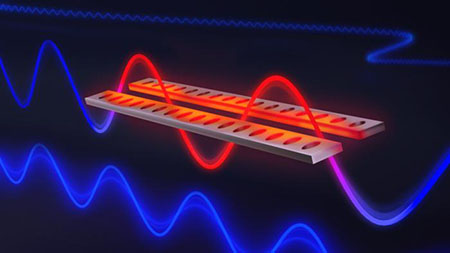 |
| State-of-the-art nano-strings have vanishingly small internal friction and record-low thermal noise. They are now so sensitive that they can feel friction from nearby objects — without ever making contact. (Image: Paresa Arabmoheghi, EPFL) |
| The researchers built a model that predicted a clear signature: lower frequency vibrations should lose more energy. They tested this using silicon nitride strings suspended about 500 nanometers above a dielectric layer and measured how quickly different vibration modes faded. The lowest frequency modes showed extra loss, exactly as predicted. |
| But a surprise came in a second experiment, where the scientists designed strings to have a high Q and placed them between photonic crystal cavities with gaps of a few hundred nanometers. As the gap narrowed, the quality factor dropped, in some cases by up to a factor of ten. The techniques developed by the researchers in this work allowed them to accurately model non-contact friction from the trapped charges in the complex geometry. |
| The findings set new design constraints for ultracoherent nanomechanical systems. Devices that rely on close proximity to other components must account for noncontact friction caused by trapped charges, which can reduce mechanical coherence. |
| At the same time, the same mechanism can serve as a tool, helping probe dielectric losses in thin films or enabling controlled coupling to other electric systems. As these resonators move toward more advanced sensing and quantum technologies, understanding and controlling such hidden sources of loss will be essential. |
| Source: EPFL (Note: Content may be edited for style and length) |