| Jul 06, 2026 |
Full control over 2000 trapped Rydberg atoms
A new laser-optical system uses 2,000 controllable beams to precisely position atoms, enabling key logic processes in a quantum computer.
(Nanowerk News) Fraunhofer ILT in Aachen has developed a highly complex laser-optical system for a quantum computer currently under construction at the 5th Institute of Physics at the University of Stuttgart. This system enables 2,000 Rydberg atoms to be positioned with sub-micrometer precision in the computer’s highly compact vacuum chamber.
|
|
To do this, the system projects an array of 2,000 individually controllable laser beams into the chamber. These beams act as optical tweezers and hold the trapped Rydberg atoms precisely at the distance required for them to interact with each other. The computer’s quantum logic processes are based on these interactions.
|
|
The task was a formidable one: to develop a system capable of controlling 2,000 trapped strontium atoms using optical tweezers and positioning them with an accuracy of less than 100 nanometers (nm) within the vacuum chamber of a Rydberg quantum computer. The vacuum chamber is the computer’s processing unit, where two adjacent atoms are brought into a state through laser excitation in which they interact with one another. These interactions can be controlled and measured. Scientists refer to them as two-qubit logic gates; they are the building blocks of the quantum logic gate in a Rydberg quantum computer.
|
|
Rydberg atoms are particularly well-suited for quantum computing. In their laser-excited state, they are more than one micrometer (µm) in size because, as a result of the excitation, their outermost electron briefly moves to an orbital far from the atomic nucleus, where it nevertheless remains bound.
|
|
However, due to the weak binding of the outer electron, the atoms are highly sensitive to electric fields, which can also originate from neighboring atoms. Scientists are leveraging this property for the highly precise electromagnetic control of quantum operations.
|
Patented qubit approach
|
|
A team at the 5th Institute of Physics at the University of Stuttgart led by Dr. Florian Meinert and Prof. Tilman Pfau is working on a universal quantum computer using Rydberg atoms. For this computer, they are using a patented fine-structure qubit based on the magic wavelength of 592 nm. At this wavelength, both states of the qubit and the Rydberg state are held equally strongly in the optical tweezers, which makes the system particularly robust.
|
|
If one attempts to simultaneously excite a pair of qubits into the Rydberg state using lasers, one of the atoms undergoes an excitation blockade due to the strong interaction between them. This is the basis for the computational operations of the demonstrator that the team is currently building and testing in Stuttgart.
|
|
The task described at the outset serves to scale the computer: The optical system in question is designed to fix the atoms in place with 2,000 laser beams and also to enable the team to rearrange the array formed by 20 x 100 laser foci and the qubits docked to it during ongoing computational processes. To ensure optimal interaction with neighboring atoms in the array, they are spaced exactly 3.5 µm apart.
|
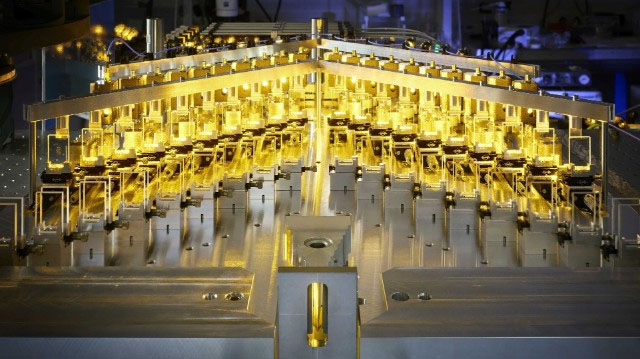 |
| The laser beams are directed onto a segmented mirror with increasingly smaller steps. The final steps measure only a few hundred µm. In this cascade, the spacing between the 2,000 spots is reduced to less than 200 µm. Even that is not enough: a further 50-fold reduction is required. (Image: Fraunhofer ILT, Aachen, Germany / Ralf Baumgarten)
|
Highly complex laser-optical system design
|
|
To achieve efficient error correction in the quantum gate, each of the 2,000 laser beams must be individually controllable. However, this must not come at the expense of precision: The distances between the laser focal points are precisely defined to within < 100 nm to ensure fast, reliably switchable interactions between the excited atoms.
|
|
The Fraunhofer Institute for Laser Technology ILT in Aachen took on the challenge posed by the Stuttgart research team and developed and designed the corresponding laser-optical system based on comprehensive simulations. Assembly was followed by comprehensive testing prior to delivery. No further readjustment was required during commissioning.
|
|
In the overall design of the quantum computer, only one square meter was allocated for the optical system, which comprises over 150 optical components. The Aachen team was also able to meet this requirement and has since successfully commissioned the compact system on-site.
|
|
In fact, they successfully developed the array of 20 rows, each with 100 individually controllable laser foci, at the required spacing of 3.5 µm between them. To achieve this, the setup—comprising cascading beam splitters, acousto-optic deflectors, lenses, and mirrors—gradually splits four initially incoming laser beams into the required 2,000 individually controllable beams. This creates an intermediate image of the array, which is directed via mirrors into a relay unit. The unit projects the intermediate image into the vacuum chamber with 50× demagnification, where the 2,000 foci serve as optical tweezers.
|
|
For some background, focused light exerts an attractive force on atoms. When the focus is moved, they move with it. U.S. researchers Arthur Ashkin and Steven Chu were awarded the Nobel Prize in Physics for their contributions to the invention of optical tweezers.
|
The initial four laser beams are split into 2,000
|
|
“One challenge was to split the four incoming, collimated laser beams—with a total power of 20 W—into 2,000 individually controllable beams of equal power,” reports Dr. Martin Traub, group leader of Optical Design and Diode Lasers at Fraunhofer ILT.
|
|
To achieve this, each beam first passes through so-called beam-splitter cubes. In the first step, these divert 20 percent of the light at a 90° angle and allow the remaining 80 percent to pass through to another cube, where the beam is split again. The process is repeated five times for each laser beam, resulting in 20 parallel beams of equal power. These then pass through acousto-optic deflectors (AODs), where they are split and deflected by diffraction in an acoustically excited crystal. “The sound waves cause a periodic modulation of the refractive index in the crystal,” he explains.
|
|
This creates a controllable optical grating in which the deflection angle of the outgoing laser beams can be varied via the sound frequency and the power distribution via the amplitude. With 100 different frequencies, 100 different deflection angles result; each of the 20 incoming laser beams is split by the AODs into 100 sub-beams, which can also be controlled individually.
|
A custom-made, extremely precise step mirror
|
|
The transition from the 100 sub-beams to individually controllable laser foci involves a series of additional optical elements. First, a Fourier lens converts the beams into a telecentric point pattern. However, due to the size of the beam splitter cubes and AODs, this pattern would be far too large to position individual atoms in the required 3.5-µm spacing within the vacuum chamber.
|
|
Further optical ingenuity is required: The 2,000 laser beams are directed onto a segmented mirror with cascading steps that become progressively smaller and ultimately consist of mirror surfaces only a few hundred micrometers in size. In this cascade, the distance between the spots is reduced to less than 200 µm. But even that is not enough; a further 50-fold reduction is necessary.
|
|
“We achieved this by directing the intermediate image via a periscope mirror onto a second plane, where a two-stage telecentric relay unit reduces it and projects it into the vacuum chamber,” explains Traub.
|
|
To achieve the single-digit µm spacing required in the array, the team incorporated its extensive expertise into the system design, the fabrication of the optical components, as well as their assembly and alignment. A hexapod system with six actuators was used to align the mirrors with the necessary precision. This system can freely adjust the mirrors in three spatial directions and angles, a meticulous approach needed because even minimal deviations in the alignment of the optical components would result in incorrect spacing within the array. That would directly compromise computational performance, as misaligned qubits can no longer fulfill their logical function. Yet this is precisely what matters: With every logical qubit, the potential performance of quantum computers grows exponentially.
|
Fraunhofer ILT’s many years of expertise contribute significantly to the solution
|
|
“We were only able to design and successfully implement the system thanks to the extensive expertise that Fraunhofer ILT has built up over its 40-year history,” reports Traub.
|
|
This demonstrates just how central lasers and optics are as building blocks and enablers for the future field of quantum technology.
|
|
“This also applies to our nearly noise-free quantum frequency converters, a network node for the quantum internet of the future recently commissioned in Aachen, and an ion trap chip for a quantum processor manufactured from quartz glass using the SLE (selective laser-induced etching) process, which our institute has already developed,” adds Dr. Bernd Jungbluth, head of the Strategic Mission Quantum Technology at Fraunhofer ILT.
|
|
Like Rydberg atoms, ions have the advantage that they inherently exhibit no manufacturing variations or long coherence times, which is drawing increasing attention to ion trap and Rydberg quantum computers within the quantum tech community. Lasers and optical technologies form the foundation for both approaches.
|