| Jun 29, 2026 |
Identifying proteins, molecule by molecule
A nanopore detection method can rapidly identify individual proteins, aiding disease research, drug development, and biomarker discovery.
(Nanowerk News) Proteins are responsible for most functions in the human body. However, their analysis, which is essential for understanding diseases, developing drugs, and discovering new biomarkers, remains highly complex. Using a technology called “nanopore detection”, a team at the University of Geneva (UNIGE) has developed a rapid and efficient method for identifying proteins, molecule by molecule.
|
|
These findings, published in the Journal of the American Chemical Society ("Single-Molecule Fingerprinting of Unlabeled Full-Length Proteins Using an Aerolysin Nanopore"), pave the way for faster diagnostics.
|
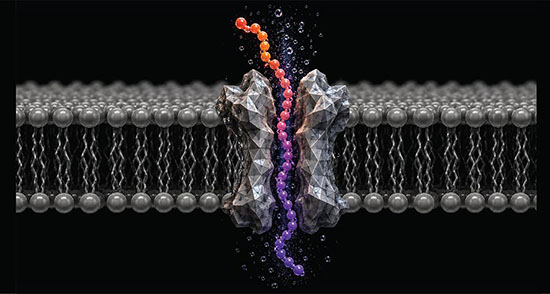 |
| Artist’s impression of a protein molecule captured as it passes through a nanopore. (Image: NanoSphere)
|
|
Nanopore detection works in a surprisingly simple way. It uses a tiny hole, just a few nanometers wide, embedded in a membrane. When an object passes through this pore, it briefly disrupts an electrical current flowing through it. Each object generates a characteristic but complex change in the electric current, a kind of “molecular fingerprint.”
|
|
By analysing these signals, researchers can eventually distinguish between different objects, even ones that are very similar. The group of Chan Cao, assistant professor in the Department of analytic and inorganic chemistry, School of chemistry and biochemistry, UNIGE Faculty of science, has shown that this biotechnology can be relevant in many fields, from faster diagnostics to personalized medicine, and data storage, where digital information can be encoded in a long synthetic molecule and then read out simply by passing it through a nanopore.
|
|
“Nanopore technology is a single-molecule detection technique and thus well suited for detecting molecules at very low concentrations. To use this technology with proteins, a key challenge was to find a way to reliably drive the protein through the nanopore. By nature, proteins carry complex electric charges and thus cannot be consistently controlled using electrophoretic forces alone, that is, the forces exerted by an electric field on charged molecules,” explain Chan Cao, who led this study. To address this challenge, the research team exploited a phenomenon called “electro-osmotic flow,” a liquid flow inside the nanopore that drives proteins through it, regardless of their charge.
|
Combining nanopore technology and artificial intelligence
|
|
In this method, when a protein passes through the nanopore, it briefly disrupts the electrical current flowing through it and is detected in a way similar to a fingerprint. It is important to ensure that similar but distinct proteins are not confused. When proteins are highly similar, the electrical signals they generate over time can be difficult to distinguish reliably.
|
|
To interpret the electrical signals produced by the nanopore, the researchers used artificial intelligence. Each time a protein passes through the tiny pore, it generates a complex signal, like a unique but noisy waveform. The researchers broke this signal down into many measurable characteristics (such as how long it lasts or how the current changes over time) and fed them into an algorithm that learns to associate patterns of these features with specific proteins.
|
|
By training on known samples, the system can then recognize unknown proteins based on their “fingerprint,” even when the differences are subtle. This development is a major step forward in protein analysis and may enable single-molecule detection and label-free protein identification.
|
|
“We are currently working on establishing a rational link between the measured electrical current and the protein sequence. This might make it possible not only to recognize proteins we have already measured, but also to directly analyze new, unknown protein samples,” concludes Verena Rukes, PhD student and first author of the study.
|