| Jun 29, 2026 |
Roll-to-roll lithography boosts flexible electronics production
A roll-to-roll digital lithography system compensates for substrate distortion in real time, enabling faster mass production of flexible electronics.
(Nanowerk News) A digital lithography system capable of continuously patterning flexible substrates has been developed. The system integrates maskless digital lithography with Roll-to-Roll (R2R) manufacturing, allowing patterns to be generated without conventional photomasks.
|
|
By compensating for substrate deformation in real time and enabling continuous processing without the fixed-stage constraints of conventional systems, the technology is expected to pave the way for the mass production of next-generation flexible electronic devices.
|
|
A research team led by Dr. Won Seok Chang, Director of the Nano-convergence Manufacturing Research Division at the Korea Institute of Machinery and Materials (KIMM), developed a digital lithography scanner that adjusts exposure patterns in real time and integrated it into an R2R manufacturing system for the continuous patterning of flexible substrates.
|
|
The system combines Digital Micromirror Device (DMD)-based exposure technology with ultra-precision motion control, enabling real-time compensation for substrate deformation and positional errors.
|
|
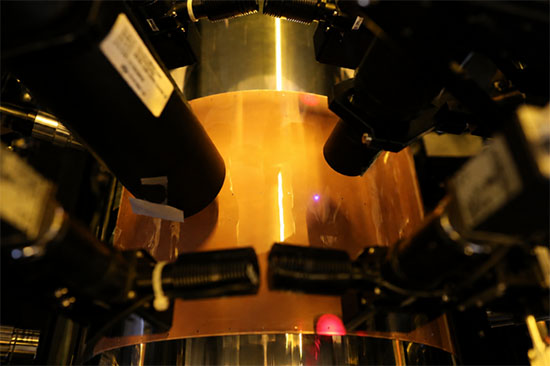
The R2R digital lithography system developed by KIMM uses DMD-based digital exposure technology to selectively project ultraviolet (UV) light onto designated areas of a substrate. To support continuous R2R operation, the research team developed a dedicated exposure module and an ultra-precision web-transport control system, achieving line widths below 10μm. During continuous web transport, the system uses vision-based measurements to adjust the projected pattern in real time, compensating for web-position errors and substrate deformation.
|
 |
| The Roll-to-Roll continuous manufacturing system equipped with a patterning roller, winders, and feeders. (Image: KIMM)
|
|
Conventional digital lithography systems generally rely on scan-stage platforms, which constrain the patternable area to the dimensions of the stage. Flexible substrates also often need to be temporarily attached to a carrier substrate during processing and detached afterward, which can reduce productivity and increase the risk of defects.
|
|
By contrast, the newly developed system uses line-beam exposure to pattern flexible substrates continuously as they pass over a rotating roller. Using vision-based measurements, the system compensates in real time for substrate deformation and positional errors, enabling ultra-precise pattern formation on a moving web.
|
|
The technology eliminates the need for conventional photomasks, allowing patterns to be generated and modified through software control. This improves production efficiency by reducing mask-fabrication time and cost. Because flexible substrates can be continuously transported and patterned without being attached to a carrier substrate, the system supports continuous, large-area manufacturing over long substrate lengths.
|
|
The technology is expected to improve productivity in the manufacture of next-generation flexible electronics and establish a new manufacturing paradigm for related industries.
|
|
This achievement adapts lithography technologies used in semiconductor manufacturing to an R2R process through maskless digital exposure, demonstrating the system’s potential as a next-generation production platform for flexible electronic devices. In recognition of its high-resolution patterning capability and real-time compensation for substrate deformation, the technology was named a finalist for the “Technology of the Year” award at the 2026 R2R USA Conference & Expo.
|
|
Dr. Won Seok Chang, Director of the Nano-convergence Manufacturing Research Division at KIMM emphasized, “The R2R digital lithography system is a key platform technology for the mass production of flexible electronic devices. We expect it to be used in a wide range of applications, including flexible printed circuit boards, high-resolution flexible electronics, and semiconductor packaging.” He added, “The technology can also be applied to digital exposure processes for patterning roll surfaces, further broadening its industrial applications.”
|
|
The technology was developed through KIMM’s institutional research project, ‘Development of Core Technologies for Real-Time Compensation-Based Roll-to-Roll Patterning Equipment.’ The research team has published 25 papers in SCIE-indexed journals, including recently in the International Journal of Optomechatronics ("DMD-based adaptive lithography system for real-time substrate deformation compensation"). The team has also filed nine international patent applications and 12 domestic patent applications. To date, one patent arising from the international filings and 12 domestic patents have been granted.
|