| Jun 25, 2026 |
Imaging for the first time how molecules rearranged during a chemical reaction controlled by light
For the first time, researchers imaged a molecule undergoing a coherently controlled chemical reaction - a reaction steered with pulses of laser light.
(Nanowerk News) Since the 1980s, researchers have sought to use laser light to control chemical reactions relevant to photochemistry, catalysis and light-responsive materials. But this technique, known as coherent control, has a blind spot: There hasn’t been a way to directly see the molecules in these reactions as their structures rearrange.
|
|
Now, researchers at the Department of Energy’s SLAC National Accelerator Laboratory have imaged a coherently controlled chemical reaction for the first time. Their work, published in Physical Review A ("Ultrafast x-ray imaging of coherently controlled molecular dynamics in real space and time"), uses ultrafast X-rays from the Linac Coherent Light Source (LCLS) to show in real time how atoms move in a molecule that was excited and manipulated with laser light.
|
|
“There are many challenges with controlling chemical reactions, but seeing is believing,” said study lead author Tom Hopper, assistant professor at the University of Central Florida who was a postdoc at SLAC at the time of the study. “If you can see something directly, it opens up a new level of control.”
|
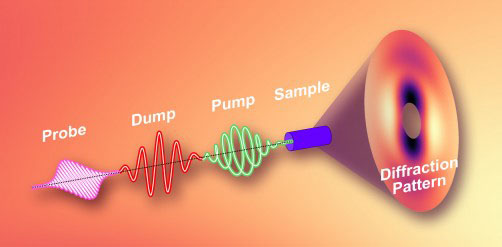 |
| This illustration shows a pump–dump–probe sequence of ultrafast laser and X-ray pulses used to control and image a chemical reaction. The pump laser pulse excites molecules within a sample and initiates a chemical reaction. It is followed by a second laser pulse, the dump pulse, that nudges the reaction down a certain pathway. Finally, an X-ray probe pulse traverses the sample at varying stages of the chemical reaction. The scattered X-rays create diffraction patterns on a detector (at right). The changing patterns contain information about the molecular structure and how it evolves during the reaction. (Image: Greg Stewart, SLAC National Accelerator Laboratory)
|
Illuminating a blind spot
|
|
What makes coherent control so tricky is that the molecule being manipulated with laser light will eventually deviate from the desired pathway. If researchers can see the molecule’s structural evolution in real time, they can start to put together a picture of when and how this happens, which may help them figure out how to prevent it.
|
|
One of the simplest and most successful methods of coherent control is the “pump-dump scheme.” This involves hitting a molecule with two laser pulses: A “pump” pulse first excites the molecule, initiating the reaction, followed by a “dump” pulse that nudges the reaction down a certain pathway.
|
|
Traditionally, researchers have used spectroscopy to indirectly infer structural information about the molecule during the reaction. In the new study, the research team used a third pulse of ultrafast X-rays, which allowed them to probe the structural information directly.
|
|
While X-rays are routinely used to watch chemical processes unfold, those experiments typically use only two pulses – a laser pump pulse and an X-ray probe pulse. In the new study, the research team had to carefully coordinate three pulses – the pump, dump and probe pulses. The team then used a new analysis method developed by Natan to transform the X-ray data into information about the molecular structure and how it changes as the reaction progresses.
|
|
“Spectroscopy is like a flashlight that only illuminates part of the reaction,” said SLAC’s Adi Natan, staff scientist in the Stanford PULSE Institute and principal investigator of this work. “With X-ray scattering, you can see everything. It allows you to have a better understanding of what happens and what the limits of our methods are. We can uncover that blind spot.”
|
A benchmark for a new tool
|
|
To test their method, the team studied iodine vapor, which consists of molecules in which two iodine atoms are bonded together. After exciting a molecule with the first pump pulse, they adjusted the timing of the second dump pulse to either bring the molecule’s energy level back down or further excite it, causing the bond to break and the iodine atoms to fly apart.
|
|
Diatomic iodine is a simple but heavy molecule with a lot of electrons, so it scatters X-rays very strongly, making it easier to demonstrate this method. But the approach can be applied to coherently controlled reactions of more complex molecules and will be especially useful when combined with the high-energy upgrade to LCLS currently in progress.
|
|
Hopper’s group also plans to study coherent control in materials instead of isolated molecules.
|
|
“I'm sure that work will be done in conjunction with SLAC,” Hopper said. “They have the best X-ray source in the world and the expertise to interpret the data as it's coming out of the experiment.”
|



