| Jun 22, 2026 |
Interface layer drives quantum dot tandem solar cells to record efficiency
Researchers used an ultrathin chlorinated polymer layer to cut charge losses and set efficiency records for all-PbS quantum dot tandem solar cells.
(Nanowerk News) Researchers in China report record efficiencies for quantum dot tandem solar cells after inserting an ultrathin polymer layer between the device's stacked components. The team, led by Professors Haisheng Song and Jiang Tang at Huazhong University of Science and Technology (HUST), used the layer to suppress charge losses at a critical interface and improve how efficiently the cells convert sunlight into electricity.
|
Key Findings
- A chlorinated conjugated polymer called D18-Cl, added as an ultrathin interfacial layer, passivated defects and improved charge extraction in lead sulfide quantum dot solar cells.
- The all-PbS quantum dot tandem device reached a power-conversion efficiency of 13.148 percent, while the semi-transparent top cell reached 10.36 percent.
- The devices recorded a fill factor above 73 percent and remained stable during operational testing.
|
|
Tandem solar cells split incoming sunlight into separate energy streams, with each sub-cell built to capture a different part of the spectrum. The top cell acts as a high-energy filter that mainly absorbs short-wavelength photons. The bottom cell, with a lower bandgap, captures the longer-wavelength light that passes through the upper layer.
|
|
Lead sulfide quantum dots (PbS QDs) are attractive absorbers because their bandgap can be tuned simply by changing particle size, and they can be processed from solution at low cost.
|
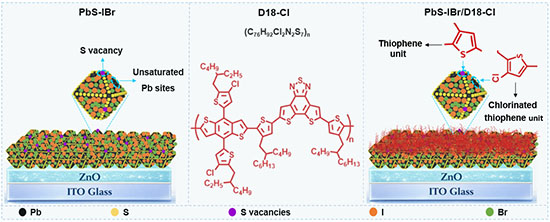 |
| Schematic illustration of the fabrication process showing the sequential deposition of the WBG PbS QDs absorber layer, followed by surface modification treatment using the D18-Cl. (Image: Reproduced from DOI:10.2738/foe.2026.0024, CC BY)
|
|
In this all-PbS tandem both sub-cells use these dots, a wide-bandgap top cell paired with a low-bandgap bottom cell. The drawback is that defects at the interfaces between layers trap charge carriers, creating recombination sites that interfere with charge extraction and hold back performance.
|
|
To counter this, the HUST team added an ultrathin chlorinated conjugated polymer, named D18-Cl, at the interface between the stacked layers. The layer shields the quantum dot surface from damage during the processing steps that follow, protecting a part of the device that is otherwise easily disturbed.
|
|
The layer also repairs the interface chemically. It coordinates with undercoordinated lead atoms and heals sulfur vacancies, closing off the microscopic pathways where charge carriers would otherwise recombine and be lost. At the same time, it reshapes the energy landscape at the interface so that charge carriers move across it more easily.
|
|
The combined effect was a sharp drop in non-radiative recombination and a clear gain in charge extraction. The semi-transparent wide-bandgap (WBG) top cell reached a power-conversion efficiency of 10.36 percent, while the full all-PbS quantum dot tandem cell reached 13.148 percent, both reported as records. Fill factor, a measure of how completely the cell delivers its available power, exceeded 73 percent.
|
|
The devices also remained stable through operational testing. The study appeared in Frontiers of Optoelectronics ("Chlorinated conjugated copolymer interface modification enables record-efficiency of all-PbS quantum dot tandem solar cells").
|
|
Interface engineering of this kind targets one of the main limits on solution-processed quantum dot photovoltaics. By treating the boundary between layers as something to be actively managed rather than tolerated, the work shows how performance that defects would otherwise erode can be recovered.
|