| Jul 11, 2026 |
Machine learning frees freshwater toxin sensors from repeated calibration
Machine learning boosts nanostructured biosensors to detect toxic algal compounds accurately across diverse freshwater conditions without repeated calibration, enabling reliable field testing.
(Nanowerk News) A machine learning model adjusts toxin readings for water-quality variability, enabling faster, lower-cost on-site testing without repeated recalibration.
|
|
Detecting microcystin-leucine-arginine (MC-LR) in freshwater is increasingly important as harmful algal blooms intensify, but biosensor readings are affected by changing water conditions. Researchers at Hanbat National University and the University of Central Florida developed a machine learning-based calibration framework for biosensors using water quality data. The model accurately predicted MC-LR levels while reducing the need for repeated recalibration, enabling more reliable on-site monitoring.
|
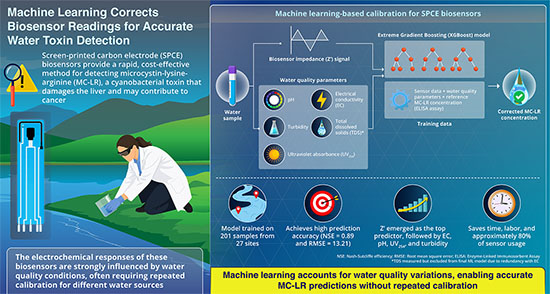 |
| The system integrates SPCE biosensors with machine learning to improve calibration across varying water conditions, enabling reliable on-site toxin detection without repeated recalibration. (Image courtesy of the authors) (click on image to enlarge)
|
|
Portable screen-printed carbon electrode (SPCE) biosensors offer a rapid and low-cost way to detect microcystin-lysine-arginine (MC-LR), an extremely potent toxin produced by cyanobacteria during harmful algal blooms in freshwater. Even at low concentrations, MC-LR can damage the liver and has been linked to an increased risk of liver and colon cancer and the World Health Organization has set a guideline value of 1 microgram per liter for MC-LR in drinking water.
|
|
SPCE sensors work by measuring changes in an electrochemical signal that reflects the toxin's concentration. However, the accuracy of these sensors is strongly affected by the water being tested. Factors such as pH, turbidity, electrical conductivity, and other water quality parameters can interfere with the sensor's readings, often requiring recalibration for each water sample.
|
|
Researchers from Hanbat National University, South Korea, and the University of Central Florida, USA, have developed a machine learning framework that accounts for water quality differences, enabling accurate MC-LR measurements without repeated sample-specific calibration. The study was led by Professor Jungsu Park from Hanbat National University and Professor Woo Hyoung Lee from the University of Central Florida.
|
|
This paper was published in Water Research ("Calibration-free on-site detection of microcystin-LR using integrated biosensing, multi-parameter water quality monitoring, and machine learning").
|
|
"This work provides a robust data-driven framework for characterizing biosensor-water matrix interactions and offers a practical approach to improving the speed and accuracy of on-site MC-LR detection in complex environmental waters," says Prof. Park.
|
|
To build and train the model, the team collected 201 measurements from 27 field sites across Florida, including freshwater, estuarine, and transitional environments, representing a wide range of water conditions. For each water sample, they measured pH, turbidity, electrical conductivity, total dissolved solids, ultraviolet absorbance at 254 nanometers (UV254), and the biosensor's electrochemical impedance (Z’), which changes in response to MC-LR. These measurements served as the input variables, while the model was trained to predict the actual concentration of MC-LR.
|
|
Among the various machine learning models evaluated, Extreme Gradient Boosting (XGBoost) performed the best, achieving a Nash-Sutcliffe efficiency of 0.89 and a root mean square error of 13.21. This level of performance demonstrated that a single unified model could accurately predict MC-LR concentrations across different water samples without requiring separate calibration models for each condition.
|
|
To identify which input variables had the greatest influence on the model's predictions, the researchers used an explainable artificial intelligence method called Shapley Additive Explanations (SHAP). They found that the biosensor's electrical impedance was the strongest predictor of toxin levels, followed by electrical conductivity, pH, ultraviolet absorbance, and turbidity, showing that incorporating water quality parameters improves the accuracy of biosensor predictions.
|
|
"This framework eliminates the need for repeated sample-specific calibration, reducing time, labor, and sensor consumption. Compared to conventional workflows, it can reduce sensor usage and thereby lowering cost and environmental burden while improving analytical efficiency," says Prof. Park.
|
|
As harmful algal blooms become more frequent with climate change, this data-driven approach could make toxin monitoring faster, more accurate, and easier to deploy in drinking and recreational water testing.
|