| Jul 07, 2026 |
Watching molecules change shape in slow motion
A slow-switching molecular cage reveals how chemical signals trigger gradual structural changes, offering design clues for molecular machines and smart materials.
(Nanowerk News) Researchers at the Nano Life Science Institute (WPI-NanoLSI) at Kanazawa University, Institute for Molecular Science and SOKENDAI have uncovered the hidden mechanism behind a molecular switch—a molecule that can change between different structural states in response to a chemical signal.
|
|
Their study, published in the Journal of the American Chemical Society ("Interplay between Slow Chirality Inversion and Slow Guest Uptake in a Triple-Helical Closed-Cage Metallocryptand"), reveals how molecules can gradually switch between alternative states, a process that could help scientists design future molecular machines, smart materials, and molecular information technologies.
|
|
To make the discovery, Shigehisa Akine and colleagues created a specially designed molecular cage that changes shape unusually slowly. This allowed them to observe, for the first time, the sequence of molecular events that occurs after the molecule receives a chemical input. The study provides one of the clearest views yet of how molecular recognition triggers structural change and demonstrates that the response speed of a molecular system can itself be engineered through molecular design.
|
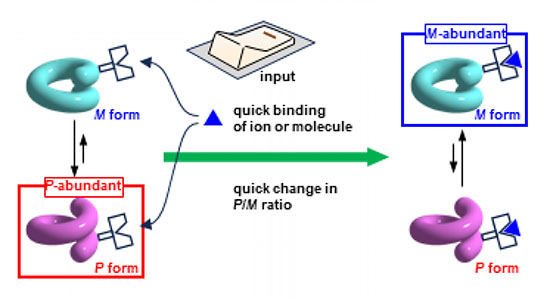 |
| Typical guest-induced inversion between the right-handed (P) and left-handed (M) forms. Guest molecules or ions bind rapidly, making the chirality inversion appear instantaneously. As a result, the intermediate processes have been difficult to observe and remain poorly understood. (Image: Kanazawa University)
|
Building smarter molecular systems
|
|
Responsive molecular materials are attracting increasing attention for their potential to sense, process, and respond to changes in their environment. Such systems are considered important building blocks for future molecular machines, molecular information technologies, and other next-generation nanoscale devices.
|
|
A key challenge in designing these systems is understanding exactly how molecular switching occurs. Many molecules can exist in multiple stable states and change between them when exposed to external stimuli such as light, heat, or chemical signals. However, the triggering event is often so rapid that only the initial and final states can be observed, leaving the molecular pathway connecting them hidden from view.
|
|
To overcome this challenge, the Kanazawa University team designed a molecular cage in which both guest uptake and structural rearrangement occur unusually slowly, allowing the entire switching process to be followed in real time.
|
A molecular cage that changes its handedness
|
|
The researchers synthesized a triple-helical cobalt metallocryptand—a cage-shaped molecule formed from three intertwined molecular strands surrounding an internal cavity.
|
|
The molecule exists in two mirror-image forms, known as right-handed (P) and left-handed (M) structures. In solution, these forms slowly interconvert, with the right-handed form normally being the more abundant.
|
|
The molecular cage was specifically designed with flexible bridging ligands that partially seal its entrances. This closed-cage architecture dramatically slows the movement of guest ions into and out of the cavity, transforming a normally rapid process into one that unfolds over several hours.
|
Watching molecular switching in real time
|
|
When cesium ions were added to the solution, the researchers observed a remarkable transformation. Over time, the molecular population gradually shifted from predominantly right-handed forms to predominantly left-handed forms. Because the switching process occurred slowly, the researchers were able to monitor the intermediate stages using nuclear magnetic resonance (NMR) and circular dichroism (CD) spectroscopy. X-ray crystallography and theoretical calculations were used to characterize the initial and final molecular states.
|
|
Together, these complementary approaches allowed the team to follow the switching process in real time, capture structural snapshots of the molecular cage, and explain why the guest ion preferentially stabilized one molecular state over another.
|
A surprising mechanism
|
|
Chemists have long debated how guest-induced structural changes occur. In one model, known as the induced-fit model, a guest molecule first binds to a host structure, triggering a conformational change. In the alternative conformational selection model, multiple structural states already exist, and the guest selectively binds to the state it prefers.
|
|
The Kanazawa University team was able to resolve this question directly. Rather than binding to the dominant right-handed form and then triggering a structural change, cesium ions were found to preferentially bind to the less abundant left-handed form already present in solution. The results demonstrate that the switching process proceeds primarily through a conformational-selection mechanism rather than a classical induced-fit pathway.
|
The hidden pathway behind the switch
|
|
Once the cesium ion is trapped inside the molecular cage, the left-handed form becomes significantly more stable. This progressively shifts the molecular population toward the new state, ultimately reversing the balance between right-handed and left-handed structures. The overall switching process, therefore, emerges from a subtle interplay between guest recognition, structural dynamics, and molecular equilibrium.
|
Opposite signals, opposite responses
|
|
While cesium ions drive the system toward the left-handed state, chloride ions favor the right-handed form by interacting with binding sites on the exterior of the molecular cage. This ability to generate distinct responses to distinct chemical signals highlights the potential of such systems as intelligent, responsive materials capable of processing environmental information.
|
Toward smart molecular architectures
|
|
“Most molecular switches operate too quickly for us to see how they actually work,” says Professor Shigehisa Akine. “By designing a system in which guest uptake and structural switching occur on similar time scales, we were able to uncover the hidden pathway that connects them. We believe these principles will be valuable for the rational design of future smart molecular architectures, including responsive materials, molecular machines, and systems capable of storing and processing molecular information.”
|
|
Beyond revealing a previously hidden switching pathway, the study demonstrates that the response speed of a molecular system can itself be engineered through molecular design—a capability that may prove important in the development of future smart molecular architectures.
|