| Jul 03, 2026 |
Microscopy at the space-time limit
Ultrafast scanning tunneling microscopy reaches the quantum mechanical space-time limit for the first time.
(Nanowerk News) Werner Heisenberg’s famous uncertainty principle describes one of the most intriguing features of quantum physics: certain pairs of physical quantities describing a particle, such as position and momentum, cannot simultaneously be determined with arbitrary precision—not because of imprecise measuring instruments, but because nature forbids it. Between position and time, however, there is no Heisenberg uncertainty principle.
|
|
A research team comprising several groups at RUN led by Profs. Jascha Repp, Rupert Huber, Franz Giessibl, and Klaus Richter, as well as a team from the Max Planck Institute in Hamburg led by Angel Rubio, has now observed for the first time that the location and time evolution of an electron cannot be measured with arbitrary precision simultaneously. This so-called space-time limit has important implications for future applications.
|
|
The findings have been published in Nature Photonics ("racking electrons at the space-time-limit").
|
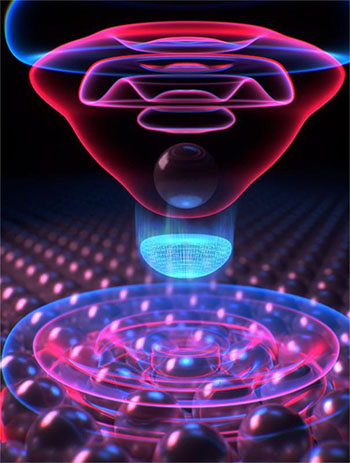 |
| Artist’s rendering of an extremely short electron wave packet (blue) at the boundary between space and time. The electron flash, which lasts only attoseconds, is generated between the tip of a special microscope and a material sample. It is triggered by precisely controlled infrared light pulses (not shown). A cloud of electrons surrounds the system, made visible by computer simulations. (Image: Brad Baxley)
|
|
Many future technologies, from green tech and quantum technologies to high-performance electronics for artificial intelligence, require a precise understanding of how matter functions at the microscopic level: how chemical reactions occur, how light interacts with matter, and how electrons move through electronic components. High-resolution still images of the microscopic building blocks of matter are not sufficient for this; rather, time-resolved slow-motion movies from the nanocosmos are needed.
|
|
At the Regensburg Center for Ultrafast Nanoscopy (RUN), ultrafast microscopes are developed and used to directly capture the motion of electrons, atoms, and molecules in microscopic slow-motion movies with the highest possible spatial and temporal resolution. Ten years ago in Regensburg, the motion of a single molecule in space and time was resolved for the first time using ultrafast scanning tunneling microscopy.
|
|
Compared to atoms and molecules, on this length scale electrons move a thousand times faster—namely, on time scales of attoseconds. The orders of magnitude are extreme: An atom is about ten million times smaller than a millimeter, and an attosecond is one-billionth of a billionth of a second. Thus, an attosecond relates to a second as a second relates to the age of the universe. What is particularly fascinating is that electron motion does not obey the laws of classical mechanics, but rather the strange rules of quantum physics.
|
|
To achieve a corresponding increase in temporal resolution compared to previous experiments and to directly image and control the quantum dynamics of individual electrons, the researchers developed a new laser system. Using its laser pulses they control electron motion on these extreme time scales in such a way that the electrons transfer from an atomically sharp metal tip to a silver surface over a distance of only a few atomic diameters. These electron movements are measured as current, and the temporal information is obtained by using two pulses of light.
|
|
Simon Maier, the lead author of the paper, explains: “By varying the time interval between the two laser pulses, we can directly observe how the electrons respond.”
|
|
The electron motion observed in this way exhibits signatures on attosecond timescales—which means that the light pulses can transfer electrons on these timescales, and one can watch them do so. What makes this special is that the electrons do not move like classical particles. Rather, as quantum mechanical waves, the electrons penetrate the energy barrier between the tip and the sample, for which they actually do not possess enough energy according to the laws of classical physics. They “tunnel” through it, as if they were passing through a massive wall without destroying it.
|
|
“Our measurement can be understood as a high-speed camera for the electron wave packets, since you can see at what point in time the tunneling process takes place,” explains Katharina Glöckl, a doctoral student and co-author of the publication.
|
|
To gain a better understanding of microscopic electron dynamics at the “space-time limit,” Prof. Angel Rubio’s group conducted complex quantum simulations. The calculations explain the experimental results with remarkable accuracy. They also show that the electron does not follow the light field immediately, but with a tiny delay of 500 attoseconds.
|
|
In this frontier region of the smallest spatial and temporal scales, the fundamental physical limits of quantum physics become apparent on multiple levels. The effect of the laser pulses, for example, cannot be clearly assigned to either the wave or photon picture of light, but bears features of both—and this is precisely what enabled the researchers to penetrate so deeply into the “space-time limit.” When electrons are moved by light pulses on such short time scales, this has complex consequences for the spatial distribution of the electrons, which are described in quantum mechanics as wave packets.
|
|
Raffael Spachtholz, also a co-author of the paper, explains: “The more precisely we want to pin down the electron’s position in time, the more energy we need to provide. And as a result, the electron wave packet spreads out more spatially.” The team investigated this relationship using a single atom placed on the surface to confine the electron wave packets atomically just before the light pulses arrive. This allowed them to directly determine the relationship between the spatial and temporal spread of the electron wave packets. Fortunately, despite strong excitation, the electron wave packets remain spatially defined with sufficient sharpness to enable atomically resolved microscopy on attosecond timescales.
|
|
With this latest breakthrough, the team is pushing the boundaries of a previously only vaguely suspected spatiotemporal limit of quantum mechanical electron wave functions, in order to systematically investigate for the first time how the temporal dynamics of electrons shape the spatial structure of their wave function.
|
|
This also opens up entirely new possibilities for applications. For example, transferring an electron to a molecule corresponds to the smallest possible charge transfer; however, if the electron is confined to a tiny space-time volume, this corresponds to extremely high local peak current densities of up to 1 trillion amperes per square centimeter.
|
|
“In the future, we want to use such wave packets to specifically trigger chemical reactions and observe, on the relevant length and time scales, how chemical bonds can be broken or altered,” explains Prof. Jascha Repp enthusiastically.
|
|
“In the long term, the insights gained could also contribute to operating electronics and quantum information processing at the intrinsic speed limit of electron motion itself—hundreds of thousands of times faster than the currently dominant CMOS technology,” adds Prof. Rupert Huber.
|
|
The two project leaders agree that the potential applications of electrons at the space-time limit are now limited more by the human imagination than by nature.
|