| Jul 02, 2026 |
Laser-controlled molecules reveal hidden reaction dynamics
Synchronized infrared lasers steer molecules between structures, exposing clear spectral fingerprints and new ways to study chemical reactions.
(Nanowerk News) Researchers from the Molecular Physics and Physical Chemistry Departments of the Fritz Haber Institute have shown how two highly synchronized infrared (IR) laser beams can control molecules as they switch between different structural conformations. Their technique provides a new window into how molecules rearrange themselves during chemical reactions, offering fundamental insights into the microscopic processes that govern chemistry.
|
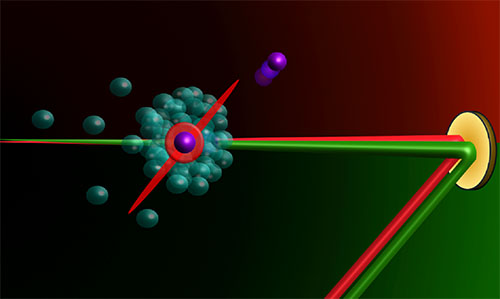 |
| Schematic depiction of the 2-color experiment: Two laser beams of different wavelengths (red and green) hit the ultracold helium droplet. (Image: Fritz Haber Institute)
|
A new tool to study chemical reactions
|
|
Chemical reactions are the foundation of all the processes that sustain life. Researchers around the world are working to develop precise physical descriptions of these processes in order to better understand, predict, or specifically control them.
|
|
In chemical reactions, molecules undergo various structural transformations, changing their 3D shapes between different conformations. These changes can be visualized as movements across an energy landscape, where the shape of the terrain determines how fast a reaction proceeds. Similar to a ball rolling through a hilly landscape, a molecule must overcome energy barriers—the 'mountains'—to settle into a new, stable state in the next 'valley'.
|
|
In an earlier study of a proton-bound phosphate-formate complex, the research team observed the unusual absence of spectral features, suggesting that structural change is triggered by laser irradiation—a process known as IR-induced isomerization. To study this fascinating process in greater detail, they have developed a new experimental approach that requires two synchronized IR lasers. The new two-color operation of the dual-oscillator IR-FEL lately constructed at the Fritz-Haber-Institute now made such experiments possible and thus opens new ways to study and control molecules.
|
Selective and efficient molecular fingerprinting
|
|
The research team trapped the molecular ions inside droplets of superfluid liquid helium —only a fraction of a degree above absolute zero— to rapidly cool the molecules while allowing them to absorb laser light for an unusually long time. As the molecules absorb light, the surrounding helium gradually evaporates, and after multiple absorption events, this evaporation produces a detectable signal.
|
|
However, if the molecule rearranges into a different structure before sufficient absorption occurs, the signal is lost. To address this, the team used two independently tunable IR free-electron laser beams to fully control the populations of the two molecular conformations. One laser can drive the molecule to rearrange into a different conformer, while the second selectively repopulates the original structure, enabling continued absorption.
|
|
The long IR excitation time (up to 10 µs) and the rapid cooling provided by the helium environment enabled the complete conversion between the isomers making it possible to measure the isomers selectively – thus yielding a molecular fingerprint that would remain hidden in measurements with a single laser.
|
|
This technique provides a powerful new way to control molecular structure and gain insight into molecular rearrangements, opening new opportunities to study the dynamics that govern chemistry at the most fundamental level.
|
Two-color operation of the FHI-FEL
|
|
Infrared free-electron lasers (IR-FELs) have proven to be ideal tools for different variants of spectroscopy. They reach access at long wavelengths (λ ≥ 15 µm) which remains limited with commercial sources. Moreover, IR-FELs provide a very large number of photons over an extended period of time. This can be used to advantage to deposit large amounts of energy into samples.
|
|
Since 2013 the FHI Free-Electron Laser (FHI-FEL) provides intense, pulsed mid-IR radiation continuously tunable from 2.8 to 50 µm wavelength. Recently the machine was upgraded to include a second FEL branch designed to generate far-IR radiation at wavelength up to 165 µm.
|
|
The temporal structure of the light of an FEL is determined by the temporal structure of the electron beam from which the light is generated. To achieve two-color IR-FEL operation, the FHI-FEL electron beam is split in two beams of electrons that are coupled into two separate optical cavities with independently tunable undulators. In this way, perfect synchronization of the two electron beams is guaranteed. This results in two independently tunable IR-FELs, a set up that’s worldwide unique.
|
|
The findings have been reported in Physical Review Letters ("Controlling Isomer Population Using a Dual-Oscillator Infrared Free-Electron Laser").
|