| Jul 02, 2026 |
MOF thin films reveal a denser, less porous structure than expected
Advanced diffraction and modeling show a widely studied MOF thin film is densely packed, reshaping expectations for sensors, microelectronics and magnetic storage.
(Nanowerk News) Due to their high porosity, metal-organic frameworks (MOFs) are regarded as promising materials for innovative applications, which is why the Nobel Prize in Chemistry was awarded in 2025 for their discovery. They are used, for example, to store gases, to capture CO2, and for the targeted delivery of medicines.
|
|
While the structure of MOFs in the form of large crystals can be determined with relative ease, thin films have largely remained a mystery. Yet it is precisely the structure that is decisive for the properties and for potential applications.
|
|
A team led by Roland Resel and Egbert Zojer from the Institute of Solid State Physics at Graz University of Technology (TU Graz), together with colleagues from the Institute of Physical and Theoretical Chemistry (led by Paolo Falcaro) and the Karlsruhe Institute of Technology (led by Christof Wöll), has now solved this puzzle.
|
|
They have published their results in a paper in the journal Advanced Functional Materials ("Resolving the Cu(bdc) Conundrum: Identifying Non‐Porous Packing of Prototypical Coordination‐Network Thin Films Combining Advanced Diffraction Techniques and Computational Modelling").
|
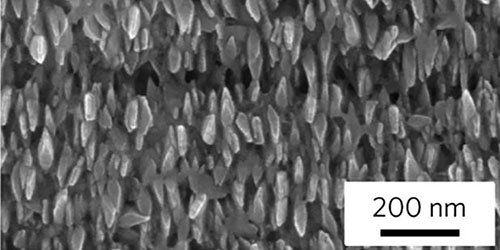 |
| A MOF film under an electron microscope. (Image: TU Graz)
|
|
Using the extensively studied copper benzene dicarboxylate Cu(bdc) thin film as an example, the researchers demonstrated that none of the structural models proposed to date are correct. Instead, they have identified a structure that explains all the observed properties and that offers a surprise: Cu(bdc) thin films are not porous at all, as one would normally expect from MOFs.
|
Structural models need to be reassessed
|
|
“Our results suggest that many published structural models of MOF thin films might be incorrect and need to be reassessed,” says Egbert Zojer. The breakthrough was achieved by combining complex quantum mechanical simulations with a specialised measurement technique, known as rotating grazing-incidence X-ray diffraction (rotating GIXD) which was performed at the Elettra synchrotron in Trieste.
|
|
Unlike conventional measurements, which measure X-ray diffraction in a specific direction and thus provide only a limited amount of data, the rotating-GIXD method provides an almost complete picture of the crystal periodicity. By combining the measurements with the aforementioned quantum mechanical simulations and a determination of the thin film’s density using X-ray reflectometry, the team was able to rule out the large number of structures previously proposed in the literature and to ultimately reveal the film’s true identity through simulations.
|
Densely packed rather than highly porous
|
|
The findings contradict the previously prevailing views. Most of the scientific literature had described the structure as highly porous, although this had already proved difficult to reconcile with certain observations made in the past. It is now becoming apparent, however, that rather than being highly porous, the Cu(bdc) thin film is densely packed and contains additional hydroxide groups, which were missing from most previous models.
|
|
The structure discovered explains why the films can hardly be loaded with guest molecules, why they exhibit unusually high stability towards water, and why they possess magnetic properties that would be inconsistent with the structures previously hypothesised.
|
New potential applications
|
|
The non-porous structure that has now been identified not only explains the material’s chemical robustness, but also confirms its ferromagnetic ground state. This shifts the potential applications of these films towards physical phenomena that could be relevant in sensor technology, microelectronics or magnetic storage systems. Furthermore, the structure contains layers of copper oxide reminiscent of high-temperature superconductors. The potential applications arising from this form the basis for further research.
|
|
“Through our work, we have been able to demonstrate that reliable structural characterisation of MOF thin films is only possible through a combination of modern diffraction methods and theoretical modelling,” says Egbert Zojer. “The diffraction methodology, established primarily by Roland Resel’s group, together with the software developed at TU Graz for analysing the synchrotron data, provides an important tool for this purpose. It lays the foundations for elucidating the structure of further MOF thin films in the future and subsequently harnessing them specifically for new applications in sensor technology and microelectronics.”
|