| Jul 01, 2026 |
Nanotubes and nanosheets boost fast energy storage
Hybrid nanotube�nanosheet electrodes speed ion flow, boost charge storage, and keep supercapacitors stable through 10,000 cycles.
(Nanowerk News) The growing use of renewable energy sources, such as solar and wind power, requires energy storage systems that can charge quickly, deliver power efficiently, and remain stable over long-term use. Batteries can store large amounts of energy, but they often take longer to charge.
|
|
Supercapacitors, on the other hand, can charge and discharge rapidly, but their energy-storage capacity is usually more limited. Developing materials that can combine high energy storage, fast power delivery, and long-term durability is therefore an important challenge for next-generation energy technologies.
|
A mixed-dimensional innovation
|
|
To address this challenge, a collaborative research team led by Prof. Da-Ren Hang at National Sun Yat-sen University and Prof. Chi-Te Liang at National Taiwan University developed a mixed-dimensional hybrid electrode material. The material combines two-dimensional vanadium disulfide (VS₂) nanosheets with one-dimensional porous hollow graphitic carbon nitride (g-C₃N₄) nanotubes (TCN).
|
|
The study is published in Journal of Energy Storage ("Constructing mixed-dimensional 2D/1D heterostructures with VS2 nanosheets and g-C3N4 porous hollow nanotubes as highly efficient and stable supercapacitor electrodes").
|
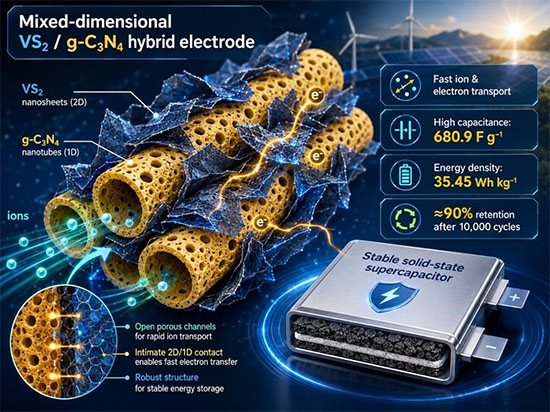 |
| A newly designed VS₂/g-C₃N₄ hybrid electrode combines nanosheets and porous nanotubes to speed up charge transport and improve solid-state supercapacitor performance. (Image: National Taiwan University)
|
Dual-synergy for enhanced performance
|
|
This design works through a dual-synergy strategy. The one-dimensional nanotubes provide an open supporting framework that helps prevent the VS₂ nanosheets from stacking together. This creates more accessible pathways for electrolyte ions to move through the electrode. At the same time, the VS₂ nanosheets contain both metallic and semiconducting phases, which helps improve charge transfer and surface redox reactions during energy storage.
|
|
The resulting TCN/VS₂ composite shows strong electrochemical performance. In a three-electrode system, it delivers a high specific capacitance of 680.9 F g⁻¹ at 1 A g⁻¹. When assembled into a symmetric solid-state supercapacitor, the device reaches an energy density of 35.45 Wh kg⁻¹ and maintains approximately 90% capacitance retention after 10,000 charge–discharge cycles.
|
|
Beyond this specific material, the study demonstrates a broader electrode-design concept. By combining nanoscale building blocks with different shapes and functions, researchers can create structures that expose more active sites, support faster ion movement, and remain stable during repeated operation.
|
|
"By integrating nanotubes that keep the electrode structure open with nanosheets that actively store charge, our work shows a practical way to design supercapacitor materials that charge rapidly and remain stable over long-term operation," says co-corresponding author Dr. Chi-Te Liang, professor of physics at National Taiwan University.
|