| Jul 11, 2026 |
Ultra-fine bubbles in ink promise new horizons for inkjet printing
Ultra-fine bubbles tune how inkjet droplets dry, reshaping particle films without additives and improving microdevice printing while avoiding contamination.
(Nanowerk News) Researchers from Tokyo Metropolitan University studying inkjet printing have introduced ultra-fine bubbles into ink droplets and showed that their drying behavior can be tuned without using additives. They discovered that the shape of the particle-laden film left after a droplet dries can be radically modified by adjusting the number of bubbles. This is great news for the printing of microdevices, where additives to ink can come out of solution and negatively affect the properties of ink deposits.
|
|
The findings have been published in Precision Engineering ("Inkjet printing of ultrafine-bubble-added SiO2 nanoparticle suspensions for film morphology control").
|
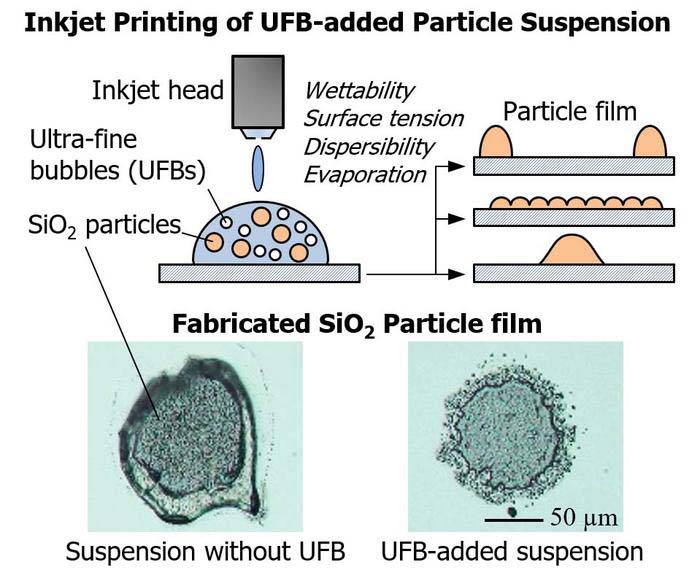 |
| Ultra-fine bubbles in nanoparticle suspensions create different patterns. The addition of ultra-fine bubbles into a suspension of particles can be used to realize more uniform coatings on a substrate, or the collection of particles at the droplet center. The effect can be tuned by modifying the proportion of bubbles to nanoparticles. (Image: Tokyo Metropolitan University)
|
|
Inkjet printing is a core technology for modern society, not only for printed media, but also in cutting-edge applications like microelectronics and MEMS (microelectromechanical systems), where coatings and layers need to be delivered with microscale precision on surfaces in intricate patterns and circuits. This extends to control over how single ink droplets dry, leaving a pattern of the sub-micron particles suspended in the ink.
|
|
When left to their own devices, particles often form complex, sometimes undesirable patterns. Examples include the famous “coffee ring” effect, often seen in dried droplets of coffee, where solid deposits are mostly left at the droplet edge. To get more even coatings, inks are commonly mixed with chemicals that modify the surface tension, but these compounds themselves are left in the film, changing how the deposited particles behave.
|
|
To get around this problem, a team led by Professor Arata Kaneko from Tokyo Metropolitan University adopted an entirely new approach. Instead of surfactants or chemically modified particles, they used nanoscale, ultra-fine bubbles dispersed in the liquid to change the properties of the droplet.
|
|
To demonstrate the principle, they used silica nanoparticles dispersed in water and passed it through an ultra-fine bubble generator. These bubble-laden suspensions were deposited on a silicon substrate in 1 nanoliter droplets through an inkjet nozzle before being left to dry. The team found that while suspensions without bubbles exhibited a strong coffee ring effect, droplets with bubbles led to gradual changes.
|
|
While the addition of some bubbles gave a more uniform coating, adding even more led to particles being accumulated at the center of the droplet. While the bubbles didn’t change the properties of the nanoparticles themselves, like how charged they were, they changed the surface tension of the suspension, and how it wets the surface.
|
|
Crucially, bubbles don’t leave any deposits once the droplet is dry. This is important when the original properties of the nanoparticles need to be preserved. For example, particles of graphene or molybdenum dioxide can be used as a gas sensor from how their conductivity changes when gases are absorbed.
|
|
However, their sensitivity is strongly affected by the shape of the deposit they form. The same goes for conducting nanoparticles in circuits, where it is vital that nanoparticle surfaces be left as pristine as possible. This makes the team’s new technology an important step forward for realizing the inkjet printing of cutting-edge microdevices.
|