| Jun 18, 2026 |
Paint it blacker: Carbon nanotube coating could make cars ultra-black
A new ultra-black automotive coating absorbs 99.9% of visible light, creating a deeper black finish that could be used on future luxury cars.
(Nanowerk News) Scientists have developed a practical way to make ultra-black coatings fit to meet the demand for trendy, luxury vehicles in China. The coating, described in a paper publishing in the journal (Matter & Light, "Robust ultra-black automotive coating with structural absorption and high absorption efficiency based on waterborne carbon black/CNT composite"), is made up of a composite of carbon black pigment and carbon nanotubes.
|
|
The resulting color is a deep jet black that also meets automotive standards, opening the door for car manufacturers to develop distinguished, high-end models in darker-than-ever hues.
|
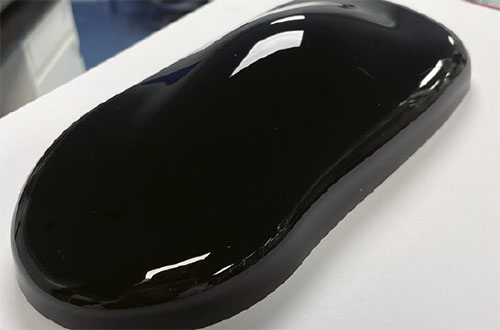 |
| Car model with ultra-black coating. (Image: Liu et al.)
|
| >
“In China, car color has become a key selling point,” says author Zhiwei Liu, a research chemist with the Color Technology, Group Core R&D Shanghai, Nipsea Group. “Deep black finishes have long been the premium choice and signature color for luxury cars due to their elegant appearance, powerful visual impact, and luxurious undertone. As a result, automotive coating companies have been actively pursuing innovations in color technology to develop mass-processable ultra-black coating solutions with extreme blackness.”
|
|
In 2019, a BMW concept car with a vertically aligned carbon nanotube (VACNT) array coating set off a race in the automotive industry to develop coatings that similarly absorb almost all light, creating a “black hole” effect that gives vehicles a pronounced, dark appearance. The industry has been on the hunt for more practical ways to achieve this ultra-black effect with automotive coating-grade properties.
|
|
Liu’s team developed a stable, nano-sized carbon black pigment-carbon nanotube composite, which they incorporated into a coating binder and sprayed onto a car model as an automotive coating.
|
|
While current approaches to making black coatings rely on carbon black dispersions alone to absorb intrinsic light, imposing a limit on how black the coating can be, the team’s new approach uses “structural absorption,” pushing the material’s light absorption efficiency to new levels and enabling it to absorb an average of 99.90% of visible light wavelengths. The film also showed excellent long-term stability even when the researchers exposed it to water and humidity tests, pointing to its value for industrial applications.
|
|
“With the rapid development of dispersing technology and equipment, there is still room for improvements in practical processability of carbon-nanotube-containing nanomaterials,” says Liu.
|
|
Making the coating with a higher proportion of carbon nanotubes can further increase its capacity to absorb light, he added, although this would also bring difficulties in industrial-grade processability. In the future, he said, the researchers may also develop an ultra-black coating that contains multiple layers, with a gradient refractive index that reduces interface reflection and further enhances light absorption efficiency for an even darker look.
|
|
While the researchers have completed the technical proof-of-concept design for the coating’s manufacturing process, it may still be a while before ultra-black cars made with this film will be able to hit the road.
|
|
“Further efforts will focus on the verification of coating application window and the comprehensive film performance validations of carbon black pigment-carbon nanotubule composite-based ultra-black automotive coating,” says Liu.
|