

Growing Crystals: Make Your Own Edible Gems
Time needed: 5-7 days (30 minutes active time)
Difficulty level: Medium
Age range: 8+ years
Adult supervision: Required for handling hot liquids
Difficulty level: Medium
Age range: 8+ years
Adult supervision: Required for handling hot liquids
What You'll Learn
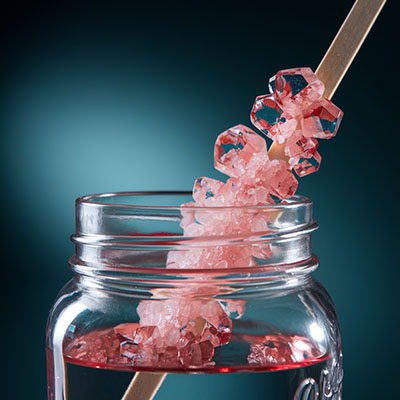
This experiment demonstrates how crystals form through a process called crystallization. You'll create a supersaturated solution and watch as beautiful crystal structures grow over several days, learning about solutions, saturation, and crystal formation - plus you get to eat the results!
Materials Needed
Materials collected: 0/8
3 cups of sugar
Clean glass jar or tall glass
1 cup of water
Wooden craft stick or pencil
Clothespin or clip
Food coloring (optional)
Optional
Flavoring extract (optional)
Optional
Large spoon
Safety Notes
Adult supervision required when handling boiling water and hot sugar solution
Hot sugar solution can cause severe burns - handle with extreme care
Ensure all equipment is clean before starting
Step-by-Step Instructions
1
Bring 1 cup of water to a boil
2
Add 3 cups of sugar, one cup at a time, stirring until completely dissolved
3
Remove from heat and add food coloring and flavoring if desired
Let solution cool for 15 minutes
4
Prepare the stick by wetting it and coating with dry sugar
Let the sugar-coated stick dry completely
5
Clip the stick to the clothespin and suspend it in the jar
6
Carefully pour the cooled sugar solution into the jar
7
Wait 4-5 days for crystals to form
Watch It In Action
Watch this demonstration to see the crystal growing process from start to finish. Pay special attention to how the sugar solution is prepared and how the crystals form over several days.
The Science Behind It
Hot water can hold more dissolved sugar than cold water, creating a supersaturated solution.
As the solution cools, sugar molecules begin to stick together in regular patterns, forming crystals.
The sugar-coated stick provides a surface for crystals to start growing, similar to how natural crystals form in rock cavities.
Common Questions
Why didn't my crystals grow?
Common issues include solution not being saturated enough, jar being disturbed, or temperature changes. Make sure all sugar is completely dissolved and keep the jar in a stable environment.
Can I use different types of sugar?
Regular granulated sugar works best. Brown sugar or powdered sugar won't create the same crystal structure.
If using salt, why Epsom salt instead of regular table salt?
Epsom salt (magnesium sulfate) forms much larger and more dramatic crystals than table salt (sodium chloride). It has a different crystal structure and higher solubility in water, making it ideal for crystal growing experiments. However, unlike sugar crystals, Epsom salt crystals are not edible.
How long will the crystals last?
If kept dry, the crystals can last indefinitely. However, humidity can cause them to dissolve or become sticky.
Take It Further
- Create custom crystal shapes by bending pipe cleaners into stars, hearts, or spirals to use instead of a straight stick - the crystals will grow along whatever shape you design
- Try growing crystals using Epsom salt (magnesium sulfate) - it forms larger, more dramatic crystals than table salt due to its different molecular structure, but remember these aren't edible
- Experiment with different colors and flavors in your sugar solution - try making rainbow crystals by using different colors in separate jars
- Compare crystal growth at different temperatures by placing jars in warm and cool locations
Related Experiments
If you enjoyed this experiment, try these next:
- Invisible Egg - Another longer-term experiment
- Frost Formation - Another demonstration of crystallization
