

Quantum Computing Basics: A Comprehensive Guide
Table of Contents
Quantum computing represents one of the most profound technological shifts of our era—a fundamentally new approach to computation that harnesses the strange and counterintuitive principles of quantum mechanics. While classical computers have transformed society over the past several decades, they face fundamental limitations when tackling certain types of complex problems. Quantum computers promise to transcend these barriers, potentially solving in minutes or hours what would take conventional supercomputers thousands or even millions of years.
The year 2025 has marked a turning point for quantum computing, with major breakthroughs in error correction, qubit stability, and practical applications. Google's Willow chip demonstrated calculations that would be impossible for classical computers, Microsoft unveiled its Majorana 1 topological qubit chip, and IBM unveiled its 1,121-qubit Condor processor. The global quantum computing market has reached between $1.8 and $3.5 billion, with projections suggesting growth to over $20 billion by 2030.
What is Quantum Computing?
Quantum computing is a type of computation that exploits the principles of quantum mechanics—the physics governing subatomic particles—to process information in ways that classical computers cannot. Rather than representing information as binary digits (bits) that can be either 0 or 1, quantum computers use quantum bits, or qubits, which can exist in multiple states simultaneously.
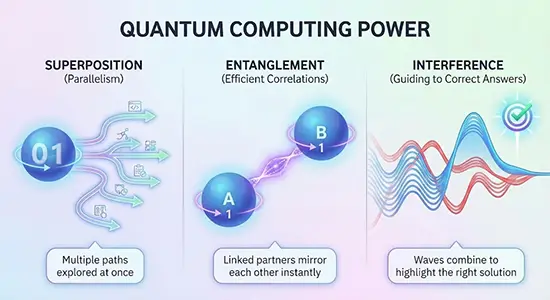
This capability emerges from quantum mechanical phenomena including superposition (existing in multiple states at once), entanglement (instantaneous correlations between particles), and interference (wave-like interactions that can amplify or cancel probabilities). Together, these properties enable quantum computers to explore vast numbers of possibilities in parallel, making them extraordinarily powerful for specific types of problems.
It's important to understand that quantum computers are not simply faster versions of classical computers. They represent an entirely different computational paradigm—one that excels at problems involving optimization, simulation of quantum systems, cryptography, and pattern recognition, while offering no advantage (and often disadvantages) for everyday computing tasks like word processing or web browsing.
Classical vs. Quantum Computing
To appreciate quantum computing, it helps to understand how classical computers work and where their limitations lie. Classical computers, from smartphones to supercomputers, process information using transistors that can be in one of two states: on (1) or off (0). All computation—from simple arithmetic to complex simulations—ultimately reduces to manipulating these binary digits according to logical rules.
Classical computers are extraordinarily powerful for sequential operations and have scaled impressively following Moore's Law. However, they struggle with problems that require exploring exponentially large solution spaces. Consider trying to find the optimal route connecting 50 cities (the traveling salesman problem): there are more possible routes than atoms in the observable universe. A classical computer must essentially check routes one at a time, making such problems intractable.
Quantum computers approach these problems differently. Because qubits can exist in superpositions of 0 and 1, a quantum computer with n qubits can represent 2n states simultaneously. With just 50 qubits, a quantum computer can work with over one quadrillion states at once. Through careful manipulation using quantum gates and algorithms, quantum computers can amplify the probability of correct answers while canceling out incorrect ones.

Fundamental Quantum Mechanics Principles
Quantum computing relies on several counterintuitive principles from quantum mechanics. These phenomena, which govern the behavior of particles at the atomic and subatomic scale, have been experimentally verified countless times despite seeming to defy common sense. Understanding these principles is essential to grasping how quantum computers achieve their computational power.
Superposition
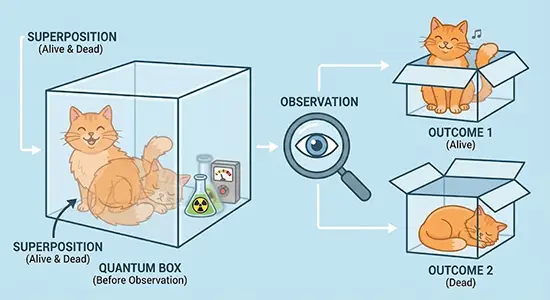
Superposition is perhaps the most famous quantum phenomenon. In the quantum world, particles can exist in multiple states at the same time until they are measured. The classic thought experiment illustrating this is Schrödinger's cat, which is simultaneously alive and dead until observed. For qubits, superposition means they can be in a combination of 0 and 1 states simultaneously.
Mathematically, a qubit's state is represented as: |ψ⟩ = α|0⟩ + β|1⟩, where α and β are complex numbers called probability amplitudes. When measured, the qubit collapses to state 0 with probability |α|² or state 1 with probability |β|². The constraint |α|² + |β|² = 1 ensures these probabilities sum to one.
Superposition enables quantum parallelism. While a classical computer with n bits can be in exactly one of 2n possible states at any moment, n qubits in superposition simultaneously represent all 2n states. This allows quantum algorithms to process vast numbers of possibilities in parallel, though extracting useful results requires sophisticated algorithmic techniques.
Entanglement
Quantum entanglement occurs when two or more qubits become correlated in such a way that the quantum state of each qubit cannot be described independently. When qubits are entangled, measuring one instantly affects the state of the others, regardless of the physical distance between them—what Einstein famously called "spooky action at a distance."
For quantum computing, entanglement is not merely a curiosity but a computational resource. Entangled qubits can store and process information in ways that would require exponentially more classical bits. When a quantum computer entangles multiple qubits and then manipulates them, operations on one qubit instantly influence the entire entangled system, enabling powerful computational shortcuts.
Entanglement also plays a crucial role in quantum error correction, where correlations between physical qubits help detect and correct errors without destroying the quantum information being processed. Additionally, entanglement enables quantum communication protocols like quantum key distribution, which can detect any attempt at eavesdropping.
Quantum Interference
Quantum interference exploits the wave-like nature of quantum states. Just as water waves or light waves can reinforce (constructive interference) or cancel (destructive interference) each other, quantum probability amplitudes can combine to increase or decrease the probability of certain outcomes.
Quantum algorithms are carefully designed to use interference constructively—amplifying the probability amplitudes of correct answers while canceling out incorrect ones. Without interference, the exponential parallelism of superposition would be useless: measuring a qubit in superposition gives a random result. Interference allows quantum computers to bias this randomness toward the desired solution.
The interplay between superposition, entanglement, and interference is what gives quantum computers their power. Superposition provides parallelism, entanglement creates correlations that enable efficient information processing, and interference guides computation toward correct answers.
Decoherence
Decoherence is the nemesis of quantum computing. It occurs when a qubit interacts with its environment—through temperature fluctuations, electromagnetic interference, vibrations, or even stray cosmic rays—causing the delicate quantum state to collapse into a classical state. Once decoherence occurs, the qubit loses its superposition and entanglement, becoming a classical bit that can no longer perform quantum computations.
Decoherence is why quantum computers are so difficult to build. Qubits must be exquisitely isolated from environmental noise while simultaneously being precisely controlled and measured. This explains why most quantum computers operate at temperatures near absolute zero (around 15 millikelvin, colder than outer space) inside elaborate shielding systems. The time a qubit can maintain its quantum state before decoherence—called coherence time—is a critical performance metric.
Qubits: The Building Blocks of Quantum Computing
Qubits are to quantum computers what bits are to classical computers—the fundamental units of information. However, while a classical bit is a straightforward concept (a switch that's on or off), qubits are far more subtle. A qubit can be any quantum system with two distinguishable states that can be placed into superposition and entangled with other qubits.
The quality of qubits matters enormously. Key metrics include coherence time (how long quantum states persist), gate fidelity (how accurately quantum operations can be performed), connectivity (how easily qubits can interact with each other), and error rate (how often operations fail). Current state-of-the-art qubits can perform thousands of operations before errors accumulate to unacceptable levels.
The number of qubits in a quantum computer determines its theoretical computational power, but raw qubit count can be misleading. A quantum computer with 100 high-quality, well-connected qubits may outperform one with 1,000 noisy, poorly-connected qubits. This is why the industry increasingly focuses on "logical qubits"—error-corrected qubits constructed from many physical qubits—rather than raw physical qubit counts.
Types of Qubits
Different physical implementations of qubits offer various trade-offs in terms of coherence time, gate speed, scalability, and engineering complexity. The quantum computing industry has not yet converged on a single winning approach, and several technologies are being actively developed by leading companies and research institutions.
Superconducting Qubits
Superconducting qubits are currently the most widely used technology, employed by IBM, Google, and many other companies. These qubits are made from tiny circuits of superconducting metal (typically aluminum) that, when cooled to near absolute zero, conduct electricity without resistance. The quantum states are encoded in the energy levels of these circuits.
The key component is the Josephson junction—a thin insulating barrier between two superconductors that allows quantum tunneling. This creates a nonlinear resonator with discrete energy levels that can serve as 0 and 1 states. Superconducting qubits can perform operations very quickly (nanoseconds) and can be manufactured using existing semiconductor fabrication techniques, making them relatively scalable.
However, superconducting qubits have relatively short coherence times (typically microseconds to milliseconds) and require extreme cooling to around 15 millikelvin using complex dilution refrigerators. Google's Willow chip (105 qubits) and IBM's Condor processor (1,121 qubits) represent the current state of the art in superconducting quantum computers.
Trapped Ion Qubits
Trapped ion qubits use individual atoms (typically ytterbium or calcium ions) suspended in electromagnetic fields inside vacuum chambers. The quantum states are encoded in the energy levels of these ions' electrons, and operations are performed using precisely controlled laser pulses.
Trapped ion systems offer several advantages: very long coherence times (seconds to minutes), extremely high gate fidelities (over 99.9%), and all-to-all connectivity (any qubit can directly interact with any other). These properties make trapped ions particularly suitable for near-term applications requiring high precision.
The main drawbacks are slower gate speeds compared to superconducting qubits and challenges in scaling to large numbers of qubits. Companies like IonQ and Quantinuum (formerly Honeywell Quantum Solutions) are leading trapped ion development, with systems currently reaching around 30-50 high-quality qubits.
Photonic Qubits
Photonic qubits encode quantum information in properties of light particles (photons), such as polarization or path. Because photons travel at the speed of light and interact weakly with the environment, photonic systems can operate at room temperature and are naturally suited for quantum communication.
Photonic quantum computing faces unique challenges: photons don't naturally interact with each other, making two-qubit gates difficult. However, recent advances in measurement-based quantum computing and photon sources have made photonic systems increasingly viable. Companies like PsiQuantum and Xanadu are developing large-scale photonic quantum computers with the goal of millions of qubits.
In February 2025, PsiQuantum unveiled its photonic quantum processor, demonstrating continued progress in this alternative approach to quantum computing.
Topological Qubits
Topological qubits represent a fundamentally different approach that could solve quantum computing's error problem at the hardware level. These qubits encode information in the global properties of exotic quantum states rather than local properties of individual particles, making them inherently resistant to local disturbances.
Microsoft has pursued topological qubits for over 17 years, and in February 2025 announced a major breakthrough with its Majorana 1 chip. This chip uses a new class of materials called "topoconductors" to create Majorana particles—exotic quantum states that are neither solid, liquid, nor gas. While still requiring validation, Microsoft believes topological qubits could dramatically accelerate progress toward fault-tolerant quantum computing.
The theoretical advantage of topological qubits is that they would require far fewer physical qubits for error correction. However, creating and manipulating topological states is extraordinarily challenging, and this technology remains less mature than superconducting or trapped ion approaches.
Silicon Spin Qubits
Silicon spin qubits encode quantum information in the spin of individual electrons or atomic nuclei trapped in silicon. Because they leverage existing semiconductor manufacturing infrastructure, silicon qubits offer a potential path to manufacturing quantum processors at the scale of classical computer chips.
Intel and several startups (including Diraq and Silicon Quantum Computing in Australia) are developing silicon spin qubits. These qubits can be very small and potentially very numerous, but controlling individual electron spins with the required precision remains challenging. Recent progress has demonstrated high-fidelity operations and multi-qubit entanglement in silicon systems.
Neutral Atom (Cold Atom) Qubits
Neutral atom qubits (also known as cold atom qubits) have emerged as a powerful "dark horse" competitor in the race for scalability. This approach uses lasers (optical tweezers) to trap and manipulate individual neutral atoms—typically Rubidium or Strontium—inside a vacuum chamber. Unlike ions, these atoms have no electrical charge, allowing them to be packed tightly together without repelling each other.
A unique advantage of neutral atom systems is reconfigurability. While superconducting or silicon qubits are fixed in place on a chip during manufacturing, neutral atoms can be moved around in real-time during a calculation. This allows for dynamic connectivity, where distant qubits can be brought next to each other to interact, drastically simplifying circuit design.
Companies like QuEra Computing and Pasqal are leading this field. In 2024-2025, QuEra demonstrated impressive logical qubit operations using this platform, leveraging the high connectivity of atoms to implement efficient error-correction codes that are difficult to achieve on fixed-grid architectures.
Quantum Gates and Circuits
Just as classical computers use logic gates (AND, OR, NOT) to manipulate bits, quantum computers use quantum gates to manipulate qubits. Quantum gates are reversible operations that transform qubit states while preserving quantum coherence. They are the building blocks of quantum algorithms.
Common single-qubit gates include the Hadamard gate (H), which creates superposition by transforming |0⟩ into an equal superposition of |0⟩ and |1⟩; the Pauli gates (X, Y, Z), which rotate qubit states around different axes; and phase gates, which adjust the relative phase between |0⟩ and |1⟩ components.
Two-qubit gates create entanglement and enable qubits to interact. The most important is the CNOT (Controlled-NOT) gate, which flips the second qubit if and only if the first qubit is in state |1⟩. Together with single-qubit gates, CNOT forms a "universal gate set"—any quantum computation can be decomposed into these elementary operations.
A quantum circuit is a sequence of quantum gates applied to qubits, analogous to a classical circuit diagram. Quantum circuits begin with qubit initialization (usually to |0⟩), apply a series of gates implementing an algorithm, and end with measurement. Unlike classical circuits where you can peek at intermediate values, measuring qubits collapses their quantum state, so measurements typically occur only at the end.

Quantum Algorithms
Quantum algorithms are carefully designed sequences of quantum operations that solve specific problems faster than any known classical algorithm. Developing quantum algorithms is challenging because they must exploit quantum phenomena—superposition, entanglement, and interference—in ways that outperform classical approaches.
Shor's Algorithm (1994) can factor large numbers exponentially faster than classical algorithms. Since widely-used encryption (RSA) relies on the difficulty of factoring, a sufficiently powerful quantum computer running Shor's algorithm could break most current internet security. This has driven urgent work on "post-quantum cryptography."
Grover's Algorithm (1996) provides a quadratic speedup for searching unsorted databases. While less dramatic than Shor's exponential speedup, Grover's algorithm has broad applications because many problems can be framed as search problems. It can also speed up optimization and machine learning tasks.
Variational Quantum Eigensolver (VQE) and Quantum Approximate Optimization Algorithm (QAOA) are hybrid quantum-classical algorithms designed for near-term quantum computers. They use quantum processors to explore solution spaces while classical computers optimize parameters. These algorithms are being applied to chemistry simulations, optimization problems, and machine learning.
Quantum simulation algorithms leverage the fact that quantum systems are naturally suited to simulating other quantum systems. Richard Feynman first proposed quantum computing in 1982 precisely for this purpose. Today, quantum simulation is perhaps the most promising near-term application, with potential to revolutionize drug discovery and materials science.
Quantum Error Correction
Quantum error correction is arguably the most critical challenge in building practical quantum computers. Qubits are incredibly fragile—environmental noise, imperfect control, and measurement errors cause errors far more frequently than in classical computers. Without error correction, errors accumulate so quickly that computations become meaningless.
The fundamental insight of quantum error correction is that multiple physical qubits can be used to encode a single logical qubit that is protected against errors. Clever encoding schemes allow errors to be detected and corrected without destroying the quantum information. However, this comes at enormous cost: current schemes may require 1,000 or more physical qubits for each logical qubit.
The year 2024-2025 saw transformative progress in error correction. Google's Willow chip achieved a crucial milestone by demonstrating that error rates actually decrease as more qubits are added—going "below threshold." This shows that building larger, more reliable quantum computers is possible. IBM, Quantinuum, Microsoft, and others have announced similar breakthroughs.
The path to fault-tolerant quantum computing—where error correction is good enough for arbitrarily long computations—remains challenging but increasingly clear. IBM's roadmap targets 200 logical qubits capable of 100 million operations by 2029. Most experts expect fault-tolerant systems to emerge between late 2020s into the mid-2030s.
Leading Quantum Computing Companies
The quantum computing industry has matured significantly, with multiple companies offering commercial quantum computing access and pursuing different technological approaches. The competitive landscape includes both established technology giants and specialized startups.
IBM is one of the longest-standing leaders in quantum computing. Its IBM Quantum program provides cloud access to quantum processors through the IBM Quantum Experience platform. In 2025, IBM operates the 1,121-qubit Condor processor and has announced roadmaps extending to 100,000 qubits by 2033. IBM's Qiskit is the most widely used quantum programming framework.
Google Quantum AI made headlines in 2019 by claiming quantum supremacy with its 53-qubit Sycamore processor. In December 2024, Google unveiled the Willow chip (105 qubits), which demonstrated below-threshold error correction and performed a benchmark calculation in 5 minutes that would take classical supercomputers 10 septillion years. Google aims for a fault-tolerant quantum computer by 2029.
Microsoft has pursued a unique path focused on topological qubits. In February 2025, Microsoft announced Majorana 1, its topological qubit chip using novel "topoconductor" materials. Microsoft's Azure Quantum platform provides cloud access to quantum hardware from multiple vendors, and its Q# language is widely used for quantum algorithm development.
Amazon Web Services offers Amazon Braket, a fully managed quantum computing service providing access to quantum hardware from IonQ, Rigetti, and others. Amazon is also developing its own quantum hardware, unveiling the Ocelot chip in 2025.
IonQ leads in trapped ion quantum computing, offering systems with exceptional qubit quality. Quantinuum (formed from Honeywell Quantum Solutions and Cambridge Quantum) combines high-fidelity trapped ion hardware with advanced software. Rigetti offers superconducting quantum systems and hybrid quantum-classical cloud services. D-Wave specializes in quantum annealing technology and demonstrated quantum supremacy for optimization problems in 2025.
Applications of Quantum Computing
While general-purpose quantum computing remains years away, specific applications are already demonstrating quantum advantage. The most promising near-term applications leverage quantum computers' natural ability to simulate quantum systems and explore exponentially large solution spaces.
Drug Discovery and Healthcare
Pharmaceutical research is one of the most advanced application domains. Drug discovery requires understanding how molecules interact—a fundamentally quantum mechanical problem. Classical computers can only approximate molecular behavior for small molecules, while quantum computers can simulate molecular interactions directly.
Google's collaboration with Boehringer Ingelheim demonstrated quantum simulation of Cytochrome P450, a key enzyme involved in drug metabolism, with greater efficiency than classical methods. Such simulations could accelerate drug development, predict drug interactions, and enable personalized medicine. Companies like Biogen and pharmaceutical giants are actively exploring quantum computing for drug discovery.
Finance and Risk Analysis
Financial services have emerged as early adopters of quantum computing. Applications include portfolio optimization, risk analysis, fraud detection, and derivative pricing. Quantum algorithms can explore many possible market scenarios simultaneously, potentially improving predictions and reducing computational costs.
JPMorgan Chase has partnered with IBM to explore quantum algorithms for option pricing, with early studies indicating quantum models could outperform classical Monte Carlo simulations. Mastercard and other financial institutions are using D-Wave's quantum annealing systems for optimization problems.
Cryptography and Security
Quantum computing has profound implications for cryptography. Shor's algorithm threatens to break RSA and elliptic curve cryptography—the foundations of internet security. While current quantum computers lack the thousands of error-corrected qubits needed, the threat has spurred urgent development of "post-quantum cryptography."
NIST finalized new post-quantum cryptographic standards in 2024 (FIPS 203/204/205), and organizations worldwide are beginning the multi-year process of upgrading their systems. On the positive side, quantum key distribution (QKD) offers theoretically unbreakable encryption, with commercial systems already deployed for high-security applications.
Optimization Problems
Many real-world problems involve finding optimal solutions among vast possibilities: supply chain logistics, traffic routing, scheduling, resource allocation. Quantum computers excel at these optimization problems, particularly through quantum annealing (D-Wave) and variational algorithms (VQE, QAOA).
BMW and Airbus are working with Quantinuum to explore quantum computing for fuel cell development and logistics optimization. NTT Docomo uses D-Wave systems for network optimization. These early applications demonstrate that quantum computers can deliver commercial value today for specific optimization tasks.
Materials Science
Designing new materials—better batteries, superconductors, catalysts—requires understanding quantum mechanical interactions between atoms. Quantum computers can simulate these interactions directly, potentially accelerating discovery of materials for clean energy, electronics, and other applications.
D-Wave demonstrated quantum supremacy for magnetic materials simulation in 2025, achieving in minutes what would take classical supercomputers nearly a million years. Such capabilities could advance technologies from smartphone sensors to MRI machines.
Challenges and Limitations
Despite remarkable progress, quantum computing faces significant challenges that must be overcome before it can achieve its full potential.
Qubit quality and coherence: Current qubits remain fragile, with coherence times measured in microseconds to milliseconds for superconducting systems. Maintaining quantum states long enough for complex calculations requires extreme isolation and cooling, adding engineering complexity and cost.
Error rates: Even the best qubits make errors roughly once in every thousand operations. While error correction has advanced dramatically, building fault-tolerant quantum computers with millions of physical qubits remains a massive engineering challenge.
Scalability: Current quantum computers have hundreds to about a thousand qubits. Reaching the millions of qubits needed for transformative applications requires solving problems in manufacturing, wiring, control systems, and cooling that don't exist in classical computing.
Software and algorithms: Quantum programming is fundamentally different from classical programming, and the ecosystem of tools, libraries, and trained developers is still developing. Many potential applications lack efficient quantum algorithms.
Cost and accessibility: Quantum computers require specialized facilities, extreme cooling, and expert maintenance. While cloud access has democratized experimentation, building and operating quantum hardware remains expensive. Current quantum computing services cost significantly more per computation than classical alternatives.
The Future of Quantum Computing
As we move through 2025—designated by the UN as the International Year of Quantum Science and Technology—the narrative has shifted from "Quantum Supremacy" to "Quantum Utility." The goal is no longer just to perform random calculations that classical computers cannot, but to deliver useful results for scientific and industrial problems, even before full error correction is achieved.
The Era of Quantum-Centric Supercomputing
The immediate future lies in Quantum-Centric Supercomputing. Just as GPUs became essential accelerators for AI, quantum processors are becoming specialized accelerators within classical supercomputing centers. IBM's roadmap exemplifies this, integrating its "Heron" and "Blue Heron" processors into high-performance computing (HPC) workflows to solve specific sub-routines of massive calculations.
Convergence with Generative AI
A major trend defining 2025 is the convergence of AI and quantum. Generative AI is now being used to design more efficient quantum circuits and optimize error correction codes, effectively "writing" better quantum software than humans can. Conversely, early experiments in Quantum Machine Learning (QML) suggest that quantum processors may soon accelerate the training of large AI models, reducing their massive energy consumption.
The Road to Fault Tolerance (2029–2033)
Leading hardware roadmaps have converged on the end of the decade for the arrival of fully fault-tolerant systems:
- IBM: Plans to launch "Starling," its first fully error-corrected system with 200 logical qubits, by 2029. Their long-term vision extends to the "Blue Jay" system with 100,000 qubits by 2033.
- Google: Following the success of the Willow chip, Google targets a commercially useful, error-corrected quantum computer by 2029, following their six-stage roadmap to utility.
- Microsoft & Quantinuum: Continue to push towards hybrid HPC-quantum systems, with Microsoft's topological approach offering a potential "leapfrog" moment if their Majorana qubits scale as predicted.
While the "NISQ" era (Noisy Intermediate-Scale Quantum) continues to offer specific value in materials science and optimization, the industry is unequivocally moving toward logical, error-corrected qubits as the standard for 2030 and beyond.
Further Reading & Official Resources
To dive deeper into the specific technologies and breakthroughs mentioned in this guide, we recommend these official resources:
Major 2025 Breakthroughs
-
Google Quantum AI: Official Willow Chip Announcement
Deep dive into the 105-qubit architecture and the "below threshold" error correction milestone. -
Microsoft Azure Quantum: The Path to Majorana 1
Detailed explanation of the new "topoconductor" materials and topological qubits released in Feb 2025. -
IBM Quantum: IBM Development Roadmap to 2033
The official timeline for the "Blue Jay" and "Starling" processors mentioned in this guide.
Standards & Global Initiatives
-
NIST.gov: Post-Quantum Cryptography Standardization
Access the final FIPS 203, 204, and 205 standards released in 2024 to protect against quantum threats. -
UNESCO: International Year of Quantum Science and Technology (2025)
The official UN portal for the global celebration of quantum science occurring throughout 2025.
Frequently Asked Questions on Quantum Computing
1. What is quantum computing?
Quantum computing is a type of computation that harnesses quantum mechanical phenomena like superposition and entanglement to process information. Unlike classical computers that use bits (0 or 1), quantum computers use qubits that can exist in multiple states simultaneously, enabling them to solve certain problems exponentially faster than classical computers.
2. What is a qubit?
A qubit (quantum bit) is the fundamental unit of quantum information. Unlike classical bits that can only be 0 or 1, qubits can exist in a superposition of both states simultaneously. Qubits can be implemented using various physical systems including superconducting circuits, trapped ions, photons, and electron spins.
3. What is superposition in quantum computing?
Superposition is a quantum mechanical property that allows a qubit to exist in multiple states at once—both 0 and 1 simultaneously—until it is measured. This enables quantum computers to process many calculations in parallel, potentially providing exponential speedups for certain types of problems.
4. What is quantum entanglement?
Quantum entanglement is a phenomenon where two or more qubits become correlated in such a way that the quantum state of one qubit instantly influences the others, regardless of the distance between them. This property is essential for quantum computing and enables powerful computational capabilities.
5. How is a quantum computer different from a classical computer?
Classical computers process information using bits (0s and 1s) sequentially. Quantum computers use qubits that leverage superposition and entanglement to process multiple possibilities simultaneously. This makes quantum computers exponentially faster for specific problems like factoring large numbers, optimization, and molecular simulation.
6. What is quantum supremacy?
Quantum supremacy (or quantum advantage) refers to the point where a quantum computer can perform a calculation that would be practically impossible for any classical computer. Google claimed quantum supremacy in 2019, and in 2024, its Willow chip performed a calculation in 5 minutes that would take classical supercomputers 10 septillion years.
7. What is decoherence in quantum computing?
Decoherence occurs when a qubit loses its quantum properties due to interaction with the environment. Factors like temperature fluctuations, electromagnetic interference, and vibrations can cause qubits to collapse from superposition into definite states, leading to computational errors. This is why quantum computers require extreme isolation and cooling.
8. What problems can quantum computers solve?
Quantum computers excel at optimization problems, cryptography (breaking and creating), drug discovery through molecular simulation, financial modeling, machine learning, climate modeling, and materials science. They are not meant to replace classical computers for everyday tasks but to tackle specific complex problems.
9. Who are the leading quantum computing companies?
Major players include IBM (with its 1,121-qubit Condor processor), Google (Willow chip with 105 qubits), Microsoft (topological qubits with Majorana 1), Intel, Amazon (Braket cloud service), IonQ (trapped ion technology), Rigetti, D-Wave (quantum annealing), and Quantinuum.
10. When will quantum computers be widely available?
Quantum computers are currently accessible via cloud platforms from IBM, Google, Amazon, and Microsoft. However, fault-tolerant quantum computers capable of solving real-world problems at scale are expected to emerge between 2030-2035. McKinsey estimates there will be 5,000 operational quantum computers by 2030.
11. What is quantum error correction?
Quantum error correction uses multiple physical qubits to encode a single "logical qubit" that is protected from errors. Because qubits are extremely fragile and prone to errors from environmental noise, error correction is essential for building reliable, large-scale quantum computers. Major breakthroughs in error correction occurred in 2024-2025.
12. What programming languages are used for quantum computing?
Popular quantum programming languages and frameworks include IBM's Qiskit (Python-based), Google's Cirq, Microsoft's Q#, Amazon's Braket SDK, and Xanadu's PennyLane. These tools allow developers to create quantum circuits, simulate quantum algorithms, and run programs on real quantum hardware via cloud services.
13. Will quantum computers break encryption?
Shor's algorithm running on a sufficiently powerful quantum computer could break RSA and other widely-used encryption methods. However, current quantum computers lack the qubit count and error correction needed. Organizations are already transitioning to post-quantum cryptography standards developed by NIST to protect against future quantum threats.
14. What is the difference between quantum annealing and gate-based quantum computing?
Gate-based quantum computing uses quantum gates to manipulate qubits and can run any quantum algorithm—this is what IBM, Google, and most companies pursue. Quantum annealing, used by D-Wave, is specialized for optimization problems. Annealing is more mature commercially but less versatile than gate-based systems.
15. How cold do quantum computers need to be?
Superconducting quantum computers must be cooled to near absolute zero—around 15 millikelvin (-273.135°C or -459.643°F)—using dilution refrigerators. This is colder than outer space and necessary to minimize thermal noise that would destroy quantum states. Other qubit types like trapped ions and photonic qubits have different cooling requirements.

Check out our SmartWorlder section to read more about smart technologies.
