| Sep 24, 2015 |
Exploring the structural basis for high-efficiency energy transfer in photosynthetic organisms |
| (Nanowerk News) Photosystem I (PSI) is one of the two photosystems found in the thylakoid membrane of oxygenic photosynthetic organisms. Its function is to harvest light energy that is utilized to drive a chain of electron transfer reactions, which leads to the production of the reduction power required for converting CO2 into sugars. In higher plants, the core of PSI is surrounded by a large light-harvesting complex I (LHCI), which forms a PSI-LHCI supercomplex with a total molecular mass of 600 kDa. The light energy captured by LHCI is transferred to the PSI core with an extremely high efficiency. |
| The crystal structure of plant PSI-LHCI supercomplex has been reported previously. However, the crystal structures reported so far lacked sufficient resolution to reveal the detailed organization of the PSI-LHCI supercomplex with atomic precision, especially with respect to the positions and number of cofactors associated with LHCI. |
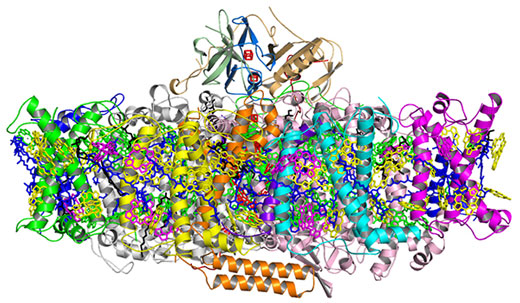 |
| Crystal structure of plant PSI-LHCI supercomplex. |
| Now, Michi Suga, Jian-Ren Shen at Okayama University in collaboration with Tingyun Kuang and Xiaochun Qin at the Chinese Academy of Sciences have solved the crystal structure of plant PSI-LHCI supercomplex to a resolution of 2.8 Å ("Structural basis for energy transfer pathways in the plant PSI-LHCI supercomplex"). |
| The research group purified and crystallized the PSI-LHCI supercomplex from the leaves of a pea plant and succeeded in improving the quality of the crystals dramatically. With these improved crystals the group was able to collect the X-ray diffraction data using the intense X-ray at the synchrotron facility SPring-8 in Japan. They then analysed the data using crystallographic approaches to determine the structure. |
| The improved structure revealed the detailed organization of protein subunits and cofactors. This enabled the mechanisms of energy transfer, regulation, and photoprotection within the PSI-LHCI supercomplex to be examined on a more robust structural basis. |
| This work provides structural insights into the energy absorption and transfer mechanisms in photosynthesis. In addition it may provide a blueprint for the design of light-harvesting setups with extremely high efficiencies that can be utilized in artificial photosynthetic systems. |
| Source: Okayama University |