| Jun 16, 2026 |
Permeable artificial cells open new routes for drug delivery
Selectively controllable, permeable membrane enables a wide range of applications.
|
|
(Nanowerk News) Artificial cells created in the laboratory offer a wide range of potential applications. Until now, however, their membranes - unlike those of real cells - have been virtually impermeable. Researchers at the Max Planck Institute for Polymer Research, led by Director Katharina Landfester, have now developed a new method to make the membranes of artificial cells more permeable to chemical substances. This prepares them for both medical research and future applications such as drug delivery.
|
|
The scientists published their findings in the journal ACS Nano ("Cosurfactant-Induced Disorder in Polymersome Membrane Enhances Diffusion of Cargo Molecules").
|
|
Human cells are complex: from the cell membrane to the cell nucleus, mitochondria, and Golgi apparatus, they contain numerous components—which makes studying them in the lab difficult. Synthetically produced cells, known as polymersomes, are made of special polymers and facilitate laboratory experiments because the “cell” can be reduced to a functional minimum.
|
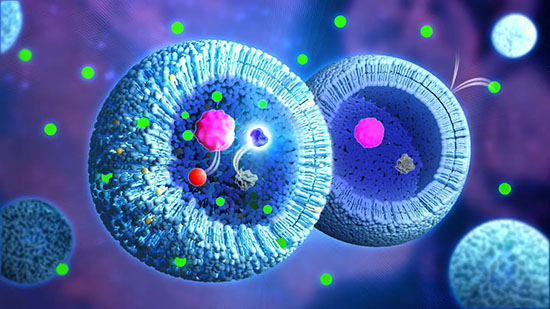 |
| Glucose (green) can diffuse through the membrane. Inside, a reaction cascade is triggered: Glucose dehydrogenase (pink) converts glucose to gluconic acid (red), which simultaneously converts NAD+ (gray) into fluorescent NADH (blue). No reaction takes place in the intact membrane. (Image: Katharina Maisenbacher / MPI-P)
|
|
Specific types of such artificial cells, “Giant Unilamellar Vesicles” (GUVs), are about one-millionth of a meter in size. They are not only interesting for laboratory work but also as transport vehicles for drugs - that is, as miniature drug capsules. They can be loaded with active ingredients and release them, for example, into tumor tissue. Until now, however, the membrane of these cells was not permeable enough - a property that is absolutely essential both for simulating certain processes in the laboratory and for drug delivery.
|
|
“Until now, polymersomes were like locked treasure chests: they could safely store valuable contents such as drugs or enzymes - but the contents could hardly escape, and new substances could hardly get in,” explains Katharina Landfester, director at the Max Planck Institute in Mainz. “Our goal was to make these membranes more ‘permeable’ in a targeted manner—without compromising their stability.”
|
|
The researchers found the key in a so-called co-surfactant - a molecule that is commonly used as an additive in the production of soaps or emulsions. Using a novel microfluidic method (a type of “lab-on-a-chip”), they formed polymersomes, with the co-surfactant oleyl alcohol serving as a solvent. A small portion of this molecule remained in the membrane, acting there as a “disruptive factor” in an otherwise ordered system.
|
|
“This remaining oleyl alcohol disrupts the regular arrangement of the polymer molecules in the membrane,” explains Gabrielle Ong, first author of the study. “A kind of ‘disorder’ arises—like a warped board on the side of a neatly stacked box. This disorder makes the membrane more permeable.”
|
|
Using methods such as nuclear magnetic resonance spectroscopy and sum-frequency spectroscopy, the researchers were able to show that the membrane becomes more disordered, thereby increasing the permeability of the artificial cells.
|
|
They also demonstrated this concept experimentally: the polymersomes were placed in a glucose solution, allowing glucose molecules to diffuse through the permeable membrane. Inside the polymersomes, the glucose initiated an enzymatic cascade reaction that resulted in the formation of the fluorescent molecule NADH.
|
|
The researchers were able to detect the characteristic fluorescence of NADH, confirming that glucose had successfully entered the polymersomes and triggered the reaction. In contrast, polymersomes with a non-permeable membrane showed no fluorescence, demonstrating that the membrane permeability was essential for the process.
|
|
“We have not only created a new tool for research - we have also introduced a new principle for materials development: disorder can be specifically harnessed to generate function,” says Priyanka Sharan, group leader and co-author of the study.
|
|
The findings open up new possibilities for the creation of artificial cells that carry out complex chemical reactions similar to those in living cells, as well as for smart materials that respond to environmental factors such as pH or salt concentration.
|