| May 12, 2017 |
New lung 'organoids' in a dish mimic features of full-size lung (w/video) |
| (Nanowerk News) New lung "organoids"--tiny 3-D structures that mimic features of a full-sized lung--have been created from human pluripotent stem cells by researchers at Columbia University Medical Center (CUMC). The team used the organoids to generate models of human lung diseases in a lab dish, which could be used to advance our understanding of a variety of respiratory diseases. |
| A paper detailing the discovery was published in Nature Cell Biology ("A three-dimensional model of human lung development and disease from pluripotent stem cells"). |
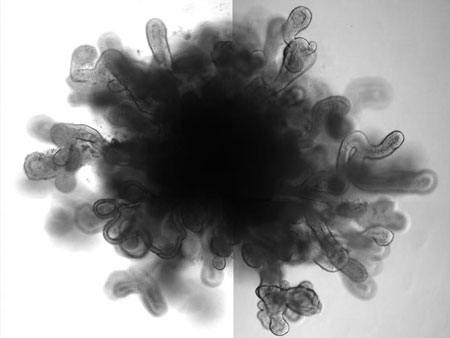 |
| Bright-field images of day 50 LBO-derived Matrigel colonies from RUES2 cells. Representative of six independent experiments. Scale bars, 500 µm. (Image: Snoeck lab/Columbia University Medical Center) |
| Organoids are 3-D structures containing multiple cell types that look and function like a full-sized organ. By reproducing an organ in a dish, researchers hope to develop better models of human diseases, and find new ways of testing drugs and regenerating damaged tissue. |
| "Researchers have taken up the challenge of creating organoids to help us understand and treat a variety of diseases," said Hans-Willem Snoeck, PhD, professor of medicine (in Microbiology & Immunology) at CUMC and lead investigator of the study. "But we have been tested by our limited ability to create organoids that can replicate key features of human disease." |
| The lung organoids created in Dr. Snoeck's lab are the first to include branching airway and alveolar structures, similar to human lungs. |
| To demonstrate their functionality, the researchers showed that the organoids reacted in much the same way as a real lung does when infected with respiratory syncytial virus (RSV). Additional experiments revealed that the organoids also responded as a human lung would when carrying a gene mutation linked to pulmonary fibrosis. |
| This video shows a mini organ in a dish mimics full-sized lung. |
| RSV is a major cause of lower respiratory tract infection in infants and has no vaccine or effective antiviral therapy. Idiopathic pulmonary fibrosis, a condition that causes scarring in the lungs, causes 30,000 to 40,000 deaths in the U.S. each year. A lung transplant is the only cure for this condition. |
| "Organoids, created with human pluripotent or genome-edited embryonic stem cells, may be the best, and perhaps only, way to gain insight into the pathogenesis of these diseases," Dr. Snoeck says. |
| Source: Columbia University Medical Center |