| Sep 18, 2025 |
Unlocking ceramic 3D printing for next-generation chemical reactorsScientists have integrated binder jet additive manufacturing with an advanced post-processing method to fabricate leak-tight ceramic components, overcoming a key challenge of ceramic additive manufacturing. |
| (Nanowerk News) While ceramic components perform exceptionally well in extreme environments — exhibiting high temperature resistance, chemical stability and mechanical strength — current methods of ceramic 3D printing fall short on scalability. This shortcoming limits their use in critical applications such as high-throughput chemical reactors, which are used for pharmaceutical or chemical processing, where large, leak-proof parts are essential. |
| ORNL’s innovative solution provides a scalable method for creating complex ceramic structures by leveraging a robust joining technique that enables smaller 3D-printed pieces to be assembled to create the needed components. |
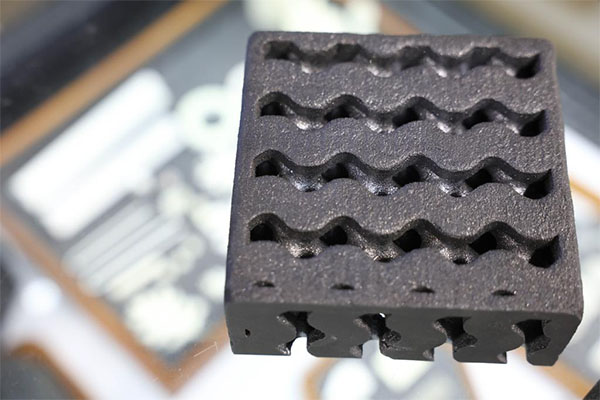 |
| This component was 3D-printed, filled with a silicon-carbide pre-ceramic polymer and heat-treated to produce amorphous silicon carbide. (Image: Amy Smotherman Burgess, ORNL) |
| “Ceramic 3D printing allows fabrication of intricate and high-performance components that are difficult to achieve with traditional manufacturing methods,” said lead researcher Trevor Aguirre with ORNL’s Extreme Environment Materials Process Group. “This advancement provides a validated methodology to produce high-quality components — and enable the development of next-generation reactors.” |
| The research team tested multiple design configurations to identify optimal structures that inherently support gas-tight integrity and developed post-processing techniques to enhance the bonding and sealing of ceramic segments. |
| Not only does the innovation help meet the increasing demand for large-scale components, but it also leverages cost-efficient binder jet additive manufacturing, or BJAM, where powder layers are fused with a binder to create solid objects. This method offers substantial economic benefits and paves the way for broader industrial adoption of ceramic additive manufacturing in other high-performance applications such as aerospace, among others. |
| This is the first known leak-tight joint fabricated using additive manufacturing methods, paving the way for scalable BJAM assemblies. |
| The ORNL team received SME’s 2025 Dick Aubin Distinguished Paper Award for this research, which recognizes significant contributions to additive manufacturing. The team also has related research published in the Ceramics International journal ("Packing density optimization and recyclability of multi-modal SiC powder feedstocks in binder jet additive manufacturing"). |
| Source: Oak Ridge National Laboratory (Note: Content may be edited for style and length) |
Check out this primer on 3D printers for beginners and professionals as well as this overview of the best repositories for free and downloadable 3D printing models and design files.