| Sep 23, 2025 |
A new bone substitute made from 3D-printed glassResearchers created a 3D-printable bioactive glass that supports bone growth in rabbits, offering a low-cost, effective substitute for bone repair. |
| (Nanowerk News) You might think that glass has no business acting as a replacement for bone, but it turns out the two materials have many similarities. Researchers reporting in ACS Nano ("Rational Design of Purely Inorganic Self-Healing Colloidal Hydrogels To Enable “Green” 3D Printing of Bioglass-Based Bone Substitutes") developed a 3D printable bio-active glass that served as an effective bone replacement material. In rabbits, it sustained bone cell growth better than regular glass and a commercially available bone substitute. |
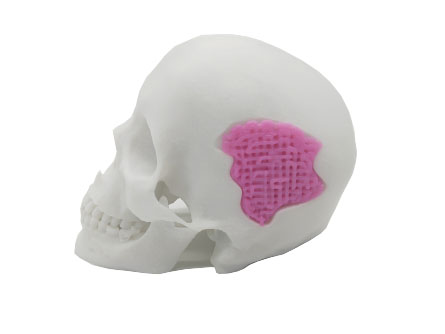 |
| This 3D-printable bio-active glass (shown in pink) could one day be used as a bone substitute. (Image: Adapted from ACS Nano 2025, DOI:10.1021/acsnano.5c06377) |
| Both bone and glass can bear weight better than they can withstand being stretched because of the crystalline structures of the molecules and minerals forming them. But unlike bone, the main ingredient in glass — silica — can exist in a liquid form and can be 3D printed into any desired shape, such as a perfect match to a missing section of bone. However, most 3D-printable glass requires toxic plasticizing agents, or the glass needs to be fused at temperatures higher than 2,000 degrees Fahrenheit (1,100 degrees Celsius). |
| So, Jianru Xiao, Tao Chen, Huanan Wang and colleagues wanted to develop a 3D-printable glass that didn’t require plasticizers or extremely high temperatures to serve as a scaffold for bone-forming cells. |
| The researchers combined oppositely charged silica particles as well as calcium and phosphate ions — both known to induce bone cell formation — to form a printable, bio-active glass gel. After the glass was shaped with a 3D printer, it was hardened into its final shape in a furnace at a relatively cool 1,300 F (700 C). Next, they tested the new bio-glass against a 3D printed plain silica glass gel and a commercially available dental bone substitute by repairing skull damage in living rabbits. |
| Although the commercial product grew bone faster, the bio-glass sustained growth longer; after 8 weeks, most bone cells present had grown on the bio-glass scaffold. The plain glass had barely any bone cell growth. The researchers say that this work demonstrates an easy, low-cost way to 3D print a bio-glass bone substitute, which could have wide-ranging applications across medicine and engineering. |
| Source: American Chemical Society (Note: Content may be edited for style and length) |
Check out this primer on 3D printers for beginners and professionals as well as this overview of the best repositories for free and downloadable 3D printing models and design files.