

| Sep 30, 2025 |
Breakthrough in 3D printing glass - without glueResearchers pioneer binder-free 3D printing of glass, using light to form precise silica structures for optics, medicine, and microfluidics. |
| (Nanowerk News) Glassmaking has always been inseparable from heat. Whether in furnaces or flame-polished labware, shaping silica has meant temperatures soaring past a thousand degrees and little room for complex designs. But a team at the Hebrew University of Jerusalem has now found a way to sidestep fire altogether, creating a binder-free method for 3D printing glass that works at a fraction of the usual heat. |
| In their study, published in Materials Today ("Stereolithography-based 3D printing of silica with solutions without organic binders"), Amir Reisinger, Natanel Jarach, and Shlomo Magdassi of the Institute of Chemistry describe a light-driven process that produces silica structures directly, without the organic binders that have dominated glass printing until now. These binders, long a necessary compromise, must be burned away in a second step that risks cracking, shrinking, or blurring fine details. By eliminating them entirely, the researchers have simplified glass fabrication and sharpened its precision. |
| The chemistry behind the method is based on a photo-induced sol-gel reaction. When exposed to light inside a standard digital light processing printer, the material undergoes a controlled transformation into a solid silica network. After only a modest heat treatment at 250 °C—far lower than the temperatures of conventional glassmaking—the printed object becomes porous glass with measurable transparency. |
| The approach yields centimeter-scale pieces, suggesting that it can extend beyond fragile lab prototypes to objects robust enough for practical use. |
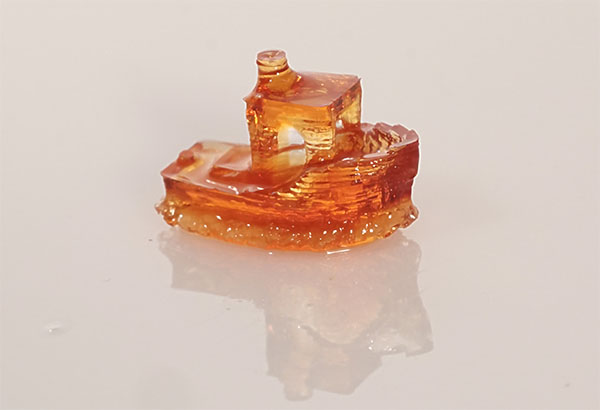 |
| 3D printed glass structure in the shape of a boat. (Image: Hebrew University of Jerusalem) |
| That matters because glass underpins much of modern technology. It carries global communications through fiber optics, channels fluids in diagnostic chips, and acts as the transparent skeleton of countless optical devices. The ability to print customized components directly from light and silica opens possibilities in fields that demand both precision and resilience. |
| The researchers imagine tailor-made micro-lenses and waveguides for optics, lab-on-a-chip platforms for biomedical engineering, and intricate microfluidic networks for chemical testing—all built without the waste or energy burden of older methods. |
| “Glass is one of humanity’s oldest materials, but this approach brings it into the 21st century,” Magdassi said. “By making glass 3D printing cleaner and more versatile, we’re opening the door to applications that touch every aspect of modern life.” |
| Source: Hebrew University of Jerusalem (Note: Content may be edited for style and length) |
Check out this primer on 3D printers for beginners and professionals as well as this overview of the best repositories for free and downloadable 3D printing models and design files.

