| Oct 21, 2025 |
Smart aquabots bring camouflage and environmental sensing to life
Scientists built ethanol-powered leaf-like robots that move quietly on water, gather data, and blend with nature, offering a new path for sustainable aquatic tech.
|
|
(Nanowerk News) Tiny robots that glide silently across the surface of water could soon play a big role in protecting the environment. Researchers from the University of Macau and Huazhong University of Science and Technology have created programmable, leaf-inspired “S-aquabots” powered by a fuel-efficient Marangoni motor.
|
|
Their study appeared in eScience ("Bio-inspired and programmable Marangoni motor for highly maneuverable and adaptable S-aquabots").
|
|
The centimeter-scale robots use ethanol-fueled propulsion, flexible electronics, and a biomimetic design to move efficiently and adapt to changing conditions on the water’s surface. In demonstrations, the S-aquabots navigated obstacles, collected pollutants, and streamed live video—all without wires or bulky power systems. The quiet, agile robots could help monitor lakes, rivers, and coastal areas for long periods without disturbing wildlife.
|
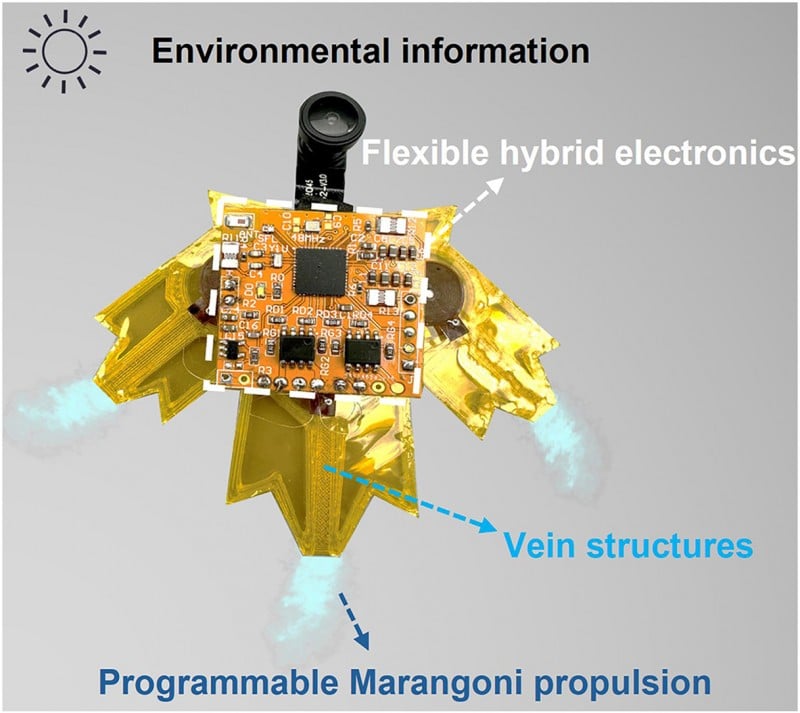 |
| Leaf-inspired aquabot with programmable propulsion and sensing. A bio-inspired S-aquabot integrates flexible hybrid electronics, vein-like fuel channels, and a programmable Marangoni motor. The design enables precise propulsion, camouflage, and real-time environmental information collection, demonstrating its potential for outdoor monitoring and adaptive aquatic robotics. (Image: Provided by the authors)
|
|
The innovation at the heart of this technology is the programmable Marangoni motor, or PM-motor. Inside each robot, ethanol stored in small chambers is released through vein-like channels under electromagnetic control. This controlled release changes the water’s surface tension, creating a propulsive force that pushes the robot forward—a process inspired by how beetles move on water.
|
|
The design is remarkably efficient: 1.2 milliliters of ethanol powers 226 seconds of motion, covering distances of about five meters. That’s 3.5 times more fuel-efficient than comparable systems. The robots can execute precise maneuvers such as U-turns, spins, and even follow predesigned paths shaped like a butterfly, guided by laser spots.
|
|
Their leaf-inspired forms also allow them to blend in naturally with floating vegetation. Moving at about 40 decibels—roughly the sound level of background noise—the S-aquabots operate in near silence. Different shapes optimize either speed, stability, or camouflage, enabling each robot to take on specialized tasks.
|
|
Each S-aquabot carries compact, flexible electronics that support wireless control and data transmission over distances of up to 50 meters. Outfitted with miniature cameras and sensors, they can record environmental data such as light intensity and air temperature in real time. This combination of agility, endurance, and sensing capability makes them ideal for long-term environmental monitoring.
|
|
“Our leaf-inspired S-aquabots demonstrate how biomimicry and advanced materials can overcome the long-standing challenges of aquatic robotics,” said corresponding author Professor Junwen Zhong. “By combining programmable Marangoni propulsion with flexible electronics, we achieved both precise control and multifunctionality in untethered water robots. The quiet motion and natural camouflage open possibilities for unobtrusive environmental monitoring.”
|
|
The research team envisions broad applications for these adaptable robots—from tracking pollutants and measuring water quality to assisting in search-and-rescue missions. Their naturalistic design allows them to operate without alarming animals, while future versions may draw on renewable energy like solar power for extended operation.
|
|
The S-aquabots represent a major step toward a new generation of aquatic robots that combine ecological awareness with technological precision, helping scientists monitor and protect fragile water ecosystems.
|