| Jun 26, 2026 |
Building digital twins as decision infrastructure for a complex world
From healthcare to climate forecasting, digital twins are expanding rapidly, with uncertainty, interoperability, and user needs emerging as key priorities.
|
|
(Nanowerk News) The growing availability of real-time data from satellites, sensors, and smart devices is making it possible to build detailed virtual versions of real-world systems. Known as digital twins (DTs), these systems use real-time data to simulate, analyze, and test different scenarios before they are applied in the real world.
|
|
DTs now operate across scales, from modeling molecular behavior for drug discovery to simulating extreme weather events and climate systems. They are also increasingly used in fields such as healthcare, infrastructure management, robotics, and urban planning. However, the rapid growth of DTs has also brought major challenges, including privacy, cybersecurity, interoperability, uncertainty, and transparency. As DTs become more detailed and influential, the paper emphasizes the need for interoperable architectures, machine-readable metadata, and standardized trust frameworks.
|
|
In a study published in the journal Big Earth Data ("Digital twins as decision infrastructure: evolution, architecture, and research roadmap"), researchers from George Mason University, Penn State University, University of Wisconsin-Madison, Harvard University, and Virginia Tech collaborated to review the current state of DTs and examined how this technology could evolve in the future.
|
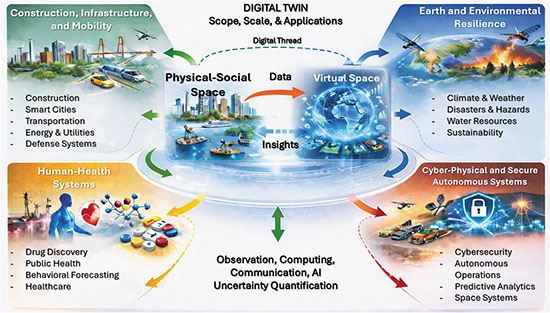 |
| Application landscape of digital twin research across multiple domains, supported by cross-cutting technological advancements that enable data acquisition, modeling, simulation, and intelligent decision-making. (Image: Reproduced from DOI:10.1080/20964471.2026.2678046, CC BY) (click on image to enlarge)
|
|
The review places particular focus on Earth system DTs, one of the most ambitious applications of this technology. These systems aim to combine environmental observations with physical models to simulate and predict large-scale processes such as hurricanes, wildfires, sea ice changes, and climate patterns, helping governments and organizations make better decisions about environmental risks and climate adaptation.
|
|
“Most work on DTs has been informed by research gaps and directions that were expert-driven and high-level. Our aim was to provide a systematic, evidence-based understanding of how DTs are evolving and what is needed for the next generation of systems,” noted Professor Chaowei Yang of George Mason University, USA, the corresponding author of this publication.
|
|
The paper defines DTs as decision infrastructures that integrate sensing, modeling, artificial intelligence (AI), and data infrastructures to dynamically represent and simulate physical or social systems. They evolve from describing current conditions, to predicting what comes next, to exploring what-if scenarios, and ultimately to enabling autonomous, uncertainty-aware decision-making across socio-technical systems.
|
|
The researchers emphasize that building useful DTs must ultimately be guided by user needs rather than technological enthusiasm alone. DTs should not function as ‘black boxes,’ where users cannot understand how decisions are made. In areas such as healthcare, public policy, and environmental management, decision-makers must understand not only predictions but also the reasoning behind them.
|
|
“A successful DT must begin with a clearly defined purpose. The central question is not whether a DT can be built, but whether it provides measurable improvement in decision-making,” mentions Prof. Yang.
|
|
As DTs become more advanced, they also place growing demands on computing systems. Large-scale DTs used for climate and environmental prediction, for example, require enormous amounts of data storage and fast computing systems to process information quickly. The study notes that these systems must balance detail and accuracy with uncertainty, ensuring predictions are both useful and understandable.
|
|
The researchers also suggest that better DTs do not necessarily depend on collecting more data. Instead, measurement design should be guided by decision needs, information gain, and the minimum useful dataset needed for effective integration.
|
|
At the same time, maintaining security and preventing bias in data are necessary. DTs often rely on sensitive information and automated systems, creating risks related to cyberattacks, privacy, and misuse of data. To address these issues, the researchers emphasize transparent governance, participatory design, and standardized trust frameworks so that DTs remain understandable, interoperable, and accountable. They argue that future DT systems should not only be scientifically accurate but also aligned with user needs and decision-making in real-world settings.
|
|
Prof. Yang highlighted the multifaceted nature of the technology, stating: “DTs represent a convergence of modeling, AI, sensing, computing, and governance. Their future depends on balancing computing demands: scalability and fidelity, innovation and regulation, individualized precision and population-level robustness, and openness and security.”
|
|
The researchers conclude that the next generation of DTs will gradually incorporate expertise from many fields, such as physics, computing, data science, governance, and decision-making. Rather than static digital models, DTs are expected to evolve into systems that support smarter decisions in increasingly complex environments.
|