

| Posted: Jul 03, 2006 |
A zinc oxide nanocomb biosensor for glucose detection |
| (Nanowerk Spotlight) New research shows that ZnO nanostructures are suitable for electrochemical biosensors. The enzyme used for glucose detection, glucose oxidase, was attached to ZnO nanocombs which resulted in a biosensor that exhibits a high affinity, high sensitivity, and fast response for glucose detection. This simple method of fabricating a ZnO based biosensor can be extended to immobilize other enzymes and other bioactive molecules on various 1D metal oxide nanostructures, and form versatile electrodes for biosensor studies. |
| This first report of constructing ZnO nanostructure glucose biosensors, titled "Zinc oxide nanocomb biosensor for glucose detection" was published in the June 5, 2006 issue of Applied Physics Letters. |
| Professor Xiaowei Sun from the School of Electrical and Electronic Engineering at Nanyang Technological University in Singapore, one of the report's authors, explains to Nanowerk: "We found that ZnO nanostructures, nanocombs in our case, can effectively modify the gold electrodes in the application of electrochemical biosensing." Sun explains several unique aspects of ZnO: |
| (1) A large isoelectric point (IEP) of 9.5, which allows it to attract low IEP proteins in a neutral solution by electrostatic attraction. This is a strong force that makes ZnO a better material to immobilize proteins (in our case, glucose oxidase); |
| (2) ZnO is a transparent conductor traditionally used as transparent electrodes for flat panel displays and solar cells, meaning it is a good electron communicator which can collect electrons generated in oxidizing glucose very efficiently and send them to the gold electrodes; |
| (3) ZnO nanostructures have large surface areas, indicating the device is sensitive and has fast response; in particular our nanocomb forms a dense network for large loading of enzyme and charge transferring channels; |
| (4) Other advantages include nontoxicity, chemical stability, and preserving the activity of the enzyme loaded. |
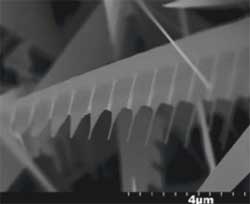 |
| SEM image of a ZnO nanocomb (Reprinted with permission from the American Institute of Physics) |
| "Typical electrochemical glucose biosensors using gold electrodes have low sensitivity" explains Sun. "Using our ZnO nanocomb electrodes, high loading of enzyme can be realized to enable a high sensitivity biosensor. Moreover, our ZnO nano electrodes can be used for other biosensors by changing the enzyme." |
| "Historically, we have been working on ZnO and its nanostructures, and we are constantly looking for new applications of these nanostructures" says Sun. "Looking ahead, we can expect a cheap and high sensitivity biosensor as a result of our work. Of course, we need to do more experiments to test out the durability and some manufacturing issues." |
 By
Michael
Berger
– Michael is author of four books by the Royal Society of Chemistry:
Nano-Society: Pushing the Boundaries of Technology (2009),
Nanotechnology: The Future is Tiny (2016),
Nanoengineering: The Skills and Tools Making Technology Invisible (2019), and
Waste not! How Nanotechnologies Can Increase Efficiencies Throughout Society (2025)
Copyright ©
Nanowerk LLC
By
Michael
Berger
– Michael is author of four books by the Royal Society of Chemistry:
Nano-Society: Pushing the Boundaries of Technology (2009),
Nanotechnology: The Future is Tiny (2016),
Nanoengineering: The Skills and Tools Making Technology Invisible (2019), and
Waste not! How Nanotechnologies Can Increase Efficiencies Throughout Society (2025)
Copyright ©
Nanowerk LLC
|

Become a Spotlight guest author! Join our large and growing group of guest contributors. Have you just published a scientific paper or have other exciting developments to share with the nanotechnology community? Here is how to publish on nanowerk.com.
