| Posted: August 5, 2009 |
New insights into health and environmental effects of carbon nanoparticles |
|
(Nanowerk News) A new study raises the possibility that flies and other insects that encounter nanomaterial “hot spots,” or spills, near manufacturing facilities in the future could pick up and transport nanoparticles on their bodies, transferring the particles to other flies or habitats in the environment. The study on carbon nanoparticles — barely 1/5,000th the width of a human hair —is scheduled for the Aug. 15 issue of ACS’ Environmental Science & Technology ("Differential Toxicity of Carbon Nanomaterials in Drosophila: Larval Dietary Uptake Is Benign, but Adult Exposure Causes Locomotor Impairment and Mortality").
|
|
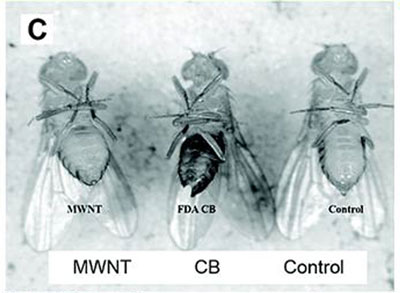
| Researchers are reporting that carbon nanoparticles can be transmitted by fruit flies and that certain nanoparticles can be toxic to adult flies. (Image: American Chemical Society)
|
|
David Rand and Robert Hurt and colleagues note that emergence of a nanotechnology industry is raising concerns about the potential adverse health and environmental effects of nanoparticles. These materials show promise for use in a wide range of products, including cosmetics, pharmaceuticals, and electronics.
|
|
The study focused on determining how different kinds of exposure to nanoparticles affected larval and adult fruit flies. Scientists use fruit flies as stand-ins for humans and other animals in certain kinds of research. There were no apparent ill effects on fruit fly larvae that ate food containing high concentrations of nanoparticles. However, adult flies died or were incapacitated when their bodies were exposed to large amounts of certain nanoparticles.
|
|
During the experiments, the researchers noted that contaminated flies transferred nanoparticles to other flies, and realized that such transfer could also occur between flies and humans in the future. The transfer involved very low levels of nanoparticles, which did not have adverse effects on the fruit flies. Since larvae can tolerate very high doses of nanoparticles in the diet, but adult flies show very different sensitivities, the environmental impact depends on the ecological context of nanoparticle release.
|
