| Posted: August 7, 2009 |
Nanoparticles take on terrorism |
|
(Nanowerk News) Chinese scientists have used sunlight and DNA to make bimetallic nanoparticles that can detect tiny amounts of explosives ("Sunlight-induced formation of silver-gold bimetallic nanostructures on DNA template for highly active surface enhanced Raman scattering substrates and application in TNT/tumor marker detection" – free access article).
|
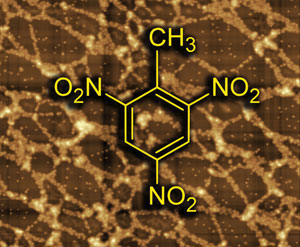 |
| Sunlight induces bimetallic nanoparticles to form on DNA. The particles can be used to detect explosives.
|
|
Liang-bao Yang and colleagues, at the Chinese Academy of Science, Hefei, exposed a solution of silver nitrate and DNA to sunlight. The light reduced the silver ions to form silver nanoparticles on the DNA. They then added gold ions, which they reduced with light, forming a gold coating on the silver particles. The synthesis is simpler and greener than other methods for making bimetallic nanoparticles, says Yang.
|
|
The team found that the nanoparticles are excellent substrates for surface enhanced Raman scattering (SERS) - their size and shape magnifies light scattering and makes it easier to detect low concentrations of absorbed molecules. They used them to detect the explosive 2,4,6-trinitrotoluene at lower concentrations than previously tested. Yang predicts that the nanoparticles could represent another weapon in the fight against terrorism.
|
|
Katrin Kneipp, an SERS expert at the Technical University of Denmark, Kongens Lyngby, says this 'is a very interesting new way to make SERS active substrates' but cautions that the nanoparticles need further testing.
|
|
The nanoparticles could have many applications in other fields, comments Yang. The team have already used them for detecting cancer and now plan to focus on improving their stability and selectivity.
|
