| Posted: February 28, 2007 |
Seeing buckyballs inside human cells |
|
(Nanowerk News) C60 particles known as fullerenes or buckyballs have the potential to serve as direct drug-delivery messengers or be used for other beneficial purposes, but they can be toxic to cells. How the tiny particles do damage depends on where they end up.
|
|
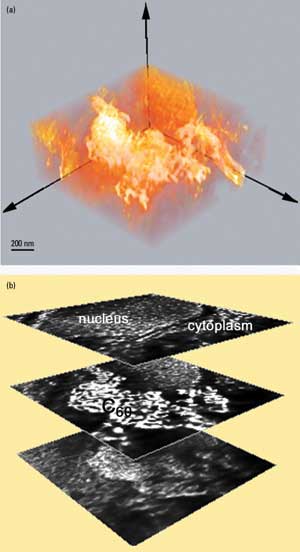
For the first time, researchers have found a way to observe the uptake of C60 into the cytoplasm and nuclei of human macrophage cells, in research published today on Environmental Science & Technology’s Research ASAP website ("Visualizing the Uptake of C60 to the Cytoplasm and Nucleus of Human Monocyte-Derived Macrophage Cells Using Energy-Filtered Transmission Electron Microscopy and Electron Tomographys") that relies on the use of energy-filtered transmission electron microscopy (TEM).
|
|
A team of researchers led by Alexandra Porter of the Nanoscience Centre at the University of Cambridge (U.K.) produced TEM images that provide cloudlike tomographic maps of the material inside cells. Interpreting these images from in vitro experiments, the team confirms that human macrophages take up C60 and then sequester the particles mainly in the cytoplasm and lysosomes. But sometimes the C60 ends up inside the cells’ nuclei, as shown in this image.
|
 |
(Image: Alexandra Porter and coauthors)
|
|
“If you can’t visualize where things are, being able to interpret the biochemistry is nearly impossible,” says Trevor Douglas of Montana State University. “What they’re doing is so incredible: to pull out a signal for buckyballs and carbon that’s different from the carbon in the cell,” he says. “This is really a very huge step. They’re not manipulating the system at all; they’re looking at it directly.”
|
|
Now that the method works for in vitro samples, the team can move on to experiments in vivo, Porter says, to look for functional consequences of exposure. Even though the researchers can map nanoparticles inside cells, Porter continues, “we now have to back this up with toxicity assays, and that’s when it becomes important.”
|
|
|
