| Dec 22, 2011 |
Targeted immune stimulation based on DNA nanotechnology
|
|
(Nanowerk News) DNA is usually known as the genetic code for protein synthesis in all living organisms. The application of DNA as a molecular building block on the other hand, allows for the construction of sophisticated nanoscopic shapes that are built entirely from DNA. In particular the recent invention of the so-called DNA origami method facilitates the fabrication of almost all imaginable 3D shapes. Here a phage-based DNA strand is used as a scaffold that is woven into shape by hundreds of short staple oligonucleotides. The outstanding advantage of DNA-based self-assembly is that during a single fabrication process billion exact copies of the designed DNA nanostructure are produced in parallel.
|
|
Now Prof. Tim Liedl, a member of Nanosystems Initiative Munich (NIM), and his team developed a DNA origami construct that serves as a carrier system to selectively stimulate immune responses of living cells. Together with the group of Prof. Carole Bourquin from the Klinikum der Universität München (KUM) the biophysicists investigated the systematic immune stimulatory effect and the potential cytotoxicity of these DNA nanostructures (see paper in ACS Nano: "Cellular Immunostimulation by CpG-Sequence-Coated DNA Origami Structures").
|
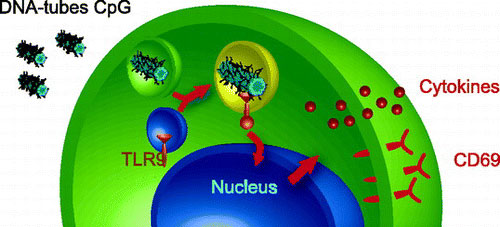 |
| To investigate the potential of DNA origami constructs as programmable and noncytotoxic immunostimulants, the researchers tested the immune responses induced by hollow 30-helix DNA origami tubes covered with up to 62 cytosine-phosphate-guanine (CpG) sequences in freshly isolated spleen cells. (© ACS Nano)
|
|
Our innate immune system can detect invasive organisms via a specific DNA motif, the so called CpG sequences ("Cytosine – phosphate – Guanine") which are prevalent in viruses and bacteria. When these sequences are internalized by certain immune cells, they are recognized by endosomal receptors like the Toll-Like Receptor 9 (TLR-9) which subsequently activate the immune system. The Toll-Like Receptors became famous at the latest in 2011, when Bruce Beutler and Jules Hoffmann received the Nobel Prize for their research on these kinds of receptors.
|
|
Verena Schüller from the Liedl group and her colleagues decorated a DNA origami construct with artificial CpG sequences and used it as an efficient non-toxic carrier system into cells. Together with the team of Carole Bourquin they demonstrated a selective immune stimulating effect of the DNA complexes by measuring the interleukin secretion of the cells as an indicator for immune activation. Such artificial nanostructures could act in future applications as target-selective delivery vehicles for the development of novel and non-toxic vaccine adjuvants or carrier systems in tumor immunotherapy.
|
