| Posted: August 22, 2006 |
Nanowire-paper offers strength, flexibility |
|
(Nanowerk News) University of Arkansas researchers have created assemblies of nanowires that show potential in applications such as armor, flame-retardant fabric, bacteria filters, oil cracking, controlled drug release, decomposition of pollutants and chemical warfare agents.
|
|
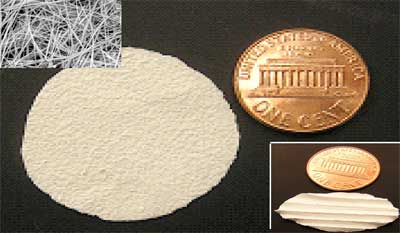
This two-dimensional "paper" can be shaped into three-dimensional devices. It can be folded, bent and cut, or used as a filter, yet it is chemically inert, remains robust and can be heated up to 700 degrees Celsius.
|
 |
| (Source: University of Arkansas)
|
|
"Humans have used paper made from natural fibers for thousands of years," said Z. Ryan Tian, assistant professor of chemistry and biochemistry in the J. William Fulbright College of Arts and Sciences. "With this technology, we are entering a new era." The researchers published their findings in the Journal of Physical Chemistry B.
|
|
Tian and his team used a hydrothermal heating process to create long nanowires out of titanium dioxide and from there created free-standing membranes. The resulting material is white in color and resembles regular paper. Further, the material can be cast into different three-dimensional shapes, with different functions. The researchers have created tubes, bowls and cups using this process. These three-dimensional hollow objects can be manipulated by hand and trimmed with scissors, the researchers report.
|
|
The university has applied for patent protection on the process used to create the free-standing membranes for filtration and catalysis, and is looking for industrial partners to license and commercialize various applications of the nanopaper technology.
|
