| Posted: March 23, 2009 |
New materials boost efficiency of blue OLEDs by 25% |
|
(Nanowerk News) Lighting consumes one-fifth of the electricity generated in the United States. Solid-state lighting offers tremendous potential to improve the situation - once major research challenges are overcome.
|
|
The most promising technology is the organic light-emitting diode, or OLED. These multi-layered devices produce light by running an electrical current through a specially engineered host material into which light-producing phosphorescent molecules are embedded or "doped." The white light envisioned for large-scale applications, such as rooms and buildings, consists of red, green and blue light.
|
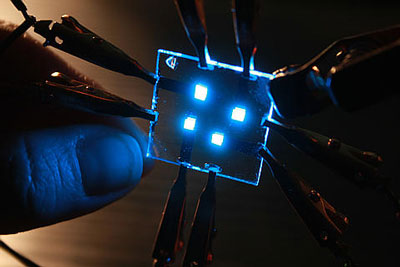 |
| New host materials for a blue phosphorescent OLED boost efficiency by at least 25 percent and help solve "weakest link" in development of cost-effective white OLEDs.
|
|
"The weakest link in OLED research is the absence of an efficient, long-lasting blue light to accompany the red and green," said Pacific Northwest National Laboratory scientist Asanga Padmaperuma. Development of better host materials to manage the flow of electricity through the device could help solve that problem.
|
|
Padmaperuma and his collegues have designed, synthesized and tested new materials that improve the power efficiency of blue OLEDs by at least 25 percent.
|
|
The Department of Energy's solid state lighting program is funding the OLED research.
|
