

What Is Bioethics? Definition, Principles, and Biotechnology Examples
What Is Bioethics?
Definition: Bioethics is the systematic study of moral questions that arise in biology, medicine and the life sciences, especially where scientific capability affects human welfare, individual choice, fairness and social responsibility.
In simple terms: bioethics asks what researchers, clinicians, companies and policymakers ought to do when new biological and medical technologies create difficult choices. For example, it asks whether a clinical trial gives participants enough information to consent, whether an expensive gene therapy should be publicly funded, and whether editing embryos should ever be allowed.
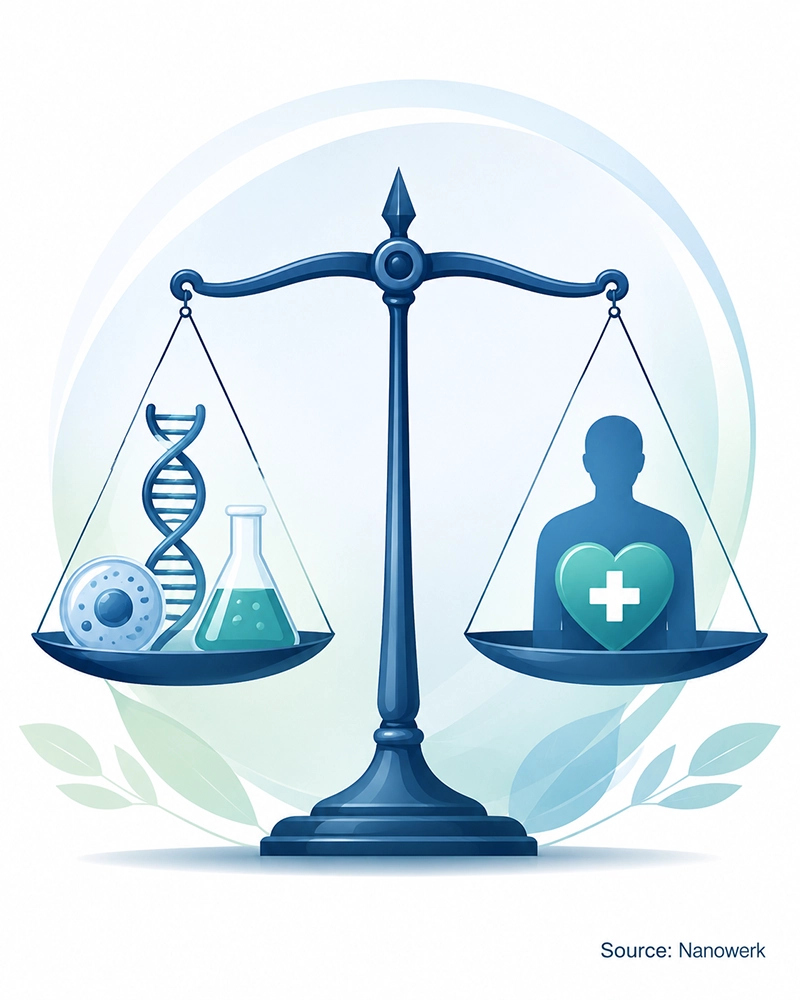
In biotechnology, bioethics provides the framework for deciding how new capabilities should be developed, tested, regulated and used. It is central to clinical trials, gene editing, embryo and stem cell research, biobanking, AI-assisted medicine, synthetic biology and decisions about who gains access to expensive new therapies.
At a glance:
- Bioethics: moral reasoning about biology, medicine and the life sciences
- Four core principles: respect for autonomy, non-maleficence, beneficence and justice
- Foundational texts: the Belmont Report and Beauchamp & Childress's Principles of Biomedical Ethics, both published in 1979
- Key oversight bodies: Institutional Review Boards, research ethics committees, hospital ethics committees and national bioethics commissions
- Current biotechnology issues: genome editing, gene therapy access, embryo research, stem cells, biobanks, AI in medicine and synthetic biology
Why Bioethics Matters in Biotechnology
Biotechnology increasingly makes it possible to edit genomes, grow embryo models, engineer cells, analyze large genomic datasets and use algorithms in clinical decisions. Bioethics does not ask only whether these capabilities work. It asks whether they should be used, under what conditions, who bears the risks, who receives the benefits and how decisions should be made when people reasonably disagree.
The field is best understood as a structured way of reasoning under moral disagreement rather than as a fixed set of answers. It supplies principles, procedures and arguments that help communities make defensible decisions about complex biomedical questions while protecting patients, research participants and wider publics.
Origins and Historical Development of Bioethics
Modern bioethics has direct roots in the trials of Nazi physicians at Nuremberg after the Second World War. Evidence of medical experiments conducted on concentration camp prisoners without consent led to the 1947 Nuremberg Code, which made voluntary informed consent essential to ethical research involving humans. The World Medical Association later extended research ethics requirements in the Declaration of Helsinki, first adopted in 1964 and revised many times since.
In the United States, research scandals exposed in the late 1960s and early 1970s showed that abuses were not confined to wartime. The Tuskegee syphilis study, in which the U.S. Public Health Service observed Black men with untreated syphilis from 1932 until public exposure in 1972, became a central example. These and other cases of unconsented experimentation prompted Congress to pass the National Research Act of 1974, which created the National Commission for the Protection of Human Subjects of Biomedical and Behavioral Research. The commission produced the Belmont Report in 1979.
The Belmont Report identified three principles for research with human participants: respect for persons, beneficence and justice. In the same year, philosopher Tom Beauchamp and theologian James Childress published Principles of Biomedical Ethics, expanding the framework to four principles for clinical practice and research. The book became one of the foundational texts of contemporary Anglo-American bioethics and remains the most widely taught analytic framework in clinical and research ethics. The word "bioethics" had been popularized earlier in the 1970s by oncologist Van Rensselaer Potter, who envisioned a broader discipline linking human health, environmental responsibility and the survival of life systems.
The Four Principles of Bioethics
The four-principles framework developed by Beauchamp and Childress identifies moral norms that recur across many ethical traditions. These principles are treated as prima facie obligations: they apply unless they conflict with another principle of equal or greater weight, in which case they must be balanced through reasoned judgment. The framework is influential, but it is not the only approach. Bioethics also includes care ethics, feminist bioethics, virtue ethics, disability ethics, public health ethics, religious ethics, global health ethics and community-centered approaches.
| Principle | Meaning | Example in biotechnology |
|---|---|---|
| Respect for autonomy | Competent people should be able to make informed, voluntary decisions about their bodies and medical care. | A patient receives clear information before enrolling in a gene therapy trial or consenting to genomic sequencing. |
| Non-maleficence | Researchers and clinicians should avoid causing unnecessary harm. | A stem cell intervention is not offered clinically until safety and efficacy have been demonstrated. |
| Beneficence | Actions should aim to produce benefits and promote welfare. | A clinical trial is designed to answer an important medical question and has a favorable risk-benefit balance. |
| Justice | Benefits and burdens should be distributed fairly. | Access to an approved gene therapy is not limited only to wealthy patients or well-resourced health systems. |
Major Branches of Bioethics
Clinical ethics addresses moral questions in patient care, including informed consent, refusal of treatment, confidentiality, reproductive decisions, end-of-life care and conflicts among patients, families and clinicians. Hospital ethics committees often help resolve difficult cases.
Research ethics governs studies involving human participants. It focuses on scientific merit, risk-benefit assessment, fair participant selection, voluntary informed consent, privacy protections and additional safeguards for groups that may be vulnerable to coercion or exploitation.
Public health ethics examines population-level interventions such as vaccination programs, infectious disease control, screening, surveillance and allocation of scarce resources. It often weighs individual liberty against collective benefit.
Biotechnology and innovation ethics addresses emerging tools such as genome editing, synthetic biology, reproductive technologies, regenerative medicine, AI in healthcare, biobanks and commercial uses of biological data.
Research Oversight and Informed Consent
In most countries, biomedical research involving human participants must be reviewed before it begins by an independent ethics committee. In the United States these committees are called Institutional Review Boards, or IRBs; in many other countries they are called research ethics committees. They review the study's scientific rationale, risks, benefits, recruitment methods, inclusion and exclusion criteria, privacy protections and consent procedures.
Informed consent is not just a signed form. It is a process through which a person receives understandable information about the purpose of a procedure or study, the expected benefits, the foreseeable risks, available alternatives and the right to decline or withdraw. Consent must be voluntary, and participants must have enough capacity and information to make a meaningful decision.
Bioethics in Genome Editing and Gene Therapy
Genome editing illustrates why bioethics is central to modern biotechnology. Somatic editing changes cells in an existing person and is generally evaluated under ordinary medical and research regulation. This pathway has already produced approved therapies, including CRISPR-based treatment for sickle cell disease. Its ethical questions include safety, long-term monitoring, affordability, fair access and the responsibilities of companies and health systems after approval.
Human germline editing is different because changes made to embryos, eggs or sperm could be passed to future generations. Clinical use of heritable genome editing is prohibited or heavily restricted in many jurisdictions and has prompted repeated calls for a voluntary global moratorium or stronger international governance. The central concerns are safety, consent on behalf of future people, social inequality, disability rights, possible enhancement uses and the risk of normalizing genetic selection.
Embryo, Stem Cell and Regenerative Medicine Ethics
Embryo and stem cell research raises questions about the moral status of embryos, the acceptable limits of laboratory culture, consent for donated biological materials and the transition from research to clinical use. The long-standing 14-day rule limited human embryo research to the period before primitive streak formation. In 2021, the International Society for Stem Cell Research revised its guidelines so that some research involving culture beyond 14 days or primitive streak formation moved from a prohibited category to a category that may be considered only after specialized scientific and ethics review, where permitted by local law and supported by public dialogue.
Regenerative medicine also illustrates the principle of non-maleficence. Unproven stem cell clinics can expose patients to physical harm, financial exploitation and false hope. Ethical translation requires credible preclinical evidence, transparent clinical trials, honest communication about uncertainty and regulation against premature marketing.
AI, Biobanks and Synthetic Biology
Artificial intelligence in healthcare creates new versions of older ethical problems. Bioethics asks who is accountable when an algorithm contributes to harm, how meaningful consent works when AI systems influence care, how to prevent biased performance across populations and how to keep clinical decision-making under appropriate human oversight.
Large genomic biobanks and personalized medicine raise related questions about privacy, data sharing, commercial use, return of results, group harms and benefit sharing. Synthetic biology adds concerns about engineered organisms, gene drives, ecological effects, dual-use research and biosafety. In each case, bioethics connects technical possibility with public accountability.
International Frameworks and Governance
Bioethics governance operates at several levels. International instruments include UNESCO's Universal Declaration on Bioethics and Human Rights, the Council of Europe's Oviedo Convention and the Declaration of Helsinki maintained by the World Medical Association. These documents shape norms even when they are not legally binding in the same way as national laws.
National bioethics commissions and advisory bodies provide policy guidance to governments. At the institutional level, IRBs, research ethics committees, hospital ethics committees, animal care and use committees, biosafety committees and stem cell research oversight committees apply principles in day-to-day decisions. This layered system reflects a central feature of bioethics: it produces frameworks, procedures and reasoned arguments rather than automatic answers.
Frequently Asked Questions
What are the four principles of bioethics? The four principles are respect for autonomy, non-maleficence, beneficence and justice. They are widely used in clinical medicine, research ethics and biotechnology policy, but they must often be balanced against one another in specific cases.
What is the difference between bioethics and medical ethics? Medical ethics is the older field, traditionally focused on the duties of physicians to patients and the profession. Bioethics is broader, covering moral questions across biology, medicine, research, biotechnology, public health and environmental issues. Medical ethics is often treated as a major branch of bioethics today, although it retains its own professional history and traditions.
Who decides whether biomedical research is ethical? Research involving human participants is usually reviewed by an independent ethics committee before it begins. In the United States these are called Institutional Review Boards, or IRBs; in Europe and elsewhere they are often called research ethics committees.
What is informed consent? Informed consent is the process by which a competent person voluntarily agrees to a medical procedure or research participation after receiving enough information to understand the purpose, risks, benefits and alternatives. It is the practical expression of respect for autonomy.
Is human germline gene editing allowed? Clinical use of human germline gene editing – editing embryos, eggs or sperm so that changes can be passed to future generations – is prohibited or heavily restricted in many jurisdictions and has prompted repeated calls for a voluntary global moratorium or stronger international governance. Somatic gene editing, which changes cells in a single existing person, is regulated differently and has already produced approved therapies.
Why is bioethics important for AI in medicine? AI in medicine raises questions about accountability, bias, transparency, consent, privacy and the role of human clinicians. Bioethics provides a framework for evaluating these systems before and after they enter clinical practice.
Further Reading
The American Journal of Bioethics, Principles of Biomedical Ethics: Marking Its Fortieth Anniversary
Journal of Law and the Biosciences, CRISPR'd Babies: Human Germline Genome Editing in the He Jiankui Affair
Stem Cell Reports, ISSCR Guidelines for Stem Cell Research and Clinical Translation: The 2021 Update
npj Digital Medicine, Ethical Debates Amidst Flawed Healthcare Artificial Intelligence Metrics
