Genetics: Definition, How Heredity Works, and Modern Applications
Definition: Genetics is the branch of biology that studies genes, heredity, and inherited variation. It explains how DNA stores biological information, how that information is passed from parents to offspring, and how genetic differences influence traits, disease risk, evolution, and biological diversity.
In one sentence: Genetics explains how information encoded in DNA is inherited, expressed, varied, and sometimes altered across cells, individuals, and generations.
What Is Genetics?
Genetics is the science of how living things inherit features from their parents and how those features vary across individuals and populations. At its core is a question that predates modern cell biology: why do offspring resemble their parents, yet remain distinct individuals? The answer lies in DNA, the molecule that stores hereditary instructions, and in the genes that are functional units within that information.
The scale is large. The human genome contains roughly 3.1 billion base pairs of DNA distributed across 23 pairs of chromosomes, with about 20,000 protein-coding genes as well as many DNA regions that regulate gene activity or produce functional RNAs. Any two humans are overwhelmingly similar at the DNA level, but millions of sequence differences and larger structural variants help explain inherited differences among individuals. Genetics is the discipline that connects molecular variation to observable biology.
At a glance:
- Field: the study of genes, heredity, and inherited variation
- Information carrier: DNA, organized into genes, regulatory regions, and chromosomes
- Founding work: Gregor Mendel's pea experiments, 1860s
- Molecular turning point: the DNA double helix, 1953
- Main branches: classical, molecular, population, quantitative, and epigenetics
- Applications: medicine, agriculture, forensics, ancestry, and evolutionary biology
Genetics is foundational to modern biotechnology. It supplies the conceptual framework behind diagnosing inherited disease, breeding crops and livestock, tracing ancestry and evolution, engineering microbes to produce drugs, and editing genomes directly. Understanding the field begins with how the science arose and how heredity works at the molecular level.
A Brief History: From Mendel to Complete Genome Sequences
Modern genetics began in a monastery garden. In the 1860s the Augustinian friar Gregor Mendel crossed pea plants and showed that traits such as seed color and flower shape were inherited as discrete units following predictable ratios, rather than blending smoothly. His work was largely overlooked for decades, rediscovered around 1900, and later became the foundation of classical genetics. The word “gene” was introduced in 1909 to name these units of inheritance, before their physical nature was known.
The molecular era opened in 1953, when James Watson and Francis Crick – building on X-ray diffraction data from Rosalind Franklin and Maurice Wilkins – described DNA as a double helix of paired bases. The structure suggested how genetic information could be copied: each strand can serve as a template for a new partner. Later work decoded the genetic code that links DNA sequence to protein and created tools to read, compare, and alter genes.
Sequencing projects then changed the scale of the field. The Human Genome Project produced a working draft of the human sequence in 2000 and a near-complete reference soon after. In 2022 the Telomere-to-Telomere Consortium published a gapless human genome sequence, adding previously unresolved repetitive regions. Genetics has moved from inferring heredity through breeding experiments to reading, comparing, and in some cases rewriting DNA directly.
How Genetic Information Is Stored and Transmitted
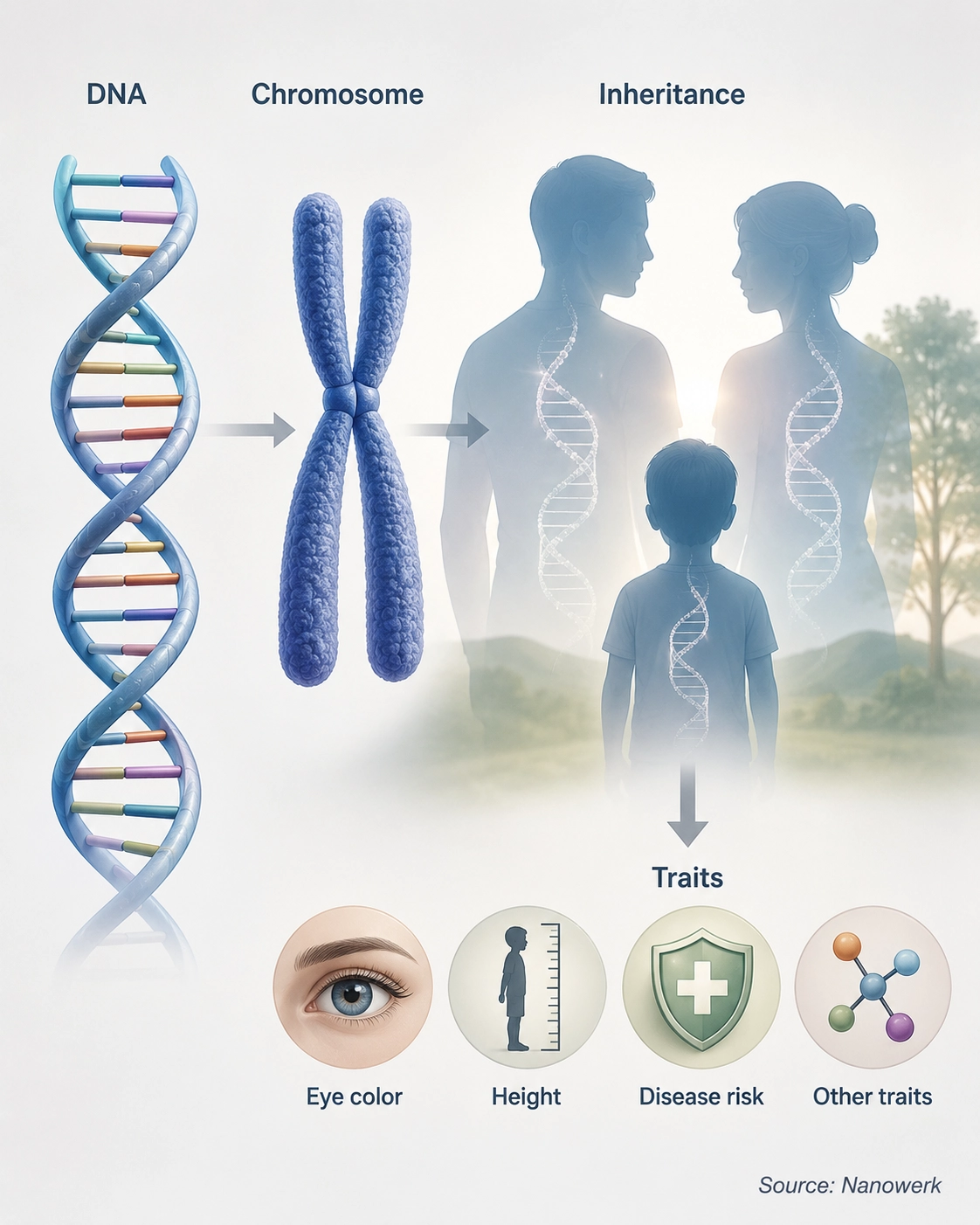
Genetic information is written in DNA as a sequence of four chemical letters, the nucleotide bases adenine, thymine, guanine, and cytosine. DNA is double-stranded, and the two strands are held together by specific base pairs: adenine pairs with thymine, and guanine pairs with cytosine. This complementary pairing is the chemical basis of inheritance, because each strand carries enough information to reconstruct the other when a cell divides.
A gene is a DNA sequence that contributes to a functional product, usually a protein or functional RNA. When a protein-coding gene is active, its DNA sequence is first copied into messenger RNA in a step called transcription, and the RNA is then read in triplets to assemble amino acids during translation. This flow from DNA to RNA to proteins, often called the central dogma of molecular biology, helps connect genotype to cell structure and function. Which genes are switched on, where, and how strongly is controlled by gene regulation, so cells with the same DNA can become very different tissues.
Inheritance follows from how chromosomes are distributed during reproduction. Humans carry two copies of each chromosome, one from each parent, and therefore two copies of most genes. Alternative versions of a gene are called alleles. An individual's combination of alleles is the genotype, while the observable result is the phenotype. When egg and sperm cells form, chromosomes are shuffled and recombined, so each offspring receives a unique mixture. This reshuffling, combined with occasional mutations, generates the variation that genetics studies and evolution acts upon.
The Main Branches of Genetics
Genetics is not one method but a family of approaches that study inheritance at different scales, from single DNA bases to whole populations. Classical, or Mendelian, genetics tracks how discrete traits are inherited through families and remains the basis of genetic counseling. Molecular genetics works at the level of DNA and RNA sequences and mechanisms, and underpins most laboratory genetic engineering. Population genetics describes how allele frequencies change across groups and is central to evolutionary biology and conservation.
Other branches address the complexity of most traits. Quantitative genetics models traits influenced by many genes plus the environment, such as height or blood pressure, and provides the statistical foundation for breeding and genome-wide association studies. Epigenetics studies chemical and structural changes that affect gene expression without changing the DNA sequence itself, such as DNA methylation or changes to chromatin packaging. Some epigenetic states can be maintained as cells divide, and in some cases they may influence inheritance, development, or disease. The table below summarizes how these branches differ in focus and typical use.
| Branch | Unit of study | Central question | Typical application |
|---|---|---|---|
| Classical (Mendelian) genetics | Discrete traits and alleles in families | How is this trait inherited across generations? | Pedigree analysis, genetic counseling |
| Molecular genetics | DNA, RNA, genes, and gene products | How does a gene work at the molecular level? | Disease-gene discovery, genetic engineering |
| Population genetics | Allele frequencies in groups | How do variants spread, disappear, or persist? | Evolution, conservation, ancestry analysis |
| Quantitative genetics | Traits influenced by many genes | How much variation is genetic, environmental, or both? | Crop breeding, animal breeding, complex disease risk |
| Epigenetics | Gene activity and chromatin state | How can gene expression change without DNA sequence changes? | Development, cancer biology, environmental response |
Mutations, Variation, and Evolution
A mutation is a change in DNA sequence. It can be as small as a single base substitution or as large as a deletion, duplication, inversion, or rearrangement of a chromosome. Mutations arise when DNA is copied, repaired, or damaged by environmental factors such as ultraviolet light or certain chemicals. Most have little or no detectable effect. Some disrupt gene function and cause disease, while others provide useful variation that can spread through a population.
Genetic variation is the raw material for evolution. Natural selection can increase the frequency of variants that improve survival or reproduction in a particular environment, while genetic drift can shift variant frequencies by chance. Recombination during sexual reproduction creates new combinations of existing variants. Together, mutation, recombination, selection, migration, and drift explain how populations change over time and why genetics is inseparable from evolutionary biology.
Tools Used in Modern Genetics
Modern genetics depends on methods for reading, comparing, and changing DNA. DNA sequencing identifies the order of bases in a genome or selected region. Polymerase chain reaction, or PCR, amplifies chosen DNA fragments so they can be detected or analyzed. Genome-wide association studies compare genetic variants across large groups to find regions associated with traits or disease risk. The falling cost of sequencing has reduced genome analysis from the scale of the multibillion-dollar Human Genome Project to hundreds or thousands of dollars per genome, depending on platform, coverage, and clinical context.
Genome editing adds a more direct set of tools. CRISPR-Cas systems can be programmed to cut DNA at chosen sites, allowing researchers to disrupt, repair, or replace genetic sequences. Other approaches, including base editing and prime editing, can make some changes without cutting both DNA strands. The flood of sequence data created by these methods depends on bioinformatics, the computational field that turns raw sequence data into biological meaning.
Genetics in Medicine and Agriculture
In medicine, genetics has moved from explaining rare inherited disorders to shaping routine care. Single-gene conditions such as cystic fibrosis, sickle cell disease, and Huntington's disease can be diagnosed by reading the responsible gene. For common diseases such as type 2 diabetes and coronary artery disease, genome-wide association studies have linked many DNA variants to risk, and polygenic scores attempt to combine these into estimates of inherited susceptibility. Pharmacogenetics uses a patient's genotype to help predict drug response, a cornerstone of personalized medicine.
One of the most direct medical applications is correcting or compensating for a genetic defect. Gene therapy can deliver a working gene, modify a faulty one, or alter a patient's cells outside the body before returning them. Several therapies for inherited blindness, spinal muscular atrophy, and certain blood disorders have moved from experiment to approved treatment. A practical limit on polygenic prediction is that scores trained mostly in European-ancestry populations may transfer poorly to other groups, which can widen rather than narrow health inequities if applied uncritically.
In agriculture, genetics is older than the molecular era: selective breeding of crops and livestock is applied population and quantitative genetics. Marker-assisted selection lets breeders track desirable alleles directly in DNA rather than waiting to see the adult plant or animal. Genetically modified organisms carry genes introduced deliberately to confer traits such as pest resistance or improved nutrition. In some countries, gene-edited crops developed without inserting foreign DNA are regulated differently from transgenic GMOs, though rules vary by jurisdiction. Genetics also supports forensic identification, ancestry testing, and the tracing of disease outbreaks through pathogen sequencing.
Ethical, Legal, and Social Considerations
Because genetic information is predictive, shared within families, and effectively permanent, it raises concerns that ordinary medical data does not. Genetic test results can reveal risk for diseases that have not yet appeared and can implicate relatives who never consented to testing. This creates tension around privacy, insurance, employment, and data sharing. Several jurisdictions have enacted genetic non-discrimination protections, though coverage is uneven and the rapid growth of direct-to-consumer testing and large research biobanks continually tests their limits.
Gene editing sharpens these questions. Editing the cells of a consenting patient is widely accepted in principle, but heritable editing of embryos – which would pass changes to future generations who cannot consent – is broadly restricted and, in many countries, prohibited. The underrepresentation of non-European populations in genetic databases is also an ethical issue, because it limits how well genetic medicine works for much of the world. These debates are not peripheral to genetics; how the science is governed will determine how widely its benefits are shared.
Frequently Asked Questions
What is the difference between genetics and genomics? Genetics traditionally studies individual genes and how specific traits are inherited from one generation to the next. Genomics studies the entire genome at once, including how all of an organism's genes interact with one another and with the environment. Genomics emerged largely after DNA sequencing made it practical to read complete genomes, and the two fields now overlap heavily in research and medicine.
Are all human traits determined by genes? No. Most common traits and diseases are influenced by many genes acting together alongside environmental factors such as diet, lifestyle, and exposures. Only a minority of conditions, such as cystic fibrosis or Huntington's disease, are caused by a change in a single gene. For complex traits, genes shape probabilities rather than fixed outcomes.
What is a genetic mutation? A mutation is a change in the DNA sequence, ranging from a single altered base to large rearrangements of chromosomes. Mutations arise from copying errors during cell division or from environmental damage, and most are harmless or have no detectable effect. A small fraction cause disease, and a small fraction provide an advantage and drive evolution through natural selection.
Can genetic test results predict whether I will get a disease? For single-gene disorders, a genetic test can identify a causal variant with high certainty, though the age of onset and severity may still vary. For common complex diseases, polygenic scores estimate relative risk across a population but cannot predict an individual outcome. A genetic result is one input alongside family history, environment, and clinical findings, not a definitive forecast.
What is the difference between a gene and a chromosome? A gene is a DNA sequence that contributes to a functional product, such as a protein or functional RNA. A chromosome is a much larger structure made of a single long DNA molecule wound tightly around proteins, and each chromosome contains hundreds to thousands of genes. Humans package their DNA into 23 pairs of chromosomes, so a chromosome is the container and a gene is one functional entry within it.
Further Reading
Nature Reviews Genetics, The Road Ahead in Genetics and Genomics
Nature Reviews Genetics, Principles and Methods for Transferring Polygenic Risk Scores Across Global Populations
Nature Reviews Genetics, Clinical Use of Polygenic Risk Scores: Current Status, Barriers and Future Directions